Drexel University and the Academy of Natural Sciences may be headed for a split, sources say
Neither the Academy nor Drexel returned calls early Friday evening seeking comment on whether ongoing talks had ended and its outcome.
Officials from Drexel University and the Academy of Natural Sciences were scheduled to meet Friday to continue discussing a path forward — with a potential split of the two organizations hovering over talks as one possibility.
“That’s certainly a [potential] outcome,” said one source familiar with the situation who requested anonymity because they weren’t authorized to speak on the matter.
But there likely also will be “reconciliation attempts,” the source said. “We either abide by the terms that we have been talking about or don’t.” If both two sides abide by the terms, they said, “then everything continues peacefully.”
» READ MORE: Let’s talk: Drexel University responds to William Penn’s offer on the Academy of Natural Sciences
The Academy and Drexel announced an affiliation in 2011, merging aspects of their operations but keeping separate boards. The Inquirer reported in April that Drexel told the Academy to either fully merge with the university or it would move to disaffiliate, and the two have been negotiating a new affiliation agreement.
Neither the Academy nor Drexel returned calls early Friday evening seeking comment on whether the meeting had ended and its outcome.
Drexel and the Academy disclosed plans in September to close the Academy museum, move the 19 million specimens in the collection, and eventually sell the building at 19th Street and the Ben Franklin Parkway.
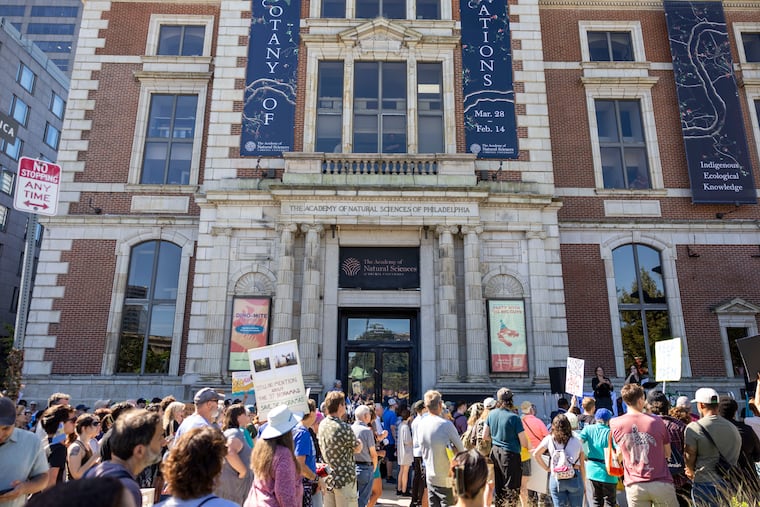
A group of protesters earlier this week gathered at the same time as a Drexel board meeting and called on the university to disaffiliate and give the Academy a chance to negotiate what’s best for it.
Drexel spokesperson Niki Gianakaris said earlier this week that the university had offered the Academy a path to disaffiliation.
» READ MORE: The Academy of Natural Sciences museum is closing, but all eyes are on its specimens — all 19 million of them
“We have been, and remain, open to that possibility,” she said. “We continue to engage in good-faith discussions with the Academy about its future.”
Her comments came days after the William Penn Foundation made public its offer to underwrite operating costs for at least a year and keep the museum’s doors open while a permanent solution can be worked on.
William Penn said the goal was to “provide time to test the interest of other funders and supporters who have not been engaged so far,” and the Academy leadership said it was open to the reprieve.
The Academy, founded in 1812, has operated a museum since 1828, and its announced closure has generated street protests, more than 100,000 petition signatures, editorials, and the scheduling of City Council hearings for next week.
The museum was shuttered to the public at the end of the day last Sunday, following large numbers of visitors in recent weeks but prior years of declining attendance. In the 2025 fiscal year, it brought in 126,000 visitors — down from 2014 when it welcomed 208,000 science fans to its “dioramas, dinosaurs, butterflies, live animals, and the renovated Children’s Nature Discovery Center, Outside In,” according to the Academy’s tax return from that year.
Since the beginning of the Drexel-Academy affiliation a decade and a half ago, “our goal has always been to improve the financial position of that museum and the Academy of Natural Sciences as a whole, the research and the collections,” said a Drexel source familiar with the matter who was not authorized to speak publicly about it. “That was written into the original affiliation, and as we moved forward in time we hit snags and different things we never quite achieved that financial resilience then. And then COVID hit and that became even more challenging for the museum.”
Drexel said it had not received a formal proposal from William Penn but that it would be open to talking with the foundation about the matter.
» READ MORE: The Academy of Natural Sciences is closing its museum after nearly two centuries
Gianakaris did not comment Friday on whether talks had been held or scheduled.
“What William Penn has put forward is not enough,” said the first source, who had noted that a split was a possible outcome. “That wouldn’t do it.”
Gianakaris said Drexel’s focus is on “safeguarding the Academy’s collections and research enterprise” while developing a “long-term model” that allows the public to engage with its collections.
Drexel’s board of trustees earlier this week discussed the matter during a two-day meeting that was scheduled months ago. The meeting, the second held since Antonio Merlo became Drexel’s president July 1, 2025, was for the board to “focus on the university’s long-term future, strategic priorities and governance effectiveness,” Gianakaris said.