Pa. AG steps into murder case that gave it new power to challenge District Attorney Larry Krasner
Krasner's office had supported granting a new trial to Lavar Brown, 49, who was convicted in a 2003 killing in North Philadelphia.
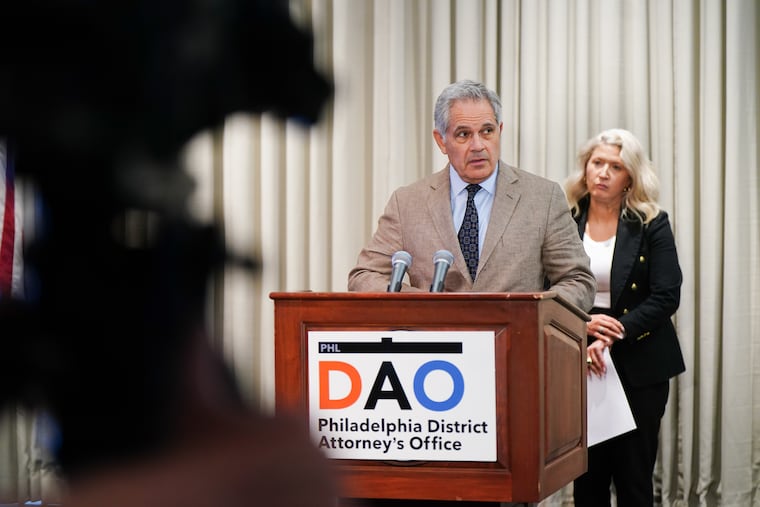
The Pennsylvania Attorney General’s Office has entered the legal fight over whether Lavar Brown — the man whose case prompted the state Supreme Court to give the office new power to challenge efforts to overturn convictions in Philadelphia — should receive a new trial.
Senior Deputy Attorney General Tracy Piatkowski announced the office was stepping in during a Common Pleas Court hearing Friday, where Brown’s attorney, Tracy Ulstad, also said she planned to ask the U.S. Supreme Court to review the state court’s decision.
Brown, 49, was sentenced to life in prison without the possibility of parole after a jury convicted him of second-degree murder in the 2003 robbery and fatal shooting of Michael Richardson, a worker at a North Philadelphia Rite Aid. Brown was also convicted of killing Robert Crawford in 2005 and sentenced to death.
In the Richardson case, a judge later vacated Brown’s sentence and ordered a new trial, after District Attorney Larry Krasner’s office supported his request for relief. Brown’s attorneys argued that he had been denied a fair trial because the prosecution’s case relied heavily on two witnesses, one of whom had implicated another person in the killing in earlier statements that were never provided to his trial attorneys.
The families of Richardson and Crawford asked the state Supreme Court to intervene, arguing that Brown’s case was among more than 100 in which Krasner’s office had supported efforts to overturn convictions and vacate sentences — efforts, they said, that the cases revealed a pattern of misleading the courts.
They also argued that Krasner had a conflict of interest in Brown’s case because two of his former law partners had been previously involved, and that his office’s position could undermine the death sentence, for which the Richardson killing had served as an aggravating factor.
The state Supreme Court agreed, and ruled that judges must notify the attorney general’s office and give it an opportunity to review and intervene in cases in which Krasner’s office seeks such relief in the future.
Since the ruling, the attorney general’s office has sought to intervene in five cases, including those of three men whose murder convictions were overturned in May, weeks before the high court’s decision, said spokesperson Brett Hambright.
Brown’s case involves three co-defendants — Christopher Kennedy, Jamaar Richardson, and James A. Richardson — who were also convicted of murder and are seeking to overturn their convictions. Piatkowski said the attorney general’s office has not sought to intervene in their cases because Krasner’s office has not conceded that they should receive relief.
On Friday, Piatkowski said she had not taken a position in Brown’s case and would request discovery materials from the district attorney’s office.
Ulstad, Brown’s attorney, declined to comment after Friday’s hearing. A spokesperson for the district attorney’s office did not immediately respond to a request for comment.