Six concerns raised over the future of the Academy of Natural Sciences in City Council’s hearing
The hearing is set to resume on Nov. 16 with council members vowing to continue their probe on how to reopen the museum and why it was closed in the first place.
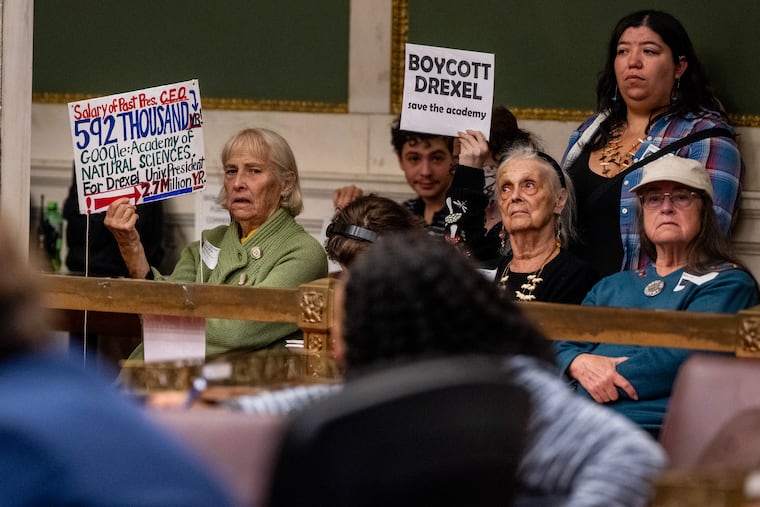
Philadelphia City Council’s hearing Monday on the closure of the museum of the Academy of Natural Sciences of Drexel University raised as many questions as it answered, following nearly four hours of testimony from experts, Drexel University and Academy representatives, and members of the public.
The hearing is set to resume at 10 a.m. on Nov. 16, with council members vowing to continue their probe on how to reopen the museum and why it was closed in the first place. Council member Nina Ahmad said she plans on Thursdayto introduce a resolution at City Council to create a task force to explore re-opening the museum.
Here’s a look at some of the issues raised at the meeting.
» READ MORE: City Council grills Drexel representatives for closing Academy of Natural Sciences museum
Why isn’t the Academy building on Philadelphia’s Historic Register?
Paul Steinke, executive director of the Preservation Alliance for Greater Philadelphia, told City Council that the Academy building at 19th and Race streets belongs on the Philadelphia Register of Historic Places.
Inclusion on that list would require that any proposed changes to the property be reviewed by the Philadelphia Historical Commission, he said.
“Right now that protection does not exist and so the Academy is vulnerable to being irreparably altered or demolished,” he said.
The alliance has retained an architectural historian to prepare a nomination for the building’s inclusion on the register, he added.
“As the Academy of Natural Sciences considers its next chapter, its historic headquarters building must be treated as an essential part of the institution’s future, not as an obstacle to it,” Steinke told council. “...The building embodies the Academy’s history and merits recognition as a significant Philadelphia and national historic landmark.”
» READ MORE: Drexel University and the Academy of Natural Sciences may be headed for a split, sources say
Drexel University is planning to move the collections out of the building, which opened in 1876, and the building needs about $150 million in deferred maintenance, according to one estimate.
Steinke said the building is eligible for inclusion in the National Register of Historic Places, which would make it eligible for federal and state grants.
“That is a source of potential support that the Academy could be pursuing now.”
What is the future of the building?
Questions swirled at the council hearing about what will happen with the Academy building if Drexel goes forward with its plans to relocate the collection.
“In the midst of talking to the hundreds of advocates who are concerned about this, they are pushing us to recognize that this is about the land, that Drexel wants the land... to help address deficits and financial issues,” Councilmember Isaiah Thomas, who heads the legislative committee, said at the hearing.
» READ MORE: ‘It’s such a special place’: Visitors crowd the Academy of Natural Sciences ahead of impending closure
Melissa Richman, Drexel’s executive director of operations, testified that Drexel has been working with Mayor Cherelle L. Parker, Gov. Josh Shapiro and former Comcast executive and U.S. Ambassador to Canada David L. Cohen on the issue.
Thomas asked if Drexel sought financial support from the mayor and was turned down.
“Again, we have been working,” Richman began, before she was cut off by Thomas.
“Ok,” Thomas said. “I get it.”
Alex Palma, president of the Museum Council of Greater Philadelphia, also questioned what would happen with the building.
“I don’t think that another building filled with million-dollar condos on the Benjamin Franklin Parkway supports us a world-class city,” he told council during the hearing.
Drexel has not said what it plans to do with the building if the collections are relocated.
A ‘larger crisis’ for cultural organizations
“Even as we focus on the Academy, we cannot ignore the larger crisis,” Patricia Wilson Aden, president and CEO of the Greater Philadelphia Cultural Alliance, testified. “Cultural organizations of every size and discipline are confronting rising costs, changing audience behaviors, chronic under-investment, and crippling funding cuts at the federal, state, and local levels...The crisis of the Academy is a bellwether that requires us to resolve to implement concrete solutions.”
She called on the city to make a stronger commitment to cultural institutions, including its museums, theaters, historic sites, libraries, cultural centers and arts organizations. The city needs a “dedicated arts fund,” she said, similar to what some other cities have developed.
“It is up to all of us, the cultural community, the scientific community, you and other elected officials all working together alongside the philanthropic community and other civic leaders to make an unflinching commitment to unlock the full potential of our creative sector,” she told council.
A precedence in Yale University
Yale University received a $160 million gift from an alumnus in 2018 to renovate its Peabody Museum, a natural history museum. The renovation was raised at the council hearing as a potential model for the Academy and Drexel. The Peabody was closed for four years while renovations occurred and reopened to the public in 2024.
“If New Haven can do it, so can Philadelphia,” Sarah McAnulty, a squid biologist whose nonprofit focuses on science education, as well as Philly Science Action and Green Philly, told council. Yale is in New Haven, Conn.
Drexel’s crisis-causing ultimatum
A year ago, the Academy was given an “ultimatum” by Drexel: “Merge fully with Drexel or get a divorce,” said Suzanne Biemiller, chairperson of the Academy’s board of trustees.
Since the two institutions were joined in a 2011 affiliation agreement, the Academy had maintained an independent board, though its finances and many of its decisions ultimately fell to Drexel.
“Under a full merger, just to be clear, the Academy’s $80 million endowment, its building, and the priceless collections would all become Drexel’s assets,” Biemiller told council. “Needless to say, this choice caused a crisis at the Academy, diverting the attention of the Academy’s leadership and financial resources from strategic conversations and fundraising.”
The ultimatum came after a year of strategic planning conducted by the Academy with input from Drexel leadership and joint trustee meetings, she said.
“In many ways, Drexel’s ultimatum upended and stymied that planning work,” she said.
A seriously expensive move for 19 million specimens
“I suspect that the realities of moving and rehousing 19 million specimens has really not been envisioned with open eyes,” said paleontologist Ted Daeschler at Monday’s hearing. He was referring to the possibility raised by Drexel leaders and others of moving the Academy’s specimens collections out of the current building to an as-yet unknown location.
Daeschler knows a thing or two about about specimens. Professor emeritus, curator, and chair of vertebrate zoology at the Academy, Daeschler is renowned as co-discoverer in Arctic Canada of Tiktaalik roseae, a fossil fish significant for being an evolutionary bridge between fish and land-dwelling animals.
Each of the Academy’s irreplaceable specimens requires individual attention to be moved safely, to remain organized, and to keep its associated data, Daeschler told those attending the hearing.
Customized storage spaces — as well as health, safety, and security systems — must be designed.
“None of these things are inexpensive,” he said.
Access to the collections for students and researchers must be maintained, and specialized specimen preparation facilities, offices, and laboratories must be in proximity to these collections, and be staffed.
“All of this adds up to probably more money than working on the Parkway building,” he said, referring to the cost of deferred maintenance to the specimens’ longtime home.