Classes are too big, and students don’t have enough resources, staff say at a “rally for Temple’s future”
At a rally outside Sullivan Hall, demonstrators said cost-saving measures had gone too far. The school pledged “open communication.”
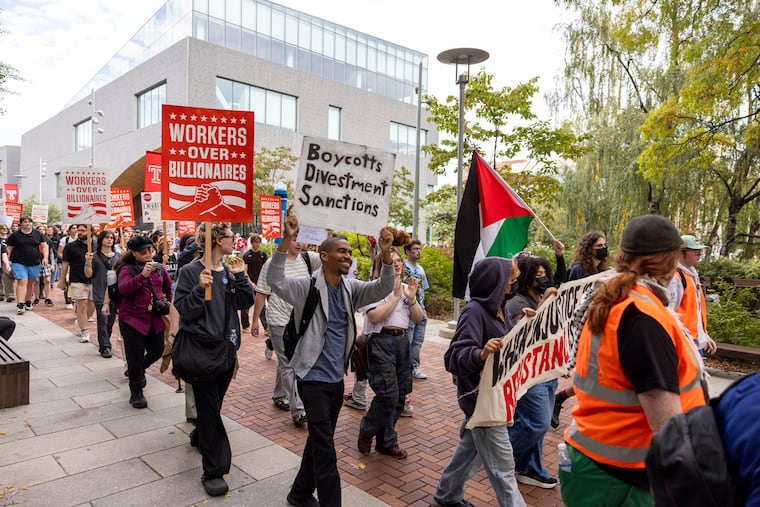
Waving signs and chanting, more than 100 Temple University students and employees rallied Wednesday to protest cuts across the university and health system.
“Who makes Temple work? We make Temple work!” they shouted.
Temple eliminated 236 positions and laid off 40 workers this summer.The university raised tuition 3.4% this year. President John Fry said at the time the decision was necessary to close a budget gap as Temple — like colleges nationwide — copes with enrollment declines amid a shrinking pool of applicants and federal policy changes that resulted in lower numbers of international students.
» READ MORE: Temple enrolled a record number of first-year students in 2025. But it lost nearly a quarter of them
The cuts have gone too far, said Jeffrey Doshna, president of the Temple Association of University Professionals, one of several unions that organized the “Rally for Temple’s Future” in advance of a university trustees meeting.
With austerity measure after austerity measure, “is there any wonder that we have a student retention problem?” Doshna told a cheering crowd. “There aren’t enough advisers for students to get appointments. There aren’t enough librarians and library staff to help students complete their research projects. There aren’t enough staff, faculty, so that students can get the classes that they need.”
Del Doktor, a faculty union official, said those who rallied are the real heart of Temple.
“We believe in its promise, its mission to provide affordable but quality education, and we know that these austerity measures, unfairly distributed, prohibit us from doing our job,” Doktor said. “I just want to do my job.”
Before the group marched around Sullivan Hall, where the board meets, a coalition of Temple unions presented demands, including increased staffing levels at the university and throughout the health system, open meetings to discuss budget matters, and a third-party public performance review of the current Temple leadership team.
Several politicians showed up to support the staff and students’ rally. City Councilmember Nicolas O’Rourke said he understood the need to make tough financial decisions, but he is “disgusted” by the cuts.
“A demand for safe and responsible staffing across the university and health system is just common sense,” O’Rourke said.
In a statement issued late Wednesday afternoon, the university said it “welcomes peaceful demonstrations like what we saw today,” noting a commitment to “open communication and engagement with our university community while we navigate the current financial challenges.”
In June, Temple asked its schools, colleges, and administrative units to cut a total of $60 million to help offset a $85 million projected budget gap.
“We will continue to provide information and opportunities for meaningful engagement as we continue to plan for Temple’s future,” the university statement continued.
Later, at the board of trustees meeting, officials were expected to move to collapse Temple’s School of Theater, Film and Media Arts and fold the programs into other schools. The Department of Theater would move into the Boyer College of Music and Dance, and the Department of Film and Media Arts would move into the Klein College of Media and Communication. Under the plan, the School of Theater, Film and Media Arts would cease to exist on July 1, 2027.
“This realignment reflects the fast-changing landscape of the media and entertainment industries and ensures that our graduates are best positioned to thrive,” the university said in a statement.
“It is important to emphasize that for this year and next, all of the academic programs in TFMA will continue as usual. Any future curricular changes will be guided by faculty and administrators in the two colleges for implementation in 2028-29 and beyond.”