Feel like cursing on Thanksgiving? It would be historically accurate.
Profanity and harsh words are as American as apple pie.
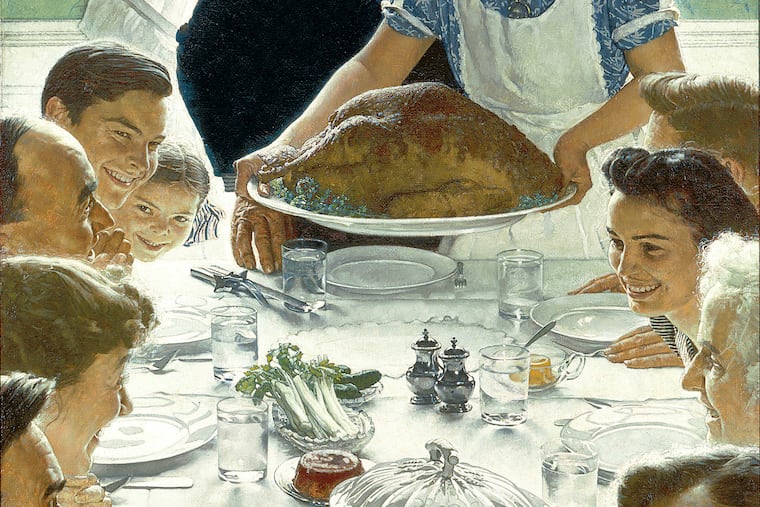
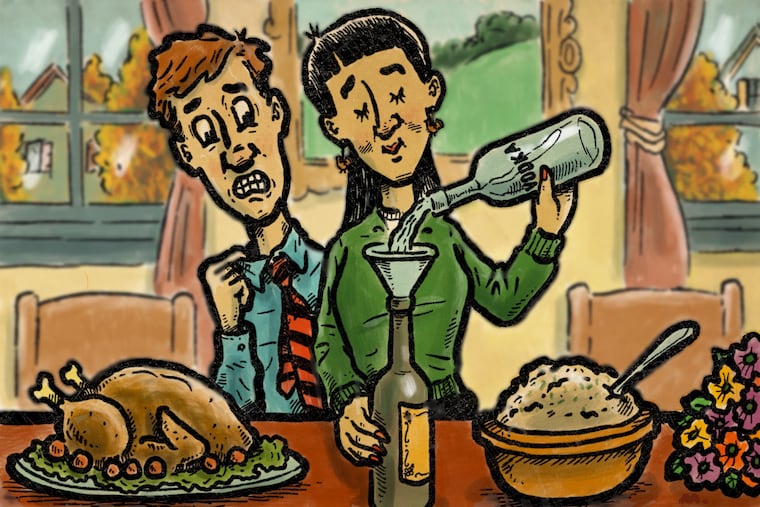
Thanksgiving is our shared national holiday for bringing family and friends together, but it also has a reputation for spurring conversational discord and even fiery arguments. Back in 1990 the comedian Richard Lewis famously wished that he could show up at Thanksgiving as a hologram image of himself rather than in person, thereby avoiding having to interact with relatives.
The fact is, cursing has been part of our shared cultural soundscape from the very beginning and so too has resistance to unseemly or impure language. Harsh words and even profanity marked the era when the Pilgrim Fathers and Mothers celebrated their first harvest festival in the New World, and these provocations have been part of American culture ever since. As history reveals, our specific insults may have changed over time, but the emotions triggering them have not.
As pious Christians, the Pilgrims abhorred impious and “filthy” language. But they couldn’t avoid it. Cursing, for instance, abounded on the Mayflower. As Plymouth founder William Bradford wrote, profane sailors on board the ship would “curse and scoff at the passengers.” He hastened to add triumphantly that “it pleased God” to smite these cursers with disease, and that the most profane of the seamen died enroute. The Pilgrim perspective on cursing helped separate them from foul-mouthed people such as the seamen, and from English people they deemed “ungodly” in general.
But it didn’t end there. Much like the Mayflower’s sailors, it turned out that many colonists carried with them earthy, bold and profane words rooted in centuries of English folk culture. Taking the Lord’s name in vain or verbally damning someone—saying “zounds” (short for “by God’s wounds”), “the devil scald them” or “a pox take you”—could land colonists in court to pay fines or submit to a flogging. But even so they continued to speak such exclamations. Blunt monosyllables for male and female genitals and at least occasionally the “s” and “f” words resounded in “filthy” gossip, insults and songs that cast aspersions on the integrity and chastity of neighbors or personal enemies.
For all the hopes of pious settlers for a “City on a Hill” free of verbal filth and conflict, the speech of English-speaking Americans (even including some of those pious settlers themselves) echoed the battles over unseemly words that had long pitted plain-speaking Englishmen and Englishwomen against nay-saying constables, judges and clergymen.
In 1692, social friction—particularly, fear and resentment aimed at “unruly,” outcast, sharp-tongued women—was on display when curse words became evidence of “familiarity with Satan” for four of the women accused as witches in Salem, Mass. Young girls offered vivid testimony that the accused were tormenting them invisibly, but the “base and abusive words” of Bridget Bishop, Wilmot Reed, Sarah Good and Rachel Clinton also helped prove their guilt. Neighbors remembered that Bishop had long been notorious for abusive expressions such as “old rogue” and “old devil,” while Clinton had openly cursed a personal foe as a “hellhound” and “whoremasterly rogue.” In the end, the women were found guilty. Clinton spent several months in jail, and the other three lost their lives on the Salem gallows.
Later, though, curse words became a part of the patriotic soundtrack of the Revolutionary War. Indeed, the Boston Massacre began with working men hurling “Damned rascally scoundrel lobster son of a bitch!” and other furious taunts at British redcoats. Such words helped fuel the crisis that unraveled Britain’s hold on the thirteen colonies.
Even George Washington used profanity to inspire—and scold—fellow revolutionaries, as rumors spread about how he cussed out a subordinate, Gen. Charles Lee, for a strategic blunder at the revolutionary Battle of Monmouth in 1778. Another officer claimed that the Father of his country “swore on that day, until leaves shook on the trees.” Differing versions of Washington’s words were passed down in folklore (with the expletive “damned poltroon!” the harshest thing he said to Lee, according to the Marquis de Lafayette). But for 18th-century officers and gentlemen, the phrase, with its implication of cowardice and ineptitude, stung deeply.
It was in 1863, during the dark days of the Civil War, when another president, Abraham Lincoln, proclaimed Thanksgiving an official national holiday. But even he was not immune from tainted speech. Lincoln, in fact, was so notorious for raunchy jokes that contained the s-word (and, on at least one occasion, the f-bomb) that political enemies nicknamed him “Old Smutty.”
Lincoln used his off-color stories to amuse and win supporters in the backslapping world of 19th-century party politics, but he also observed a cardinal rule of public life at the time: such language was to be shared only with men in informal settings where women and children were absent. Lincoln recognized that off-color stories told in public undermined the gentlemanly and fatherly image politicians needed for success. Facing an uphill reelection campaign in 1864, the president was taken to task by his close confidant David Davis: “If the country knew you were telling those stories, you could never be elected and you know it.” Lincoln laughed, but he agreed that vulgar words were not for the public stage.
Nowadays, however, our curse words signal authenticity, honesty, daring edginess and badass swagger, even as most of us still perceive such words as breaking rules. But their transgressiveness is precisely what gives these words their attention-getting power. Today, the rawness of how politically polarized many of us are—an anger signaled by profanity such as President Trump’s contemptuous “Jon Jerkoff” to characterize Georgia Sen. Jon Ossoff, or Democratic Mayor Jacob Frey’s call for ICE to “get the f--- out of Minneapolis”—can easily boil over at family gatherings, with Thanksgiving being a prime example.
For better or worse, it’s a long American legacy. You can ponder that history as you unleash your anger at Uncle Bill over the turkey and stuffing. Or, recalling what the Pilgrims wanted rather than what they achieved, maybe take another silent bite out of that drumstick instead.
Steven H. Jaffe is a writer, historian, and curator who has worked for a wide range of museums and institutions, including the Museum of the City of New York, the South Street Seaport Museum, The New York Historical and the American Jewish Historical Society. He is the author of New York at War and Activist New York, among other books. He lives in Maplewood, New Jersey, with his family.
Made by History takes readers beyond the headlines with articles written and edited by professional historians. Opinions expressed do not necessarily reflect the views of The Inquirer.