Rookie Oliver Bonk’s ability to bounce back has impressed his coach: ‘I love that about a young guy’
"He just kind of was breathing through it, and didn’t faze him. I thought he even played better after it. ... He didn’t let that moment get to him,” Tocchet said of the 21-year-old.
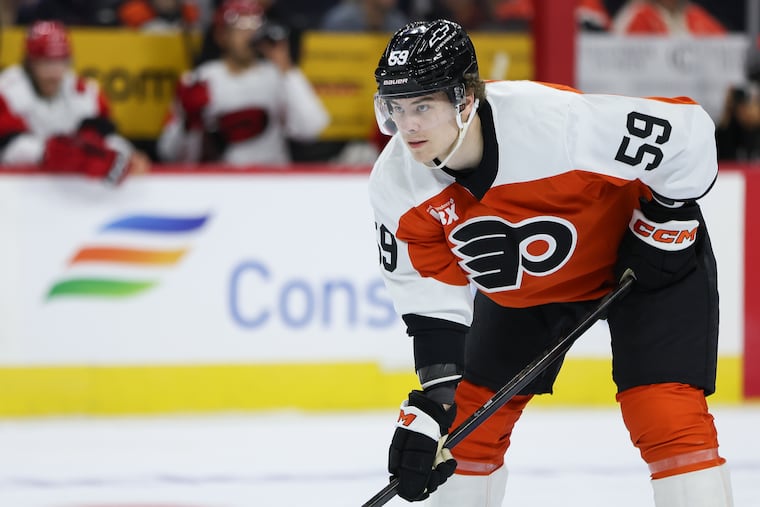
DETROIT ― Oliver Bonk was faced with pressure.
But at just 21, the blueliner showed the poise of a grizzled NHL veteran as he turned away from pressure by Seattle Kraken forward Ryan Winterton, carried the puck behind his own net, and took off up the left wing. Winterton tried to chase him down, and Bonk almost stumbled, but he kept his balance and made a nifty feed to set up Christian Dvorak for the Flyers’ first goal of the night.
That moment came less than 48 hours after he was on the ice for three Carolina goals in his season debut on Sunday. And after he had a bad line change on Tuesday that led to a Jordan Eberle penalty shot.
Coach Rick Tocchet said he looked down the bench afterward on Tuesday and saw that while Bonk knew he messed up, “he just kind of was breathing through it, and didn’t faze him. I thought he even played better after it. I love that about a young guy. He didn’t let that moment get to him.”
» READ MORE: Flyers say their winless start hasn’t fractured the locker room ‘one ounce’: ‘We’re all in this together’
The young blueliner didn’t let playing on the top pair next to Travis Sanheim get to him either. Known for his calmness with the puck, he is averaging more than 18 minutes a night across his two games and has three shots on goal, seven shot attempts, and one assist.
“Just his calmness, how much he competes. I mean, everything he does is pretty much, he’s making the right decision and kind of led the way last night in the comeback,” said Bonk on Wednesday about what he has learned from playing with Sanheim, noting that you dream as a kid to play on the first pairing.
“Kind of got the boys going during the PK and everything that he does. So it’s fun to watch him play.”
Bonk was sent down to Lehigh Valley of the American Hockey League on Sept. 25 despite an impressive camp. He acknowledged that while he was “definitely disappointed ... I wasn’t disappointed to the point where, like, ‘Oh, I’m never going to make the NHL. It’s just a matter of time, so just kind of keep going.”
That’s all he and the Flyers can do right now as they try to claw out of an eight-game winless start (0-5-3) against a Detroit Red Wings team looking for its second win (7:30 p.m., ESPN+, Hulu).
Bonk speaks to his father, Radek, every day — not always about hockey — and said the former NHL forward was disappointed in his son’s minus-3 against Carolina but thought it was “the best minus-3 game he’s ever seen.” Maybe he can also ask Radek how his 1995 Ottawa Senators snapped their winless streak to start the lockout-shortened season in Game 9.
Let’s continue emptying the notebook.
What is scooter skating?
Speaking following the Flyers’ 3-2 shootout loss to the Seattle Kraken, Trevor Zegras used the term “scooter skating,” adding that the plan was to get more players involved in the play. But what exactly is scooter skating?
“You’ll see the really good teams [that] when you delay the fourth guy, he scooters. If you watch us last night, there’s four instances where our D are too ... [overly excited],” Tocchet said on Wednesday. “They get up in the play so you have to just slow your skating down, right? The delay comes, and then you scoot your skate, so you time it right, and then you get your shot.
» READ MORE: An ‘indecisive’ Noah Cates has been one of several Flyers to get off to a slow start in 2026-27
“We were getting it too close. And then, when you get it, you’re on top of their rail guys [along the boards]. I’m a big [believer that] you’ve got to scoot your skating, so that’s something that we worked on today. It happened honestly four or five times where, if we waited just an extra two seconds, we would have had a Grade A instead of a blocked shot. So that’s something we’ve been really working on.”
Tocchet’s approach is that the trailer of a play — whether off the rush or in the zone — should slow down slightly by “scootering” their feet or making some snow to ensure they are not bunched up with their teammates. Right now, he feels the trailing player is not gap-controlling properly by being overly aggressive as they come down the ice or inside the zone. The puck carrier can also scooter to make sure trailers catch up. He added that some teams “pack it in,” so the Flyers should not pack it in too to get a better shot angle.
Power-play punch
The Flyers need power-play help, and although some are wondering why Michael Bunting is on the first unit, he does have a history of success.
In 422 NHL games, including four with the Flyers, Bunting has spent over 800 minutes on the power play, scoring 36 goals, putting 224 individual shot attempts on goal, and registering an eye-popping 23.6% shooting percentage.
His individual numbers (2.65 ppg/60 and 4.86 ppp/60) are better than those of guys like Travis Konecny (1.34 and 3.94), Trevor Zegras (1.56 and 3.93), and Matvei Michkov (1.83 and 4.23). In fact, Bunting’s 24 power-play goals over the past three full seasons rank 46th in the NHL, and ahead of All-Stars like Sebastian Aho, Artemi Panarin, Tage Thompson, Kyle Connor, and Mitch Marner.
Part of that is because he plants himself in front of the net, whether at five-on-five or on the power play. Looking through the year-by-year NHL Edge pages, outside of 2025-26, he was in the 81-99 percentile of players putting shots on goal from in front.
A Calder Trophy finalist in 2021-22, he brings a gritty, dirty-goal, net-front presence that’s been absent in recent seasons.
“I think that’s been my game, my whole career. I’ve produced every single year in this league, and that’s where I feel comfortable, is the hash marks down,” he said. “I’m able to play anywhere in the lineup, whether it’s the first line all the way down to the fourth line. I feel like I can complement and change my role wherever they put me.
“I’m definitely not afraid to, obviously, play more minutes, play with the bigger boys and help them and complement them and create space for them. I’m just here and hoping to help out in any way they see fit.”
Breakaways
Goalie Joseph Woll (0-2-2, .914 save percentage) will start against the Red Wings. He is 2-1-1 with a 2.49 goals-against average and a .920 save percentage in four games against the team from the Motor City.