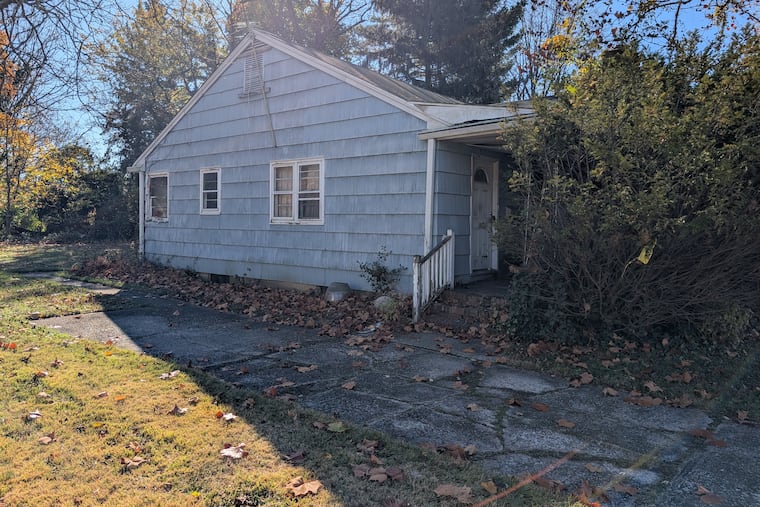
Overgrown hedges are making Cheltenham sidewalks impassable, neighbors say. One man is trimming some himself.
A lifelong Elkins Park resident tired of overgrown bushes and uneven sidewalks has taken matters into his own hands.
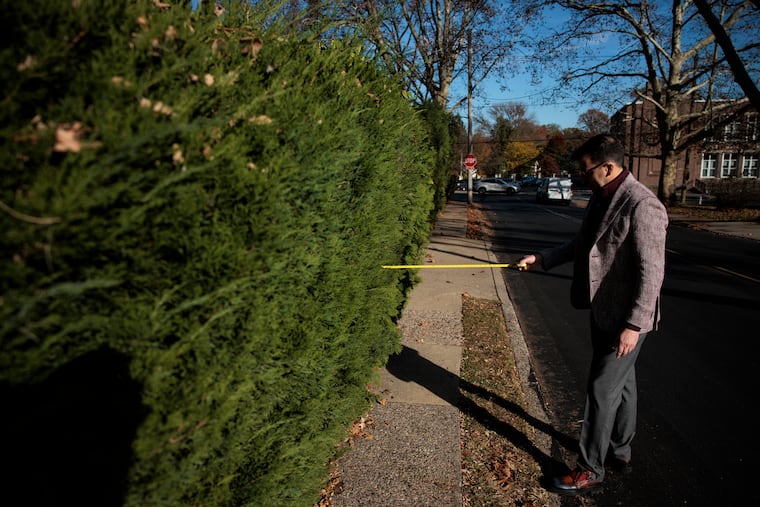
When Brian Gralnick walks his daughter in a stroller through Melrose Park, he carries garden shears to fend off the foliage.
“I’m not going to push my daughter into a rose bush,” Gralnick said.
Cheltenham’s sidewalk code enforcement is complaint-based, officials said, meaning the township addresses violations when residents point them out.
Gralnick, a 47-year-old lifelong Elkins Park resident, has taken matters into his own hands: trimming shrubs that block his path.
He’s also a frequent filer of sidewalk complaints to the township.
“I could do a dozen on a weekend, easily,” Gralnick said. “It’s just around accessibility issues, though.”
For years, he’s talked to township officials about sidewalk obstructions, emails show. He even once offered a tour of his route through Melrose Park, Gralnick said, but the problem persists.
“The hedges have shown tremendous growth,” he said of one property. “Code enforcement, less so.”
Homeowners typically pick fast-growing species for their hedges, which require trimming multiple times per year, said Kai Jones, the owner of Jones Lawn and Landscape in Wyndmoor.
As an inner-ring suburb, Cheltenham has shrubs that are over 50 years old, longtime residents said.
Gralnick said his focus on accessibility began not with his children but with seniors, when he worked in Pennsylvania’s Department of Aging.
“If my kids’ 18-inch-wide stroller cannot safely fit on the sidewalk, how is someone using a walker or a wheelchair … supposed to navigate it?” he said.
How Cheltenham polices sidewalks
The township code prohibits vegetation that obstructs “normal passage” on sidewalks.
When the township receives a complaint, Scott Lynch, head of building and codes and the fire marshal, or another inspector typically visits the site within one business day.
Then, Cheltenham sends a courtesy letter, rather than a violation notice, Lynch said, because it’s the most effective way to get responses from residents. “Eighty-five percent of the time, we get cooperation just with a courtesy letter,” he said.
If the resident doesn’t respond to the letter within three days, Cheltenham issues a violation notice. After 10 days, Cheltenham can file a citation with a local court, which can decide to fine the property owner up to $600 per day, Lynch said. In some cases, the township does the work and charges the property owner.
“Sometimes, this looks to other residents like no action is being taken, while really there’s a process (albeit frustrating) playing out behind the scenes,” township spokesperson Lauren Walter wrote in an email.
At times, Cheltenham opts not to penalize residents who are in touch with the township and either can’t afford to work on their properties or are otherwise vulnerable, Lynch said.
Repeated trimming issues test the limits of the township’s complaint-based approach, Lynch said: If a resident cuts their bushes back from the sidewalk, they have addressed the code violation. Cheltenham can’t tell homeowners to cut the foliage further onto their own property to make the trim last longer.
But some sidewalks are chronically blocked, residents said. On an afternoon in late October, pedestrians heading to Myers Elementary School from Union Avenue used foliage-narrowed sidewalks on one side that made it difficult to push a stroller or pass someone without stepping onto the grass. Google Maps images show the sidewalk encroached by the same bush in April 2025.
“Most of these houses, the hedges look neat,” Gralnick said. “The township needs to understand that neatly trimmed vegetation is not the same as an accessible, walkable sidewalk.”
Cheltenham employees do visual inspections to confirm hedge work has been completed, Lynch said, which may or may not include leaving their vehicles, depending on what they can see from behind the wheel.
“Inspectors need to get out of their cars and actually walk,” Gralnick said.
Some sidewalks are uneven and narrow
Cheltenham wants residents to walk more and use mass transit, according to the township’s comprehensive plan.
But several Elkins Park-area residents who walk said they use the street to avoid uneven slabs.
“I often walk in the street as the pavement is better,” said Gennel Williams, 43, a Cheltenham resident for more than five years. “My mom also took a tumble on the uneven sidewalks a few years back and now refuses to walk outside during the winter.”
Lauren Siegel, 66, is a long-distance runner. She prefers the risk of car traffic, “because the sidewalks are such a tripping hazard.”
For some, the issue is relative. Molly Wernick, 38, who recently moved back to the township from Point Breeze, said the sidewalks in her area are better than in South Philly. “What I’m dealing with now is like, smooth sailing,” she said.
Meanwhile, Gralnick’s frustration has driven him to write Aerosmith-inspired poetry.
“Living on the hedge—Where the stroller meets the street,” Gralnick wrote in a ditty he shared with The Inquirer. “Living on the hedge—No room for wheels or feet.”
One sidewalk, on Spring Avenue, is hemmed in by two large trees on one side and a hedge on the other.
“We get complaints every spring from people about that,” Lynch said.
After The Inquirer contacted the township for this story, Lynch said Cheltenham is looking at the Spring Avenue property again.
The township will also revisit the hedge issue by Union Avenue, Lynch said.

Inquirer Greater Abington
This suburban content is produced with support from the Leslie Miller and Richard Worley Foundation and The Lenfest Institute for Journalism. Editorial content is created independently of the project donors. Gifts to support The Inquirer’s high-impact journalism can be made at inquirer.com/donate. A list of Lenfest Institute donors can be found at lenfestinstitute.org/supporters.