MI5 chief warns of escalating hybrid threats from Iran and Russia on British soil
Ken McCallum said Tehran is seeking to intensify its attacks in Britain beyond the traditional targets of Iranians opposed to the country’s Islamic authorities.
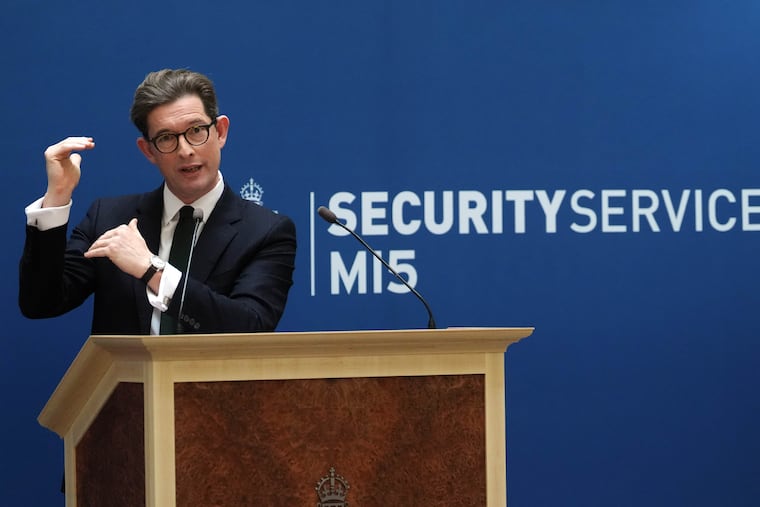
LONDON — The head of MI5, Britain’s domestic security agency, singled out Iran in his annual threat briefing Tuesday, accusing the country of stepping up attacks as tensions between the two nations escalate.
“The spring saw a wave of arson and sabotage incidents targeting Jewish communities in the U.K. and other European countries,” the MI5 chief, Ken McCallum, said during the briefing. He attributed those attacks to Iran and called them “sickening.”
“The other major shift this year has been Iranian ambitions to come at harder targets, like military sites,” he added.
McCallum’s comments follow a series of attacks on British soil that targeted Jewish and Israeli-linked institutions and, mostly recently, an air base that the United States used during its war on Iran that began in February.
In his speech, McCallum said more than 50 people had been arrested in connection with Iran-linked operations in Britain in the past 12 months. That includes two Iranian nationals charged this month over a suspected terrorist plot targeting Jews in the Manchester area, in northwestern England.
Tensions were already high between Iran and Britain. But the nature and scope of the incident at the air base, RAF Fairford, has heightened concerns that the confrontation has taken a more serious turn as Iran lashes out, attempting to intimidate a key U.S. ally and sow terror in Jewish communities.
In his talk, McCallum laid out a series of threats facing the country such as artificial intelligence, terrorism, and China. Russia, he said, “remains aggressor No. 1,” citing hybrid attacks across Europe aimed at undermining support for Ukraine.
Moscow’s reliance on criminals or “naive volunteers” is not the “actions of a great power with the strategic upper hand,” he noted.
Last month, intelligence officials learned about a possible Iranian threat to U.S. bases in Europe, including RAF Fairford, which is in southern England.
Days later, five men were arrested after driving three white vans near the base. The men were initially arrested on suspicion of terrorism and explosives offenses but were later released on bail after police only found gasoline in the vans, raising questions about the severity of the plot. Security experts suggested it might have been a botched arson attack — similar to previous incidents linked to Iran.
On Monday, Prime Minister Andy Burnham of Britain told Parliament, “We will not tolerate these threats on our soil.”
Burnham said the Fairford plot was “almost certainly” directed by Iran’s Revolutionary Guard, Iran’s powerful security apparatus. The events prompted a sweeping counterterrorism investigation that led to two more arrests, but those men have also been released on bail.
The United States later pulled its bombers out of England after receiving additional intelligence about a possible Iranian-led drone attack. British security experts have raised doubts, however, about whether Iran has the capabilities to pull off a sophisticated drone operation on British soil. Asked to comment on that, McCallum said, “Given what we’ve actually seen in practice in the U.K. in recent years, that has not been anywhere near the level of capability.”
British officials including McCallum have been vocal about the Iranian threat, noting how the country relies on criminal proxies to carry out attacks. At the center of those operations is the Revolutionary Guard, which British authorities took steps this year to designate a terrorist organization.
Burnham told Parliament, “We will crack down on Iran’s use of criminal networks, using our full range of powers to target them and their funding streams, and we will bring further sanctions to restrict the capacity of Iran and the IRGC to do us harm.”
As part of that effort, the British government on Monday identified and imposed sanctions on two Iranians it said were involved in coordinating overseas attacks: Ruhollah Bazghandi, the Revolutionary Guard’s counterespionage chief, and Shahram Ali Reza Tamarzadeh Jakki, a facilitator linked to an Iranian criminal network that targeted Iranian dissidents.
Iran has denied any role in the events at the air base.
Before the arrests at RAF Fairford, British authorities were already focused on Iran after it was accused of carrying out a retaliation campaign in Europe. In those cases, the authorities blamed Kataib Hezbollah, a U.S.-designated terrorist group that is a proxy for the Revolutionary Guard.
The Iranian proxy used a front group — Harakat Ashab al-Yamin al-Islamiyya, or Hayi — that took credit for attempted attacks in Britain, Belgium, and the Netherlands. In London, four Hatzola ambulances, which serve primarily Orthodox Jewish communities, were set on fire. The attacks claimed by Hayi did not lead to any deaths and were generally unsophisticated, carried out by local criminals or teenagers hired online who often said they did not know who had recruited them.
A commander from the group was charged in the United States in May with leading the attacks and other incidents in Europe.
This article originally appeared in the New York Times.