For twin brothers abducted in the Oct. 7 attacks, adjusting to freedom is a new challenge
On Wednesday, Israelis marked the third anniversary of the deadliest day of violence in the country’s history.
TEL AVIV, Israel — On Wednesday, Israelis marked the third anniversary of the deadliest day of violence in the country’s history. On the morning of Oct. 7, 2023, a Jewish holiday, Hamas led a cross-border assault from the Gaza Strip on southern Israel, overrunning army bases and border communities and hunting down revelers at a music festival.
Gunmen killed about 1,200 people, according to Israeli authorities, and took about 250 more back to Gaza as hostages. The attacks ignited a devastating war in the Palestinian enclave, where tens of thousands of people have been killed in Israel’s counterattack and much of the area has been reduced to rubble.
The hostages were returned to Israel in stages. Dozens of them died in captivity, and their bodies were transported home. Several of those who survived have written memoirs. Some have gotten married or had babies.
Gali and Ziv Berman, twin brothers, were 26 when they were captured in Kfar Aza, the kibbutz where they lived. A year after they were released, they are trying to focus on rebuilding their lives. Gali is studying law, governance, and diplomacy in college, and Ziv is in a new relationship with a woman who survived the attack on the music festival.
The journey back to something like normality is far from over, and the horrors of Oct. 7 still haunt them and the country.
The return
As Israeli soldiers drove the Bermans out of Gaza on Oct. 13, 2025, after two years of captivity during which they were separated, beaten, deprived of food, and mostly kept in dank tunnels underneath the enclave, Ziv said they had “thousands of questions.” They did not know if their family had survived the Oct. 7 attack. They wanted to know the latest about their favorite soccer team, Maccabi Tel Aviv.
The brothers also wondered what had happened to Kfar Aza. They discovered that more than 60 of the kibbutz’s roughly 1,000 inhabitants had been killed and some 19 others abducted. “We wanted to go home,” Ziv said. “They told us it was gone.”
They saw their mother, Talia, for the first time at an army base near the border with Gaza and learned that their close family members were alive. “We were speechless,” Gali said. “There were no words.”
Their parents had moved to Beit Guvrin, a kibbutz farther away from Gaza. The brothers spent their first week of freedom at a hospital but left one day to visit their father, who suffers from advanced Parkinson’s disease and dementia. “He looked at us, it sunk in, and he began to cry,” Gali recalled.
Soon, they were reunited with Emily Damari, a close friend and neighbor from Kfar Aza who was kidnapped with them on Oct. 7. Damari was freed months before the brothers were and campaigned for their release. In August, Gali and Ziv danced at her wedding to Danielle Amit, an Israeli food influencer.
The brothers have also been finally able to mourn their friends who did not survive.
In December 2023, Israeli forces accidentally killed three hostages who had tried to escape after mistaking them for militants. Two of them were from Kfar Aza, including Alon Shamriz, a childhood friend of the brothers.
Sitting outside a Tel Aviv cafe in the sunshine earlier this year, the brothers said their freedom did not feel complete because the body of the last captive, Master Sgt. Ran Gvili, was still in Gaza.
Gvili, a member of an elite police counterterrorism unit, had rushed into battle on Oct. 7. He was gravely injured and was dragged into the enclave.
Gali performed his military service in an infantry combat unit and Ziv in the armored corps. They said they could not tolerate leaving a dead or wounded soldier in the field. “He went to fight for us,” Gali said.
Less than two weeks later, Israel recovered Gvili’s remains. For many Israelis, and for the brothers, it was only then that the hostage saga ended.
The abduction
Gali and Ziv said they had grown up as part of the so-called Qassam generation, a reference to the crude Qassam rockets that militant groups fired from Gaza at Israel. In Kfar Aza, early warning alerts gave them 15 seconds to take cover, at most. “From a young age,” Gali said, “we were running to shelters.”
They had never imagined an assault on the scale of Oct. 7. As adults, they had settled into a relatively tranquil and comfortable life, working as technicians at a sound and lighting production company based in the kibbutz.
When the attack began on Oct. 7 and the sound of gunfire grew closer, Damari was afraid of being alone, so Gali dashed to her home to be with her. Gunmen burst into the bedroom, killed Damari’s dog, Choocha, and shot and wounded her.
Militants set fire to Ziv’s home nearby, where he had taken shelter in a safe room. The room soon filled with smoke. The choice, he said, was “to suffocate or to come out. I came out.”
Gunmen forced Damari and the brothers into her car, and they were driven into Gaza. In the chaos of the attack and their abduction, Ziv, who was blindfolded and sitting in the front, had no idea that Gali was in the car, too.
Gali said he would never forget the cheers he heard in the streets of Gaza as they passed. It seemed like everybody was out. “A million people,” Ziv remarked.
On their first day in captivity, Gali was taken away. Ziv and Damari were held together until Day 40, when they were led down into tunnels and the captors separated the men from the women.
The brothers were reunited for the first time six months into their ordeal, in the ruins of a bombed-out house. Their captors filmed them as they cried out in surprise and embraced for a propaganda video that was never released. They spent two nights together catching up and barely slept, Gali said.
A few weeks later, they spent more days together in a tunnel with other hostages. A third encounter, filmed near the coast of Gaza for another propaganda video, lasted only a few hours.
The new life
The transition from the harrowing ordeal of captivity to freedom is a process. The brothers’ year back in Israel has been starkly different from their previously quiet, routine existence.
They each lost about 45 pounds in Gaza. Ziv has undergone extensive dental treatment, saying he had not cleaned his teeth for about a year when he was held hostage.
The brothers have traveled widely. They met with President Donald Trump in the United States and have spoken to American Jewish communities, determined to “tell the world,” they said, about what happened.
Gali said that he and Ziv have grown even closer, their shared experiences ingrained in them forever. “The wish to be together is stronger,” Gali said this week. Even as they try to focus on the future, Gali, Ziv, and Emily still talk about “the memories and the traumas” of what happened to them, he said.
The brothers recently returned from a visit to Thailand and, after visiting the graves of friends over the weekend, they left for another short trip abroad. They wanted to be far from the sights and sounds of the Oct. 7 commemorations, Gali said, the first since their return from Gaza.
The brothers’ status as returned hostages has brought them a celebrity they never sought. When strangers approached them at the Tel Aviv cafe this year to greet them or offer a kind word, they accepted the attention graciously.
The country also went through two years of war, Gali said. “There were times when people had to choose between funerals,” he added.
They seemed at ease but said they were trying not to look back. They joked at one point about how in Gaza, the hostages’ empty, rumbling stomachs would “talk to one another.” But, Ziv quickly added, “There, it wasn’t funny at all.”
On the day of their release, they asked the helicopter pilot transporting them to the hospital to fly over Bloomfield Stadium, the home of Maccabi Tel Aviv, their beloved soccer club. They have tried to make up for lost time by watching lots of matches and playing soccer themselves, and by sticking close to the family, Ziv said.
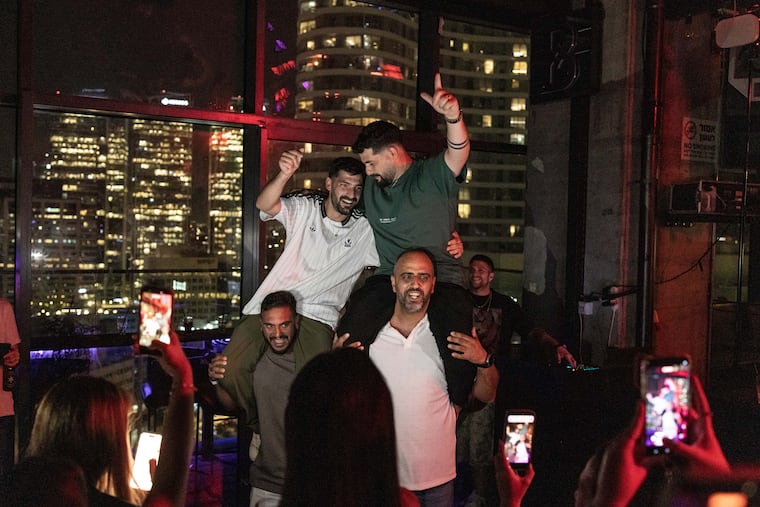
The brothers celebrated their 29th birthdays last month with a jubilant dance party. Hundreds of relatives and friends, including some freed hostages, came to rejoice with them at a club in Tel Aviv.
The future, however, will forever be tinged with anguished memories. “The time in captivity will always be a part of me, for good and for bad,” Gali said this week. “But we are alive. We take nothing for granted.”
The Berman brothers are trying to embrace life anew.