Soldiers seriously wounded in Iranian drone strike tell AP the military's medical system failed them
Soldiers and family members have told The Associated Press of a failure to recognize the seriousness of injuries, a poor plan to get the wounded to hospitals and red tape that has hindered care.
The shrapnel hit Army Lt. Col. Arturo Lincón’s body like shattered glass.
One chunk of metal lodged into the left side of his jaw. Another piece sliced through his salivary gland before bouncing off his jaw and piercing the back of his neck, severing an artery and embedding in a vertebra.
Lincón was among dozens of U.S. soldiers injured in an Iranian drone strike on March 1. The attack on the second day of the U.S. war with Iran killed six troops who were providing logistical support of critical supplies at Port Shuaiba in Kuwait.
Whether the military was properly prepared for treating its wounded has become a sharp point of contention. Soldiers and family members have told The Associated Press of a failure to recognize the seriousness of injuries, a poor plan to get the wounded to hospitals and red tape that has hindered follow-up care. The Pentagon has said that the medical care was appropriate.
Nine U.S. service members who were wounded spoke to the AP on the record — rare for troops still in the Army — about what they describe as a medical system that left them in many ways fighting to get treatment on their own.
The medical care was just one of the military’s failures stemming from the Port Shuaiba attack that soldiers described to the AP. The Army declined to comment on the AP’s reporting, saying it had not yet briefed the families of those killed on the outcome of its investigation into the attack. The Pentagon also declined to comment.
The soldiers’ criticism comes against the backdrop of years of disinvestment and drawdowns in the Middle East by multiple administrations and political leaders who sought to end U.S. involvement in the region. Those choices left the region without any major U.S.-run medical facilities.
Lincón’s wounds included a damaged left vertebral artery, which supplies blood to the brain, and put him at risk for a stroke. That was not considered by the Army to be serious enough to be admitted to Landstuhl Regional Medical Center in Germany, a major U.S. military facility, even though Lincón said a nurse there marveled that he was alive.
Instead he was sent to the nearby Army barracks and told to schedule outpatient appointments.
“I was just kind of on my own, at least it felt like that,” said Lincón, a veteran of wars in Iraq and Afghanistan.
Lincón’s was not an isolated case.
Another soldier who had shrapnel removed from his head, Maj. Stephen Ramsbottom, said he waited over four months to receive his MRI results.
“I’ve had to build my own case for everything,” Ramsbottom told the AP. “It’s very frustrating.”
Soldiers helped save each other after Iranian attack
After the deadly drone strike, soldiers, who are equipped with tourniquets and trained in first aid, tended to each other and then searched on Google to race the wounded to the nearest hospital in Kuwait City about 20 minutes away.
Some of the most seriously wounded soldiers were medically evacuated from Kuwait within two days. Lincón, who was only about 7 feet (2.1 meters) from the blast, spent a week hospitalized there where he had surgery to remove shrapnel from his jaw. He said medical staff told him he had a traumatic brain injury from the force of the blast that ruptured his eardrum and left him briefly blinded.
Chief Warrant Officer 4 Rodney Bearman, who had shrapnel embedded from his face to his legs, and some of the other soldiers who were briefly seen at Kuwaiti medical facilities were sent to the homes of U.S. government employees. Iran had unleashed missiles and drones that made it risky for evacuation flights.
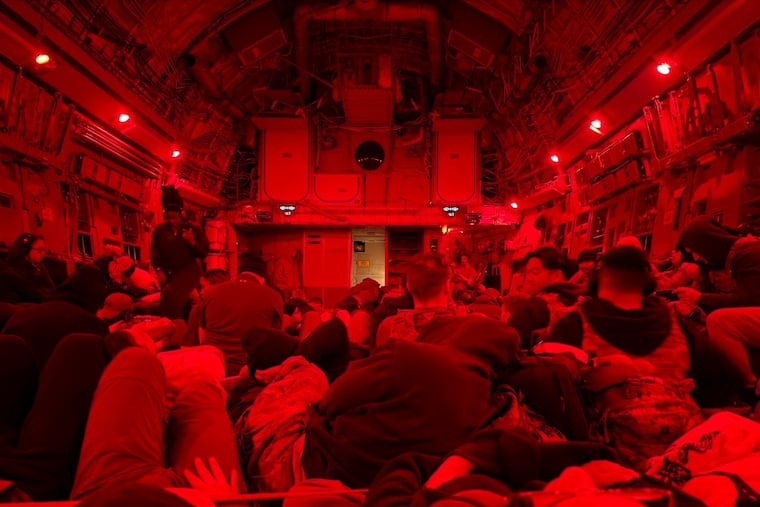
Some 10 days after the attack, the soldiers were loaded onto a cargo plane. They sat on the floor with straps, including Bearman, who could barely eat or lie down.
When they arrived in Germany, Bearman said they learned they were not documented as wounded in combat and would not be hospitalized at Landstuhl. Instead, they were sent to the barracks, as Lincón had been, and told to get outpatient care. Bearman said they were documented that way due to a coding error.
“Never did I think that if I was wounded that these things would happen,” said Bearman, who has served for over three decades, including in Afghanistan. “Some sacred trust that I thought would never be broken was broken.”
Lincón says he went days without pain medication. He carried a CD with a copy of medical records from Kuwait that he showed the ER doctor at Landstuhl who expressed concern that he had not been evaluated yet by a trauma team.
Pentagon says all wounded troops are evaluated
Soldiers may not be aware of initial evaluations, like the Army’s battlefield concussion evaluation, that focus on identifying symptoms such as double vision or repeated vomiting and other observations. Troops with mild TBIs and hit by shrapnel often returned to duty quickly in Iraq and Afghanistan. Many soldiers who spoke to the AP did not know the severity of their TBIs.
A Pentagon official told the AP that Landstuhl’s mission, especially in battlefield casualty situations, is focused on stabilizing patients to transfer them for more specialized care at a military hospital in the U.S. rather than admitting them.
Meanwhile, large hospitals closer to Kuwait have been shuttered. For example, Air Force Theater Hospital at Joint Base Balad in Iraq was handed over to the Iraqi government in 2011 as part of drawdown efforts.
In a statement, the Pentagon said that all wounded troops who arrive at its medical facilities are evaluated and may be admitted based on the severity of the injury according to physicians who follow “healthcare-industry practices.”
After about a week in Germany, many of the injured soldiers were sent to Fort Hood in Texas, where they underwent the Army’s demobilization process to return deployed troops home.
Medical records shared with the AP by Ramsbottom and another officer show they were not diagnosed with TBIs until Fort Hood. The officer, who was blown off his chair, said he did not get care for weeks after that diagnosis and had to identify the specialists he needed, like a neuro-ophthalmologist to diagnose the blurred vision from his TBI rather than counting on the military’s medical system.
Maj. Billy Key says he did not get specialized care until mid-April when he was sent to a U.S. soldier recovery unit to be treated for his head injury, hearing loss and the smoke inhalation that damaged his lungs.
“It took too long,” he said.
Dr. James Kelly, chief medical scientist at the Invisible Wounds Foundation, which is focused on military brain injuries, said it’s still not uncommon for a TBI diagnosis to take longer than it should, which could impact a soldier getting treatment as early as possible for the best outcome.
“It’s disappointing but not surprising,” said Kelly, an emeritus professor of neurology at the University of Colorado School of Medicine. “In a war scenario, it goes on a fair bit.”
An initial thorough check should be done by a medically trained person, not simply another soldier, he said. Kelly said that too often medical records note only a concussion, which is in fact a mild TBI, but can be overlooked.
Many soldiers are struggling months after the attack
Lincón spent seven weeks getting specialized outpatient care at Walter Reed National Military Medical Center in Maryland, before being sent home to Kansas. Shrapnel is still in his back because it was too close to his spinal cord to remove without risking being left paralyzed. He struggles with dizziness that disrupts his life, he said.
He was awarded the Purple Heart and is back on active duty as an instructor at Fort Leavenworth. But his troubles continued beyond medical care.
Lincón, who was born in Texas to Mexican parents, was issued only a temporary one-year passport after his passport was blown up in the attack and he was asked for additional documentation to prove his U.S. citizenship. After the AP reached out to the State Department to inquire about his case, the 1995 West Point graduate said he received a call saying the request for more information was a mistake and he would be receiving a passport that would be good for 10 years.
“I’m American enough to have fought in three different wars,” Lincón said.
He’s also concerned his medical records are incomplete. His claim for Traumatic Injury benefits under the Servicemembers’ Group Life Insurance was denied due to not meeting the threshold for hearing loss, though it never addressed his other issues, he said. The program gives cash to service members who suffer severe injuries.
The Army’s Human Resources Command did not immediately respond to an email from the AP asking for an explanation.
“I’m fortunate to survive and that’s how I look at it,” Lincón said. “That’s the only way to look at it at this point.”