Pa. wants to test the air in two dozen properties near a contaminated Chester County site
The proposed monitoring comes after a September report found higher concentrations of carcinogenic chemicals above residential standards to the east than expected.
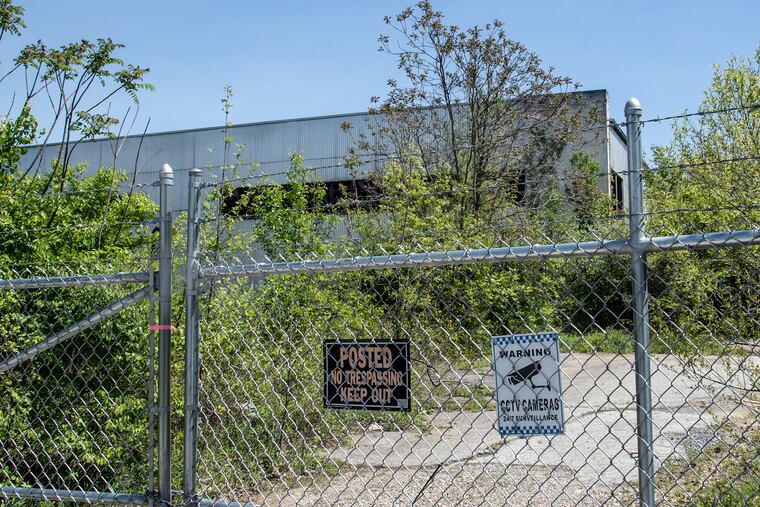
The Pennsylvania environmental agency wants to collect air samples in about two dozen properties near the contaminated Bishop Tube industrial site in East Whiteland Township this winter, after recent sampling of groundwater revealed a higher level of contamination near homes east of the property.
Previous sampling of 10 properties revealed no risk, said Dustin Armstrong, the project officer for the Pennsylvania Department of Environmental Protection, which is overseeing the cleanup.
But “based upon the data that we just got in that pre-design investigation, we decided on some additional follow-up,” Armstrong said during a public meeting Thursday.
The meeting, the first since a settlement deal was reached with polluters of Bishop Tube, a 13.7-acre, vacant industrial site on Malin Road in Frazer, East Whiteland Township, covered the details of the agreement, and the recent findings of a pre-design investigation, a process that directs cleanup of contaminated sites.
The proposed 24-hour monitoring comes after a September report sampled groundwater and surface water between March and June 2026 around Bishop Tube and found higher concentrations of carcinogenic chemicals above residential standards to the east than expected.
The department wants to resample previous locations, as well as 14 additional properties on Fahnestock Road, Conestoga Road, Lancaster Avenue, and houses in the development neighboring Bishop Tube, along Village Way.
The department sent out survey forms for the air monitoring earlier this month, and has received half back so far, Armstrong said.
Bishop Tube, which has been at the center of a years-long fight over clean-up standards and a debate over building housing there, operated from 1951 to 1999 making steel tubing. It left behind contamination, including trichloroethylene (TCE), a degreasing solven. Per- and polyfluoroalkyl substances (PFAS) have also been detected there, according to DEP records.
The property is on Pennsylvania’s Priority List of Hazardous Sites for Remedial Response, and the department has a plan to clean up the site according to Act 2 standards, which aim to make former industrial and commercial sites ready for redevelopment.
Earlier this year, the department entered a settlement agreement with companies that polluted on the property, for roughly $11.5 million. That includes a trust fund set aside for any additional issues, which were indeed identified as part of the pre-design investigation.
Under the agreement, which still needs a federal judge’s approval, the property’s owner Constitution Drive Partners would serve as the site remediator, using funds from the trust to clean up the site, which would be subject to DEP oversight and approval. Developer Brian O’Neill, president of Constitution Drive Partners, has owned the property since 2005 and wants to build homes there.
Remediation of the site could take several years, officials said Thursday.
At the meeting, residents worried over the terms of the settlement, and that there weren’t enough safeguards in place for the cleanup process.
“The fox should not be in charge of the health and safety of the hens,” resident Debra Mobile said. “I want to know how you are going to protect us.”

Want to get Inquirer Chester County straight to your inbox every week? Sign up here for our guide to the news, stories, and events shaping life in your community.
This suburban content is produced with support from the Leslie Miller and Richard Worley Foundation and The Lenfest Institute for Journalism. Editorial content is created independently of the project donors. Gifts to support The Inquirer’s high-impact journalism can be made at inquirer.com/donate. A list of Lenfest Institute donors can be found at lenfestinstitute.org/supporters.