Phillies 2027 starting pitching outlook: Free-agent options, prospect forecast, and more
The starting rotation is the foundation of the Phillies, but that doesn’t mean there aren’t questions and a need for a few more arms next season.
While the Phillies are poised for some bigger roster changes this offseason, the rotation remains the foundation of the club.
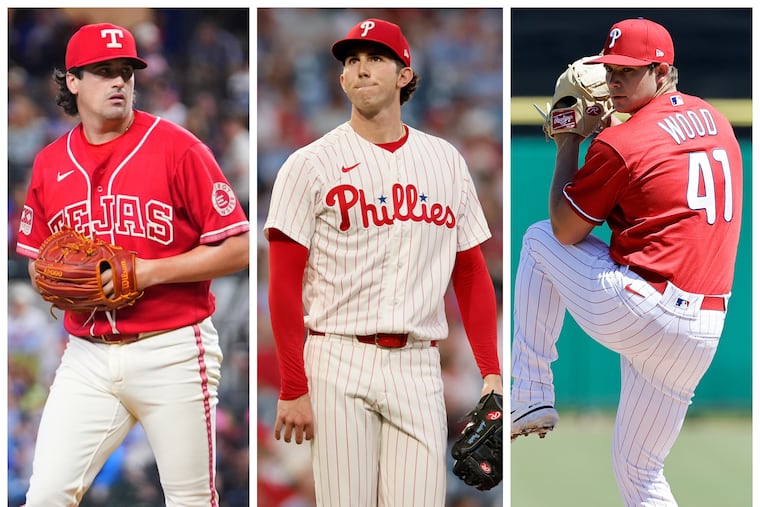
The organization doubled down on its top-end starters when it signed Jesús Luzardo to a five-year extension and Cristopher Sánchez to a six-year extension in March.
But while the front end of the Phillies’ rotation could compete with just about any club in baseball, the lack of depth beyond it remains a concern. It was exposed by a September shoulder injury to Luzardo, and ultimately became instrumental in the Phillies’ downfall against Atlanta in the wild-card series.
“I think we still start with a good foundation,” president of baseball operations Dave Dombrowski said at his year-end news conference. “It’s not starting pitching; it’s starting pitching depth. … We’ll get some starting pitching depth.”
Here’s a breakdown of the rotation’s outlook for 2027 and beyond:
The lefties
After signing their respective extensions, Sánchez and Luzardo are set to anchor the Phillies into the 2030s.
For the second consecutive year, Sánchez was named a National League Cy Young Award finalist, and it’s likely Luzardo will receive some down ballot votes, too. Sánchez recorded a 2.91 ERA, while Luzardo posted a 2.87 ERA, good for fourth in the NL.
Both of them relied on their trademark pitches to eclipse 200 strikeouts this season. Sánchez’s changeup had a 46% whiff rate, and neutralized lefties and righties alike. His 207 innings were a career-high and only trailed Miami’s Sandy Alcantara.
» READ MORE: Phillies offseason tracker: Free agency news, trades, key dates, and the latest on the lockout
Luzardo’s sweeper, which he only added to his arsenal in 2025, had a run value of plus-23, making it the sixth-most valuable pitch of any type in baseball, according to StatCast. Hitters averaged just .112 against it.
Both Sánchez and Luzardo pitched a complete game in an era of baseball where that is becoming exceedingly rare. But after Luzardo’s 1-0 shutout against the Braves on Sept. 7, he soon hit the injured list with shoulder inflammation and did not make another regular season appearance until Game 162. Luzardo, who said he believed the inflammation was unrelated, returned to start Game 1 of the wild-card series against the Braves, holding them to one run over five innings.
But Luzardo’s injury exposed just how shallow the Phillies’ starting depth was. As the Phillies’ late-season losing streak continued, delaying a playoff clinch, they wound up starting Aaron Nola on two days’ rest in the final week. It was a desperation move — one that didn’t work out — and was only necessary because the Phillies had no other reliable depth starters for a must-win game.
And that final week of the regular season hamstrung the Phillies when the wild-card series began.
“Down into the last week and last game to have to get in, not able to rest Sánchy, not able to rest Wheels, you kind of limp in, in a sense, with standpoint from our pitching,” manager Don Mattingly said. “And that just put us in a tough spot, from the beginning of that.”
Wheeler’s return
Zack Wheeler maintained throughout the season that he never doubted he could return from the thoracic outlet syndrome that cut his 2025 campaign short. But that didn’t make his 3.00 ERA and 1.049 WHIP in 162 innings after returning to the mound on April 25 any less impressive.
After returning from the injured list one rib lighter, Wheeler looked like his same old self. Against him, hitters had a 36.3% chase rate and 30.9% whiff rate.
Wheeler openly expressed frustration that he was not included as an All-Star this season, despite having a 2.13 first-half ERA. He did not make the NL team by player vote, nor was he initially named a replacement by the league. (After his public statements, MLB did reach out and offer him a spot, at which point Wheeler declined, saying he had been “disrespected”.)
» READ MORE: Phillies’ Cristopher Sánchez, Jhoan Duran and Don Mattingly named finalists for MLB awards
Following the season, Wheeler garnered some recognition from his peers, winning MLBPA’s Comeback Player of the Year.
The question now becomes how long Wheeler wants to continue to pitch. In 2027, Wheeler will enter the final season of his Phillies contract, and he has been open about wanting to retire after that. It’s unknown whether the impending lockout and how it could impact the 2027 season will change the 36-year-old’s calculation. Two of Wheeler’s career goals — a World Series and a Cy Young Award — have so far proved elusive.
When asked about whether he would be interested in a potential extension after the Phillies’ elimination from the wild-card series, Wheeler said he hadn’t thought about it.
Nola’s second half
After a tumultuous first half, Nola managed to turn things around once the calendar flipped to August. His first-half ERA of 5.75 became 3.33 after the All-Star break, earning enough trust to be given the ball to start the decisive Game 3 of the wild-card series.
Sure, following the disastrous final week of the season, the Phillies didn’t have many other options. And Nola did have command issues against the Braves and got a quick hook for Wheeler, who was pitching on short rest. But his second half overall was something for the veteran right-hander to build on for the next four years of his contract.
“I think it speaks to a lot about Aaron Nola that he didn’t give in and say, ‘Oh, it’s going to be a bad year’ or anything else. Kept working,” Mattingly said of Nola during the postseason. “I think there was adjustments with the ABS early for him. He’s a guy that’s on the edges all the time. I think he changed his mix a little bit through the course of this and just kept going.
» READ MORE: Will the Phillies spend to beef up the middle of the order? Here are some free-agent options.
“I think that’s what happens with guys is they’re later in their career and they’ve got some miles on them, they make adjustments. They keep going. They’re competitive. They haven’t been this good for this long for no reason. So they keep making adjustments to what they have to do to have success.”
Nola also managed to stay healthy for the entire season after an injury-riddled 2025. He took down 175⅓ total innings.
Overall, he continued to struggle with the long ball. The 38 homers Nola allowed in 33 starts were the most in the majors. But that’s always going to be a potential consequence for a low-90s mph pitcher like Nola who works in the zone, relying on command and off-speed pitches. The key for success is cutting down on walks and baserunners to try and limit homers, when they do happen, to solo shots.
It’s possible experimenting with a new pitch this offseason could help Nola navigate lineups easier as he enters his age-34 season. His knuckle curve is his best weapon, but his four-seam fastball ranks as one of the lowest-rated pitches by run value at minus-15. Refining another pitch could give hitters a different look.
Other members of the rotation, namely Wheeler and Luzardo, have added pitches to their arsenals in the past to great success.
Painter’s growth
It was a tale of two seasons for Painter, with the dividing line on June 18 — the date that he was optioned to triple A after a string of poor starts.
When he was sent down, it wasn’t a guarantee that Painter would come back at all. The Phillies told him he would have to earn it. But a month in Lehigh Valley allowed him to work on his mechanics and improve his fastball and changeup. The 23-year-old returned as a different pitcher.
“Painter took a while to get over the hump,” Dombrowski said. “I don’t know another club in baseball that wouldn’t want him in their rotation going into next year.”
» READ MORE: Garrett Stubbs on why a lockout will cost games, the salary cap debate, and more | ‘Phillies Extra’ Q&A
His ERA had climbed to 7.06 by the time the Phillies decided to demote him. In the second half, he had a 3.65 ERA. Hitters had batted .316 against him before the reset; after, it dropped to .212.
Perhaps his most significant outing was his final one of the year, when Painter entered Game 2 of the wild-card series in the eighth inning. It was his playoff debut and first late-inning relief appearance, and the Phillies’ season was on the line.
In a hostile, high-pressure environment in Atlanta, Painter wound up delivering three scoreless innings to earn the win in extras and force a Game 3. Catcher J.T. Realmuto called it a “career-altering performance.”
It wasn’t always smooth sailing, but Painter showed glimpses in 2026 of the heralded top prospect that the Phillies had been waiting for. And more importantly, he has a strong foundation to springboard off as he enters his second major league season.
Free agent options
With their 2027 rotation seemingly set, the Phillies don’t need to be shopping for high-end starting pitchers like Tarik Skubal, the two-time Cy Young winner who is likely to command the biggest contract of this free agency period.
A more ideal fit for the Phillies is a swingman-type pitcher in the mold of 2024 addition Spencer Turnbull, who could provide length out of the bullpen but also transition to starting if and when needed. It would give them an option other than Alan Rangel, who was the main choice to fill in when Painter was in triple A, and pitched to a 5.88 major league ERA.
Colin Rea fulfilled that role with the Cubs in 2026 and is a free agent after Chicago declined his $7.5 million team option. The 36-year-old had a 4.34 ERA over 137 total innings, split between 19 starts and 15 relief appearances.
» READ MORE: A (likely long) lockout looms again for MLB. Why a salary cap is at the center of it all. Again.
Rea struggled to miss bats overall, with just a 19.8% whiff rate and 41.7% hard-hit rate. His best offering by far in his seven-pitch arsenal is his changeup, which has a plus-7 run value and had a .182 batting average against in 2026. With the Phillies needing to make several additions to their team for 2027 in other areas, Rea could be a relatively inexpensive option that could fulfill multiple roles.
Cal Quantrill could be another depth option. He is coming off a career year with the Rangers, going from signing a minor league deal to posting a 2.86 ERA and 1.04 WHIP over 110 major league innings. The right-hander made 15 starts and 17 relief appearances for Texas, but ended the season on the injured list with a right lat strain.
Like Rea, Quantrill doesn’t generate a ton of swing-and-miss, posting just a 19.6% whiff rate. But Quantrill, 32, historically has been effective at limiting walks, and had just a 5.5% walk rate in 2026. His sinker averages 94 mph and tops out at 96.2, while his splitter is one of his go-to secondary pitches.
Quantrill’s father, Paul, spent two seasons of his 14-year career with the Phillies.
On the farm
Following the graduation of Painter — who had been the Phillies’ top-ranked prospect since 2023 — to the major leagues, a new pitcher has since taken up the mantle at No. 1: Gage Wood.
“Gage Wood is very close to pitching at the big league level,” Dombrowski said in October.
Wood posted a 4.36 ERA in 95 innings in his first full professional season, helping double-A Reading make it to the Eastern League championship. While that number doesn’t exactly jump off the page, his 34.4% strikeout rate and 7.4% walk rate certainly do.
The righty can touch 99 mph with his fastball, and added a split-change to his arsenal in 2026. In double A, he had a 35.97% chase rate and 35.6% whiff rate.
» READ MORE: With help from TB12, Aidan Miller is healthy, grateful for adversity, and primed to impact the Phillies in 2027
Wood represented the Phillies at the 2026 All-Star Futures Game, starting for the National League in his potential future home ballpark at Citizens Bank Park.
Brad Pacheco had a 4.00 ERA in 101⅓ innings for single-A Clearwater. Like Wood, however, he had a strong strikeout rate (26.6%) and walk rate (5.3%) in 2026, indicating solid command.
Pacheco, a 21-year-old right-hander, is ranked the Phillies’ No. 18 prospect by MLB Pipeline. The Phillies signed him out of Venezuela in 2023.
Moisés Chace will be interesting to watch in 2027. The Phillies acquired the right-hander at the 2024 trade deadline from the Orioles in exchange for Gregory Soto, and he immediately became one of their more intriguing pitching prospects because of his fastball, which had a lot of ride. But Chace, 23, had a velocity drop in 2025 and eventually underwent Tommy John surgery, which sidelined him for all of 2026.
As the Phillies saw with Painter, the first year back from Tommy John can be uneven for a pitcher. Still, Chace, who is ranked the Phillies’ No. 13 prospect, will be one to watch when he returns to action for the first time since May 2025.
Hua Ho hasn’t thrown a professional pitch yet but will be another name to keep an eye on. The Phillies signed the 18-year-old out of Taiwan during the 2026 international signing period. To give Ho a $500,000 contract, they acquired part of that bonus pool money from the Guardians in a trade for minor leaguer Ryan Degges.
Ho is 6-foot-2 with a five-pitch mix, according to MLB.com. His fastball tops out at 95 mph, and he already ranks as the Phillies’ No. 25 prospect before making his pro debut.

As the Phillies’ representative in the players’ union, Garrett Stubbs is on the front lines of baseball’s upcoming labor dispute. The backup catcher, who was designated for assignment on Thursday, joined Phillies Extra to discuss why the players won’t go for a salary cap, sitting in on early negotiations, when baseball might be played in 2027, and (spoiler!) his plans to create content during the looming lockout. Watch here. Watch here.
You can also subscribe to the podcast version of Phillies Extra on Spotify or Apple Podcasts.
Previous episodes: Tim Mayza | Aidan Miller | Scott Franzke | Larry Andersen | Matt Klentak | Jeff Francoeur | Luke Murton | Mike Hazen | Tony Gwynn Jr. | Kevin Stocker