Historic midterm rout serves as a sweeping rebuke of Trump era
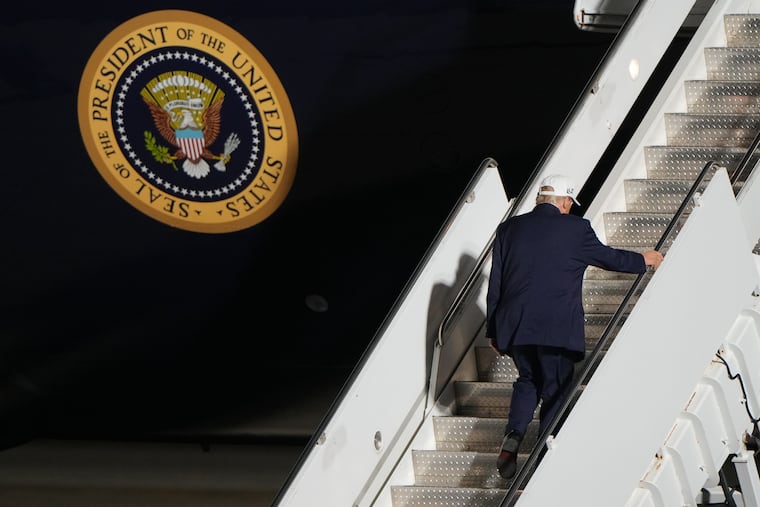
President Donald Trump implored voters over the course of the midterm campaign to “pretend I’m on the ballot.” Voters did.
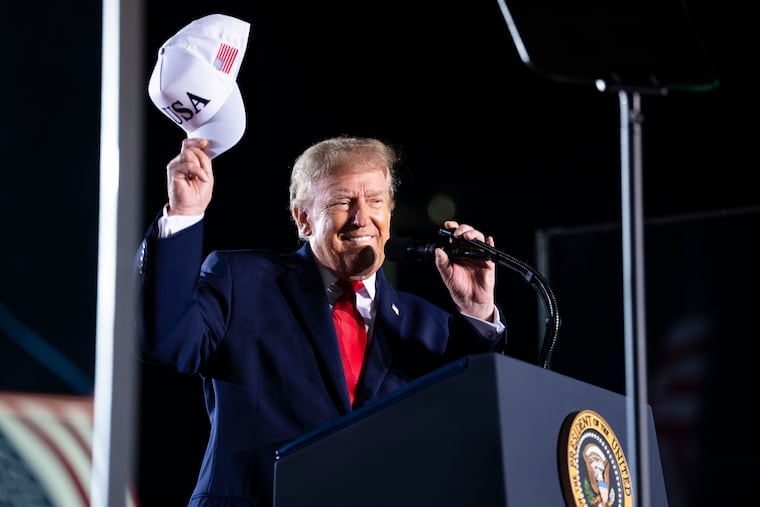
President Donald Trump implored voters over the course of the midterm campaign to “pretend I’m on the ballot.” He said it not once, not twice, but 47 times this fall.
And voters did — just not the way he hoped.
The Democratic wave in the congressional elections Tuesday amounted to a stinging rebuke of a deeply unpopular president after more than a decade in which he has dominated the national stage. More than any of his predecessors, Trump deliberately made the midterm contest a referendum on himself, only to pay the price.
The electoral backlash extended even into deep red states and indicated that Trump has lost his hold over the coalition that lifted him to the White House twice. Frustrated by high gas prices, an intractable war with Iran and allegations of flagrant profiteering by Trump and members of his circle, voters who previously took a chance on an outsider promising change either rejected his party or stayed home.
As of early Wednesday morning, the Democratic margin of victory in the overall national vote for House seats was expected to be about 13 percentage points, the largest that either party has lodged in a congressional election since at least 1976, according to estimates by The New York Times. It will dwarf even the margins that the Republicans won in their two big landslide victories of modern times when they defeated congressional Democrats when Bill Clinton held the White House in 1994 and Barack Obama was president in 2010.
Thanks to redistricting, that margin may not translate into as many seats as the winners gained in those watershed years. Gerrymandered House districts leave far fewer seats available for poaching by the other party than in the past. But the overall margin of Democratic victory indicates that while the president has two more years left in office and can still wield power to great effect, Americans are signaling the beginning of the end of the Trump era.
“It’s basically a repudiation of Trump and the Republicans and what they’ve done for the last two years,” said Douglas B. Sosnik, who was White House political director for Clinton and closely tracked the races this fall. “I do think starting tomorrow, we’re in this new phase and it’s a transition phase and it will last two years. And it will be much more volatile than the last two years.”
Trump quickly tried to save face by insisting that the rout by Democrats was not really a rejection of him since he was not actually on the ballot — never mind that he told voters repeatedly to vote as if he were.
“I wasn’t on the ticket, and because I wasn’t on the ticket, we couldn’t get enough people out to vote,” he told the Times in an interview Tuesday night.
Even many Republicans would roll their eyes at that assertion, as this was a campaign that revolved so demonstrably around Trump.
It was Trump who decided to start a war with Iran that jolted energy markets and sent prices at the pump soaring. It was Trump who chose the candidates, the issues, the strategy and the message.
It was Trump who demanded complete loyalty from a party whose candidates were nervous about distancing themselves from him. And it was Trump who has shrugged off questions about the ethics of his moneymaking in office, helping propel voter concerns about corruption.
The defeat of two Senate Republican candidates that he personally selected over potentially more electable contenders in deep red states — Ken Paxton in Texas and Darline Graham in South Carolina — demonstrated the consequences of his interventions. His push to throw out the normal process and redraw House districts in the middle of the decade to try to stack the deck for Republicans backfired.
Many voters told pollsters and interviewers that they felt hoodwinked by Trump, believing that he was going to bring down prices and not start new wars. They expected him to close the border, but bristled at what they saw as heavy-handed arrests of people living in the country for years. They rebelled against the tariffs that increased costs for consumers.
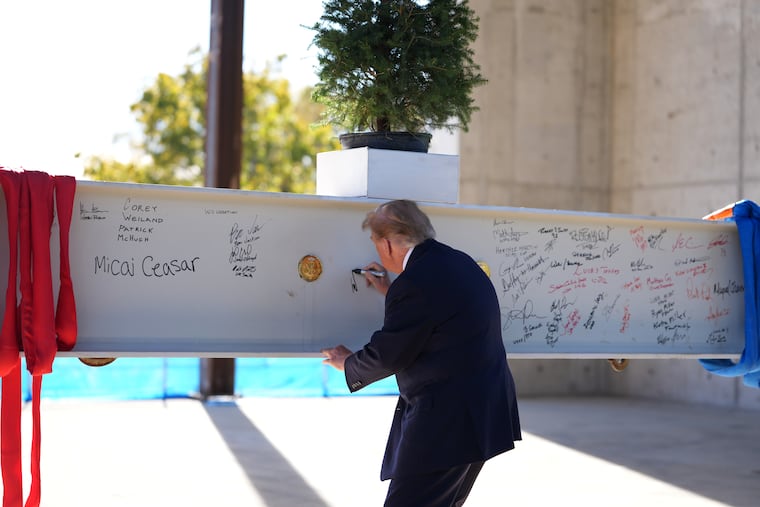
The way Trump spent his last day before the election proved to be a metaphor for how out of sync his political instincts were with the season. Instead of emphasizing plans to address the cost of living worries weighing on many voters, he delivered his final pre-election address at the Reflecting Pool, talking about algae and pipes. It was a vivid reminder of his obsession with pet construction projects in Washington, despite the warning signs of how it rankled voters — as if Richard Nixon had made his final pre-election speech in front of the Watergate complex.
Even if Trumpism may be receding, Trump has the power of the presidency for two more years and will do everything he can to remain a dominant voice for as long as he can. His allies warned against assuming that he is a spent force.
“Trump’s critics have written his political obituary before and been wrong every time,” said David McIntosh, president of the Club for Growth, a group that promotes conservative economic policies.
“The fix is Republicans getting back to our principles,” he added. “That’s how we win in 2028.”
There is, of course, a natural tendency to draw great lessons from a big midterm wave, to assume that it represents a fundamental shift in the American electorate. It certainly may. But history has seen plenty of examples when it did not last long. And it remains to be seen whether Tuesday’s results signal a broader ideological shift among voters.
The post-Watergate wave of 1974 was thought to presage a long winter in the political wilderness for Republicans, but Ronald Reagan brought the party back to the White House just six years later. The 1994 and 2010 Republican sweeps were expected to presage the end of the Clinton and Obama presidencies, but both came back to win reelection handily two years later.
Lynn Vavrek, a professor of American politics and public policy at UCLA, said the most important factor in the election was sky-high gas prices so it may not follow that the country’s political character has profoundly changed.
“It doesn’t mean the MAGA coalition is crumbling,” she said. “Does it mean the shine has come off Donald Trump a little bit? Yes. Are people less enamored of him? I think the answer to that is yes.” But she said it does not necessarily mean that Republicans are going to abandon the “identity-inflected policies” on issues like immigration and diversity that have animated the party under Trump.
This is, after all, a fundamentally altered party, one that Trump forged in his own image, empowering those who defer to him and purging those who exhibit independence. “We don’t know how the president’s going to react, but thus far we’ve only seen members of his party acquiesce to him,” said Christina M. Greer, a political science professor at Fordham University.
Joe Grogan, who served as Trump’s domestic policy adviser in his first term, said that regardless of the election results, the president has changed the political landscape by advancing issues that were not adequately addressed enough before, like pushing for better trade deals and securing greater military spending by NATO allies. The party, he said, is not moving back to what it once was.
“We’re still in Trump’s party, regardless of what happens tonight,” Grogan, now at Covington & Burling, said before the polls closed. “People who expect Trumpism to get repudiated I think are mistaken. There will be some debates that I think will be healthy for the party. But I just don’t see there being a huge wellspring for the party to go back to the one that George W. Bush led for two successful elections.”
At the same time, Democrats will debate how to interpret their victory. Their main identity this year was simply being against Trump, which was more than enough. But progressives will say that it was energy on the left that powered the success, while moderates will say it was the appeal to disaffected Republicans in states like Texas and Kansas that was crucial.
“The biggest story is non-MAGA Republicans have broken with the Republican Party,” said Rahm Emanuel, a former Democratic Chicago mayor and ambassador exploring a run for president. “The question is do we want to make this election transactional or transformational? What we do in 2027 will determine that.”
James Blanchard, who was first elected to Congress in the post-Watergate Democratic sweep of 1974 and later served as governor of Michigan, said this year’s election felt similar to that historic year. But he said that does not mean that American politics will return to the way they were before Trump. “We can never go back, unfortunately,” he said. “We’re going to have to go forward.”
“It’s the end of Trump,” he added, “even though he’s still going to be there.”
This article originally appeared in The New York Times.