FIFA quietly paid millions in taxes for its president
By the time Gianni Infantino’s American assignment is over, FIFA will have paid about $4 million of his taxes.
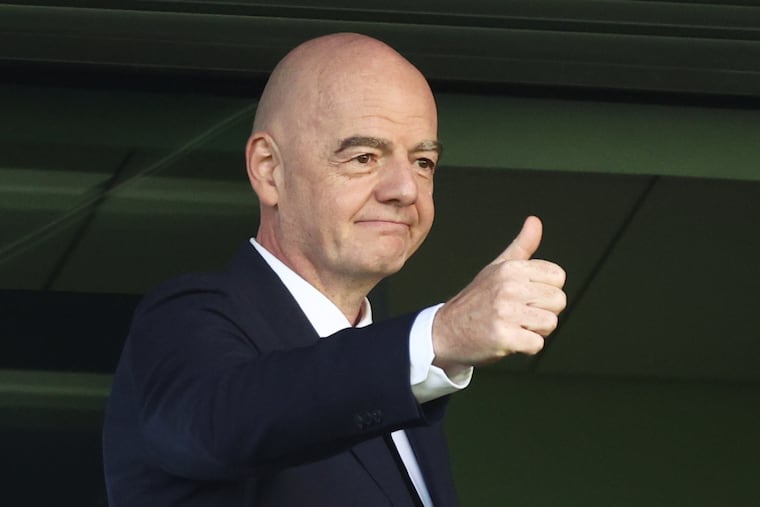
A typically dry meeting of the three-person committee that determines the pay of FIFA’s most senior officials was winding down in Bangkok one day in May 2024 when one member brought up what he considered a pressing matter.
Bruno Chiomento, a Swiss accountant, noted that FIFA’s president, Gianni Infantino, had relocated from Switzerland to Miami — where he would face higher income taxes — ahead of the 2026 World Cup. FIFA should pay to offset that extra tax burden through 2026, Chiomento argued. The other members quickly agreed without much further discussion, according to documents reviewed by The New York Times. FIFA would ultimately pay 100% of Infantino’s tax bill to the U.S. government.
A decade ago, an international corruption scandal nearly brought the end of soccer’s global governing body and vaulted Infantino into power. FIFA introduced sweeping transparency reforms in response, including a bylaw requiring that the compensation of top leadership be made public.
But to the consternation of several senior officials, the tax benefit approved in the Bangkok meeting was never disclosed in filings, according to documents reviewed by the Times and two people familiar with the benefit, who declined to be identified because they were not authorized to discuss internal matters. By the time Infantino’s American assignment is over, FIFA will have paid about $4 million of his taxes. Infantino earns about $6 million per year, according to FIFA’s annual report.
“All FIFA’s internal regulations and processes, and all applicable laws, have been followed,” FIFA said in a statement. “FIFA ensures all reporting and taxation requirements are met.” FIFA declined to provide further detail about its tax arrangement with Infantino, but it added that any payments to senior management were independently audited.
Infantino has courted controversy in recent years over how he has run the top institution for the world’s most popular sport, including his courtship of President Donald Trump, his business dealings on behalf of FIFA and efforts to steer the World Cup to Saudi Arabia.
He is now facing his biggest crisis, after news emerged in July that he secretly held talks to sell a share of World Cup rights to a company owned by the brother of Jared Kushner, Trump’s son-in-law. A global outcry followed, with governments and global soccer officials calling into question his suitability to continue running the 122-year-old institution. He is standing for reelection in March.
The U.S. tax arrangement fits a broader pattern of Infantino’s benefiting personally at FIFA with the help of people who themselves have received perks, including weekslong trips to the recent World Cup, complete with travel, luxury accommodation and access to the most prestigious areas of the stadiums, the documents show.
Chiomento, the former chair of Ernst & Young’s Swiss unit who first raised the tax matter, has known Infantino for years. He received advice from outside experts — including David Zollinger, Infantino’s personal lawyer, documents show. FIFA’s own administrative staff had concerns about a conflict of interest in hiring Zollinger, but the organization still called on his services for several issues that could affect his client.
FIFA declined to comment on why figures connected to Infantino advised on his personal tax affairs. Chiomento did not respond to multiple requests for comment. Zollinger, citing attorney-client privilege, also declined to comment.
During the Bangkok meeting, Chiomento argued that since FIFA, which has its headquarters in Zurich, had agreed to pay any additional taxes for about a dozen staff members who needed to move to the United States to prepare for the 2026 World Cup, it should do the same for Infantino. Still, some senior FIFA officials have questioned not only the calculation that Infantino should contribute nothing toward his American tax bill but also the message it sent about the privileges enjoyed by the organization’s most senior figures.
FIFA’s staff members had received tax advice from a separate group of experts that did not include Zollinger, the FIFA president’s lawyer, according to the documents.
As FIFA’s chief of governance, compliance and audit, Chiomento holds outsize influence over Infantino’s tenure as president — a position amplified by his concurrent role as chair of the compensation committee. He has also been called upon to weigh in on other sensitive matters involving the president.
One arose this year before the World Cup. Infantino unilaterally chose to replace FIFA-assigned drivers with GRIZ Global Solutions, a security firm run by an American Special Forces veteran that bills itself as providing “tier one” service to the world’s most important people. He then requested that the same level of service be provided for his wife throughout June and July, covering the period of the tournament, the documents show. When asked to approve that additional agreement, Chiomento agreed within hours.
FIFA would spend hundreds of thousands of dollars with GRIZ. Internally, at least one official questioned the necessity of providing Infantino’s wife such services, the documents show. The daily rate was $1,300 per Griz agent, not including the cost of cars, drivers and other expenses.
At the World Cup, Chiomento, an avid soccer fan, was everywhere. He ensured as much by receiving the equivalent of a VIP pass — a privilege not afforded to any of the dozens of members of committees like his, according to two people with direct knowledge of the arrangement. Dressed in an official FIFA suit reserved for its most senior officials, featuring the organization’s insignia embossed in gold on the breast pocket, he attended any match of his choosing. Chiomento also traveled on special FIFA charter flights between games, as did Zollinger and members of Infantino’s family.
“The governance framework and internal processes put in place by FIFA are robustly applied to the hiring, remuneration and involvement of external service providers, as well as to its guest management operations,” FIFA said in its statement.
The gold-lettered suit is not the only distinction FIFA has bestowed on Chiomento.
His role had a salary of $250,000. FIFA then changed it to 250,000 Swiss francs, boosting his income by about $50,000 because of currency exchange rates. Salaries for all the other committee heads remain in dollars.
FIFA has turned to other acquaintances of Infantino for other sensitive assignments, too. In 2024, when the organization redrafted its governing statutes, it called upon Zollinger and Gianni Rizzello, a lawyer not on FIFA’s staff who studied law at the University of Fribourg at the same time as Infantino, to help draft them. Those revisions formally increased Infantino’s presidential powers, which had been curtailed under the reforms he had once championed.
FIFA subsequently tapped Rizzello to help draft the compensation and benefits policy for FIFA’s most senior executives. He sought Infantino’s direct input on the revisions even though the policy directly affected the president personally, the documents show.
The policy, approved just before the World Cup, eased restrictions on giving and receiving gifts; loosened rules on VIP invitations; and granted greater discretion over the use of private jets, a mode of transport Infantino uses frequently as FIFA has an agreement with Qatar’s national carrier. It also arranged, for the first time ever, for FIFA to pay thousands of dollars in fixed compensation to the leaders of a number of advisory committees introduced under Infantino. The timing alarmed some members of FIFA’s administrative staff, said two people with direct knowledge of the discussions, who worried that the payments could give the impression of currying favor with officials who would vote in the coming election.
The new policy also expanded housing benefits for Infantino. Under it, the president could request FIFA-funded accommodation in any location where the organization maintains an office — a footprint that has swelled under Infantino to include offices in Panama, Barbados, Indonesia and Morocco.
FIFA was already paying roughly $600,000 a year to rent a house for him in Miami in addition to an apartment in Switzerland, having also rented one for him in Paris. After moving to Miami in 2023, Infantino lived for more than two years in a $27 million waterfront mansion owned by former Google CEO Eric Schmidt. Matthew Hiltzik, a spokesperson for Schmidt, confirmed that Infantino had resided there for about three years and paid market rates. Since then, the FIFA president has lived in an apartment that a Delaware company bought from singer Marc Anthony for $8.6 million last fall. It’s unclear who owns the company.
Rizzello declined to comment, citing client confidentiality. He also enjoyed VIP access to the World Cup courtesy of FIFA. And he attended a private celebration at a restaurant in Zurich in March marking 10 years of Infantino’s presidency alongside the president’s inner circle, including Zollinger, his wife and their blue-eyed Border collie.
This article originally appeared in The New York Times.