Comcast workers brace for cuts as company redesigns how it operates and invests in AI
The company’s cost-cutting transformation is expected to cost over $1 billion to implement in the next quarter.
Comcast is undergoing a cost-cutting transformation, executives said on an earnings call Thursday.
The changes are expected to cost over a billion dollars in the next quarter of the fiscal year, but the company expects long-term savings to be much greater.
Executives did not directly address the potential for layoffs on Thursday’s call, but sources have told The Inquirer that workforce cuts are expected and some are already taking place.
“We are fundamentally redesigning our organization,” chief financial officer Jason Armstrong said on the call. “We’re simplifying our organizational structure to move faster, improve execution, and operate more efficiently.”
Armstrong said in early September at a Goldman Sachs conference that Comcast had just embarked “on the largest cost transformation in the company’s history.” One of the goals is to “eliminate layers to get to much faster decision-making,” he said.
More details emerged Thursday about what this transformation entails. It includes investing in technology — namely expanding AI use in customer experience — and adding “technology leadership to increase the pace of innovation.”
Armstrong noted the company has partnered with Cresta and Sierra, companies that offer AI agents that can connect with customers.
“These capabilities are central to our new operating model, enabling us to bring products to market faster, simplifying customer interactions, and deliver a better experience more efficiently,” Armstrong said. “As personal AI agents reshape how consumers discover, purchase, and manage services, we’re positioning Comcast to capitalize on that shift.”
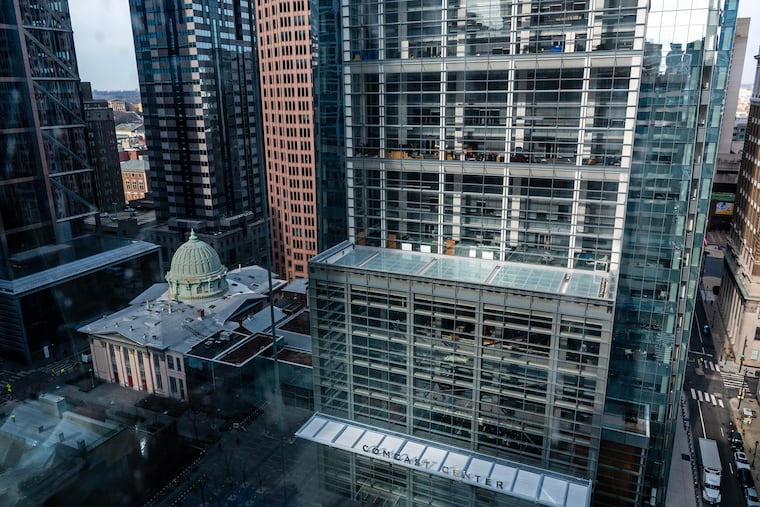
Comcast, with a two-building headquarters in Center City, has 15,000 employees in the Philadelphia area. It had 179,000 full-time and part-time employees across several countries as of December 2025, according to an annual report to the U.S. Securities & Exchange Commission.
Co-CEO Michael Cavanagh on Thursday described the changes now taking place as “the most significant operating and cost transformation in our company’s history.”
“This goes well beyond cost savings,” he said. “We’re challenging established ways of working and redesigning how we make decisions, allocate resources, and run the business to create a more agile, efficient organization that can compete more effectively and invest more decisively in growth.”
The company has recently faced challenging competition in the broadband internet market and has been losing cable customers for years.
Revenue was flat in 2025 compared to the prior fiscal year, company leaders reported in January, and company shares reached their lowest level in over a decade this year. The company reported bringing in $123.7 billion in revenue last year and on Thursday reported a 6.1% decrease in revenue in the most recent quarter.
» READ MORE: How Comcast is trying to turn around its internet customer exodus
Comcast’s corporate restructuring comes on the heels of several other major changes.
In the summer, the company announced that it plans to split Comcast’s consumer and business services, including wireless and broadband, from the NBCUniversal media group, creating two separate public companies.
In January, the company completed the spin-off of some of its NBCUniversal networks into a new venture under the name Versant. Ahead of finalizing the split, in 2025, the company made Cavanagh co-CEO alongside Brian Roberts who had held the position alone since 2002.
Around that time, the company told employees in a memo that it was cutting divisional offices in Denver, Atlanta, and Manchester, N.H.