Why Pa. Attorney General Dave Sunday is challenging corporate mergers
Sunday sued to block a media merger that had been endorsed by President Trump, and continued litigation against Ticketmaster after the federal government settled.
Pennsylvania Attorney General Dave Sunday had a decision to make.
The federal government and dozens of states, including Pennsylvania, had sued Ticketmaster and parent company Live Nation, accusing them of violating competition laws in the live events market.
But just days into the closely watched civil trial this spring, the U.S. Justice Department cut a deal with the companies — at the direction of President Donald Trump, the Wall Street Journal later reported.
Several Republican-led states joined the settlement, which critics viewed as inadequate. But Sunday, a Republican elected in 2024, chose not to settle and continued to try the case, along with some 30 other states.
“We chose to stay in and fight it out in the jury trial,” Sunday said. “And thank God we did.”
A New York federal jury in April found the biggest U.S. concert ticket seller held an illegal monopoly over big concert venues, a verdict that came after fans and artists including Taylor Swift had criticized the companies. A judge still has to weigh potential penalties, while the companies are hoping to overturn the verdict.
The episode marked Sunday’s foray into the world of antitrust at a time when the Trump administration has at times been at odds with states over how best to enforce competition law.
Since then, Pennsylvania’s top law enforcement officer has sued to block a media merger that had been endorsed by Trump over the deal’s potential to “knock out the Fake News,” challenged a playground equipment merger that Sunday says could increase costs for taxpayer-funded projects, filed a complaint that sought to protect competition in the asphalt market, and sued drugmakers and pharmacy middlemen for allegedly inflating insulin prices.
Sunday spoke with The Inquirer about his approach to these cases and whether he agreed with a senior Justice Department official’s assessment that antitrust law has “become a battlefield for political resistance to the Trump administration.”
The interview has been edited for length and clarity.
How did antitrust become a priority for your office?
The whole purpose of antitrust is to make sure that illegal monopolies don’t exist. When you have an illegal monopoly, it negatively impacts consumers because when they control all the things that an illegal monopoly controls, it impacts innovation. It drives prices up, and it’s just not lawful.
We have seen, since I was elected, a flurry of potential mergers, potential acquisitions that we felt were in flagrant violation of our antitrust laws that prohibit illegal monopolies, and so that’s how we got into this.
In the Live Nation case, why did you decide to continue at trial, as opposed to settling?
When we conduct analyses on these different issues, the question very simply is, ‘What is the impact on Pennsylvania?’ And as a result of an understanding of that impact, what should the correct course be?
Live Nation-Ticketmaster — that materially impacted, disproportionately, Pennsylvania, in particular the Southeast Philadelphia region, the collar counties, some areas in Northeast [Pennsylvania], and in Harrisburg, the Hershey Amphitheater.
I felt that I would be not doing my job if I would have just walked away from that and not pressed forward, considering the impact of the Live Nation-Ticketmaster merger and the inflation of prices, and concert tickets, and sporting events.
Do you think DOJ was wrong to settle?
I was not part of their decision-making. It was very unusual and unexpected for another partner in longtime litigation like that to very quickly — and without notice — walk away from a case.
But going back to the bipartisan relationships amongst attorneys general across the country, we were able to very quickly adapt and move forward, and that’s just what we did.
Earlier this year Pennsylvania and several other states sued to unwind the merger of broadcast TV companies Nexstar and Tegna, even though the Justice Department approved the deal. Why did you take that action and what’s at stake in this case?
We have two very large media markets that would have been directly impacted by the merger, and that would be the whole Harrisburg-Central Pa. area, and also up in the Northeast region in the Wilkes-Barre-Scranton area as well.
We look at this from a Pennsylvania perspective, and sometimes looking at it from a Pennsylvania perspective can reasonably differ from a national analysis, and that’s what we saw here.
What’s at stake is a lack of competition with regard to media, and that obviously is something that’s really important. Competition amongst media outlets is a foundational element to the First Amendment and to the way that we communicate with each other, and the way that news media communicates with us.
Nexstar says the combined company is a fraction of the size of the Big Tech companies it competes against like Meta’s Facebook and Instagram, Google’s YouTube, and TikTok. Why should broadcasters face constraints on growth that don’t apply to the tech platforms, especially when so many people get their news and information from those tech companies?
The analysis as to how people get their news in their media is different based on location, and you know there’s a lot of people in those media [markets], older Pennsylvanians, older adults that rely on broadcast media for their news.
And that being said, just because you have one technology where that might be the case, you have to look deeper than that again at the actual usage and what news platforms these individuals are utilizing to get their information. That’s what we did here.
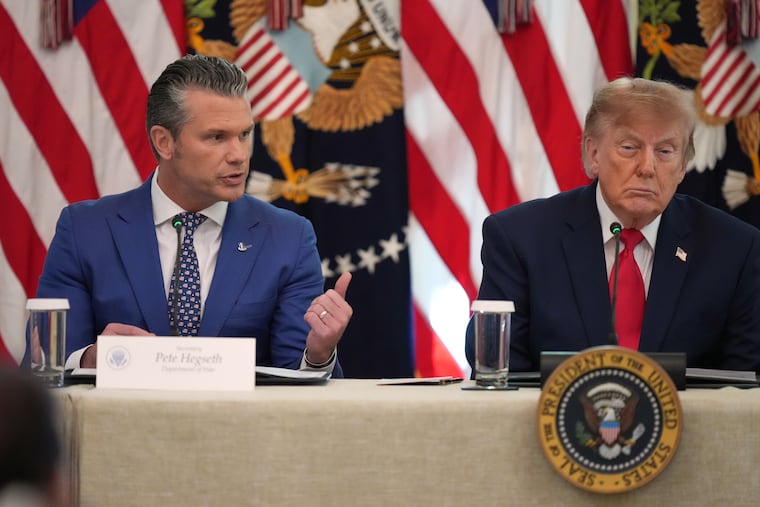
President Trump endorsed the merger in a Truth Social post earlier this year. Did that give you any pause in deciding whether to challenge the merger?
I actually didn’t even see the post, but [my office has] the same analysis for every legal issue that comes through. And I have a very robust, thoughtful, smart team of lawyers in the office and investigators, and they’ve been doing this for a long time through many different administrations.
We process it through the lens of what is the right thing to do for Pennsylvanians.
Associate Attorney General Stanley Woodward — the DOJ official who oversees antitrust matters for the Trump administration — recently criticized state attorneys general who have sued to block corporate mergers that had already been approved by the federal government. With regard to the Nexstar case, why not defer to the Justice Department, which approved the merger?
With all respect to the Justice Department’s legal analysis, there will be times where there will be disagreement. We are a sovereignty here in Pennsylvania, and we have the right to take actions that may deviate from those actions taken by the federal government, that we believe are the right thing to do to make sure that Pennsylvanians are protected under the law.
Woodward also said, “It seems antitrust enforcement, like many areas of American law, has become a battlefield for political resistance to the Trump administration.” Have you seen evidence of that?
There obviously in this world are partisan actions that some people take. From my experience, the AGs that I work with all the time across the country and our staffs, they literally look at the facts and the law and the impact on their states.
These are professionals that focus on doing the right thing for the right reason. And I can tell you that political consideration has never been part of our conversation in literally anything that we’ve done.
Colorado Attorney General Phil Weiser, a Democrat, said in September that “the federal government has become an unreliable and inconsistent partner in antitrust enforcement.” Have you seen any evidence of that?
We have an outstanding relationship with the Federal Trade Commission. The Federal Trade Commission has been a consistent partner with us. As you know, under federal law, the DOJ and the FTC both have powers to enforce antitrust law.
I’ve been in office for a year and eight months at this point. Phil Weiser has been doing this for a long time. He’s going to be leaving his office soon. He’s running for governor, and so you know he would have a longer time period to pull from.
I don’t have as much of a time period to pull from, but what I can say is that the FTC certainly has been more active with us on these issues than the DOJ.