2026 Subaru Trailseeker: Outback clone joins new EV lineup
The brand known for the outdoors and love teams with the brand known for rock-solid reliability to offer four new EVs each. Will the one aimed directly at the popular Outback SUV make a mark?
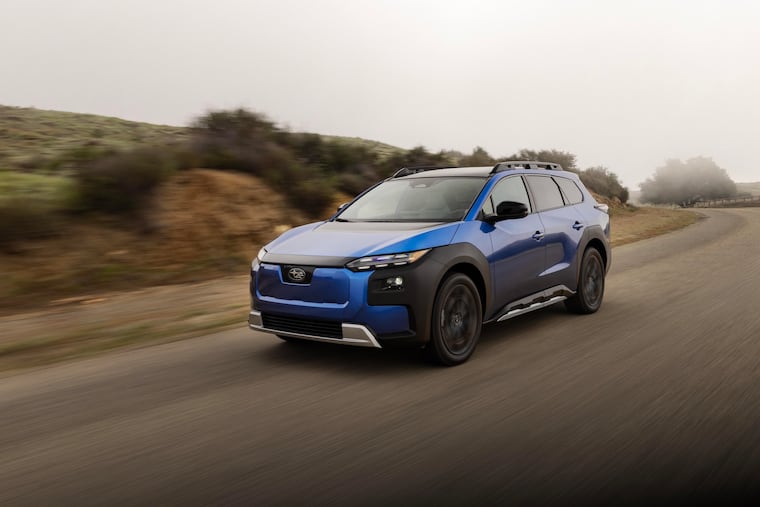
2026 Subaru Trailseeker Touring: Two heads are better than one?
Price: $48,400 as tested. Just $395 for the pretty blue paint. The panoramic roof is free for the Touring trim level.
What others are saying: “Highs: Way quick, roomy, relaxed ride. Lows: Driving range is mid-pack, bland road manners, base model lacks camera-based off-road assistance feature,” says Car and Driver.
What Subaru is saying: “Our most adventurous EV, the Trailseeker features 375 horsepower and 8.5 inches of ground clearance.”
Reality: Subaru (and Toyota) have put together a speedy, gasoline-free version of the Outback. What could be better?
What’s new: The new EV from Subaru is really the product of a joint venture between the maker of all-wheel-drive vehicles and another little Japanese automaker you might have also heard of, Toyota.
It’s one of four models the companies are producing as matched sets; the Trailseeker is a twin of the Toyota bZ Woodland. The front end looks quite like a Toyota while everything from the windshield on back resembles an Outback.
Competition: Despite reports of their demise, there are still a lot of EVs out there for sale. Competitors include Chevrolet Equinox EV, Ford Mustang Mach-E, Mini Countryman EV, Nissan Ariya, Tesla Model Y, Toyota BZ Woodland, and Volkswagen ID.4.
The Trailseeker has made a splash, though not quite a tidal wave. The model is 1.2% of EV sales for the third quarter, landing just outside the top 10, according to Cox Automotive. Tesla’s Model Y (37.2%) and Model 3 (15.1%) are tops in the segment, with the smaller Hyundai Ioniq 5 at 3.9% and three-row Kia EV9 at 2%.
Up to speed: The first thing you may notice about this outback clone is that it’s an absolute rocket. Mr. Driver’s Seat once thought the turbocharged versions of the Outback were fun, but let’s look at the numbers.
The 375 horsepower brought to you by the dual electric motors rockets the small SUV to 60 mph in 3.9 seconds, according to Car and Driver. That compares to the 6.2 seconds for the gasoline-powered Outback turbo.
There is a button to offer Power or Eco modes, but both of these seemed superfluous.
Shiftless: Twist the console knob counterclockwise for Reverse and clockwise for Drive; press a button for Park, and pull up the little parking brake lever right nearby.
On the road: The Trailseeker wears the crown of the Outback nicely, moving smoothly through curves and narrow roads without any surprises or wandering. It’s not quite fun but it’s nice enough.
Highway manners are also delightful, and bumps don’t upset the Trailseeker’s composure. I confess we did not go seeking any trails; I figured the vehicle would be doing that for me, as advertised, but alas I was left pavement-bound. Still, a vehicle that stays on course well shows promise for any off-roading you may attempt.
Driver’s Seat: The leather upholstery courtesy of the Touring trim looked and felt quite nice. The seats kept occupants in place while offering nice comfort as well, plus heating and ventilation.
The gauges are the Toyo-baru standard for EVs, with a faraway gauge pod letting you know what’s going on much like the smaller Subaru Solterra and cousin Toyota bZ. It reads clearly. I’ve gotten over missing the more upright windshield of older Subarus and their close-up gauges.
Friends and stuff: The rear seat offers nice legroom, headroom, and foot room. The center seat sits up kinda high off the corner cushions, and occupants will have the console and floor hump to deal with. Corners are heated in back as well, so those kids get EVERYthing.
The rear seat felt surprisingly slippery to the touch. I realized the front seats do as well, but the contours hide it well. This may not be the right vehicle for squabbling children.
Cargo space is 74 cubic feet with the rear seat folded. Towing capacity is 3,500 pounds.
In and out: The Trailseeker sits at a nice height so entry and exit are easy for almost anyone.
Play some tunes: The 14-inch Subaru Multimedia System provides a clear picture of your map and other functions as well. Dialing in the sound settings could be a little fussy, with sliders and arrows in the screen.
Sound from the system was pretty good, about an A-.
Keeping warm and cool: The sales sheet advertises radiant leg heaters for the front row, but tests in humid August didn’t allow for sampling. These are likely a range-saving idea.
The HVAC blowers are pushed quite low by the large touchscreen, a problem that’s becoming more common among vehicles, but maybe the defrost setting will help out here.
The controls are inside the touchscreen but along the bottom, with inconvenient pixel-based arrows for the blower speed and icons for the blower location. Temperature dials are a little shallow and can cause Mr. Driver’s Seat-sized fingers to interfere with the multimedia system if you’re not careful.
Fuel economy: The listed range on the spec sheet was 274 miles, but the most I ever saw was 250 miles. It did seem to stretch the first few miles on most trips, but I don’t think it added up to 24 extra.
The Tesla-compatible NACS plug can recharge the vehicle from 10% to 80% in as fast as 28 minutes.
Where it’s built: Gunma, Japan
How it’s built: Consumer Reports hasn’t rated this Subaru yet. The Solterra gets a 3 out of 5.
In the end: As consumers tired of the volatility of oil prices, the Seat family is finally shopping for an EV. After a short test drive, the Lovely Mrs. Passenger Seat has zeroed in on this one for herself.
And to answer my question in the intro, what could be better? A little more range, and a little less screen time.