Penn’s new $35 million brain cancer center will develop treatments for deadly cancers
A new $35 million research center at Penn will develop novel approaches to treat brain cancers. “There can be no quit in this game," said neurosurgeon Nduka Amankulor, who will direct the center.
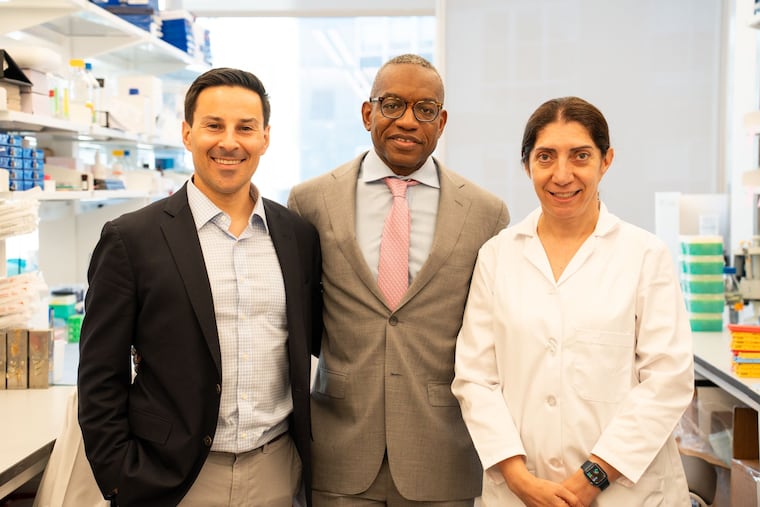
Penn Medicine neurosurgeon Nduka Amankulor believes that harnessing the immune system will be key to treating brain cancer.
He will lead a new $35 million research center at Penn to develop treatments, including so-called immunotherapies such as CAR-T therapy for glioblastoma and RNA therapies designed to reactivate the immune system, officials announced Thursday.
“What we need are 10 to 20 approaches that are like that in order to treat all of brain cancer,” said Amankulor, who will serve as executive director of the new Troiano Brain Tumor Center.
Set to officially launch in mid-November, the center will comprise nearly 100 individuals, including physicians, scientists, and support staff across disciplines.
Brain cancer is notoriously difficult to treat, in part because it can evade the immune system and vary widely in its biology and response to treatment. While novel CAR-T immunotherapies developed at Penn have revolutionized treatment for blood cancers, they haven’t been successful in solid tumors.
And the need remains great for brain tumors that often have poorer prognoses and greater quality-of-life challenges relative to other cancers.
Consider glioblastoma, the most aggressive form of brain cancer. Patients typically die 14 to 18 months after diagnosis, Amankulor said.
He lost his own father to brain cancer when he was 16. That experience, along with the patients he sees as a doctor, inspires him to work harder toward cures.
“This is one of humanity’s greatest unsolved problems,” he said. “There can be no quit in this game.”
New approaches
Translating scientific advances into clinical treatments has proven difficult for brain cancers.
One problem: Brain tumors are what scientists call “heterogeneous.” That means their genetic makeup and composition varies widely, making a one-size-fits-all approach impossible.
Alongside a multidisciplinary team, pathologists will focus on identifying the genetic mutations driving each tumor. That will guide research into targeted therapies.
Brain tumors are also exceptionally good at hiding from and shutting down the immune system.
As the most important organ in the body, the brain has ways of protecting itself from foreign invaders like viruses and bacteria, Amankulor said. Brain cancers can exploit those same mechanisms, allowing tumors to evade the immune system.
The center’s research will focus on therapies that can rewire the immune system, such as CAR-T, or chimeric antigen receptor T-cell therapy, to better target and destroy cancer cells.
Amankulor pointed to an experimental form of CAR-T for glioblastoma now being studied in a clinical trial at Penn. The technology came out of Penn scientist Donald O’Rourke’s lab, and lead trial investigator Stephen Bagley will serve as clinical director at the center.
Amankulor is also interested in developing RNA-based therapies to reactivate the immune system. The treatments could target cells surrounding the tumor, such as certain so-called myeloid cells that tumors have hijacked to suppress an immune response.
Think of it like taking away the tumor’s shield.
Other strategies include immune adjuvants, which are drugs that can boost the body’s immune response.
Amankulor developed an approach using retinoic acid for a type of brain cancer called IDH-mutant diffuse gliomas. Currently in a clinical trial, the therapy activates an immune “alarm signal,” he said, helping immune cells target the tumor.
$35 million launch
Amankulor said the investment in the center will help attract people from outside the brain cancer field, whose expertise could enable new therapies when paired with knowledge of brain tumors.
He believes multiple approaches are needed.
“[You have to] have a tool kit that you can reach into to build the exact solution that’s matched for a specific patient,” Amankulor said.
The center’s $35 million funding comes from a mix of philanthropy and institutional investment. Penn declined to specify the size of the foundational donation from Penn alum John Gabriele Troiano and his wife, Rosanna Troiano, who live in Manhattan.
John Troiano lost both his parents to brain tumors and previously supported research at Penn on immunotherapy for terminal brain cancers.
“No one should lose a loved one to this disease, and we know the devastation of that kind of loss all too well,” Troiano, who founded the private equity firm The Beekman Group, said in a Thursday news release. “Rosanna and I have made it our mission to ensure that others don’t experience the same.”