This Eagles Pro Bowl QB quit football at 27 and still suffers from PTSD. He has a message for Jalen Hurts
For Mike Boryla, it was concussions. For Hurts, it is dangerous blood clots. Different diagnoses in different eras, but Boryla wants Hurts to consider the preciousness of his post-football life.
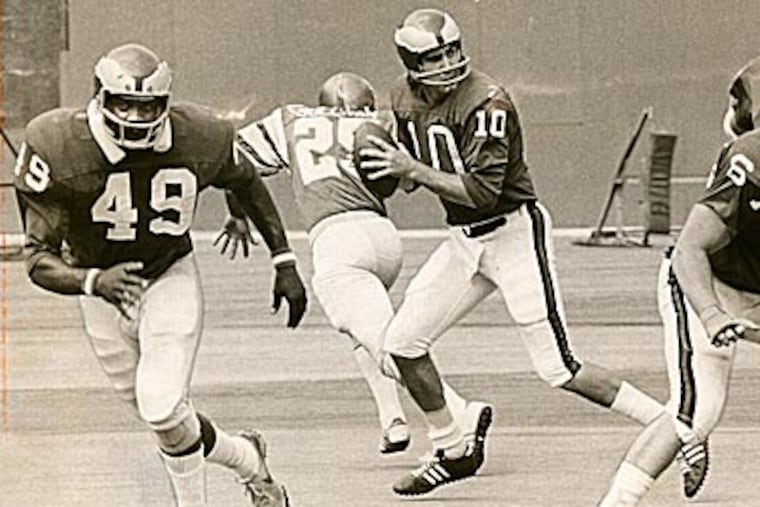
Mike Boryla has never seen Jalen Hurts take a snap. He’s never seen him throw a spiral, or run for a touchdown, or execute a Tush Push. It’s not personal; the former NFL quarterback, who played for the Eagles from 1974-76, doesn’t watch football at all.
This isn’t a choice, but a necessity. The last time he tried was about seven years ago, at his home in Castle Rock, Colo., with his wife Annie.
As the Denver Broncos took the field, Boryla started to get sick. Painful memories of his five-year career came rushing back. The glare of a flashlight in his eyes; the uneasy feeling of reviewing film he had no recollection of.
Concussions weren’t often talked about in the 1970s; when they were, Boryla says they were dismissed as “no big deal.”
Decades later, he is still suffering from what psychiatrists diagnosed as post-traumatic stress disorder. So whenever the Broncos are on, Boryla drives to a nearby sushi restaurant. He sits with a friend, eating sashimi, sipping chai tea, blissfully unaware of the local football team.
He’s always been aware of Hurts, though, albeit not through his television screen. Boryla has followed the Super Bowl-winning quarterback by way of box scores and articles, and has long held admiration for him.
Which is why, when he found out about Hurts’ diagnosis of deep vein thrombosis and “bilateral pulmonary emboli,” he was distraught.
“I’m just devastated about what happened to Jalen Hurts,” Boryla said. “I’m just blown away with his blood clot making it to the lungs. I feel so bad for him. He’s such a great guy, and such a critical quarterback, but I’m just devastated by that.”
The former Eagle knows some of what Hurts is feeling. He too found himself at a health crossroads in his late 20s; not due to blood clots, but three concussions, one in high school, and two in the NFL.
There were times when Boryla would wake up on a cold, hard bench, in the middle of a game, with a coat covering his face, so the broadcast couldn’t catch him crying.
“One of my coaches could see that I was really freaking out,” he said. “He goes, ‘Mike, you just got dinged, OK? Dinged.’”
While Hurts is expected to play again, if treatment for his pulmonary emboli goes smoothly, Boryla wants him to consider the bigger picture.
“I’d say [to Jalen] that at some point, you’re going to have to have another career, because you’re so young,” Boryla said. “You’ve got plenty of years left after football.”
Some fans might not know of Boryla. He was selected out of Stanford in the fourth round of the 1974 NFL draft by the Cincinnati Bengals, who then traded him to Philadelphia for a future pick. In the mid-1970s, he battled for a starting spot with Roman Gabriel on a series of teams that would best be described as forgettable.
The Rockville Centre, N.Y. native had his moments, like winning his first three starts in 1974, the first time an Eagles quarterback did so since 1951, according to Eagles historian and former Daily News writer Ray Didinger. In 1975, Boryla made the Pro Bowl as a reserve, and threw a pair of fourth-quarter touchdown passes to lead the NFC to a 23-20 victory.
The Eagles declined to pick up his option in the summer of 1977, which allowed Boryla to become a free agent. He signed a four-year deal with the Buccaneers, but had a series of knee injuries in addition to the concussions, was put on waivers at age 27, and opted to confront his post-football life.
For the next three decades, a man who lived every boy’s dream distanced himself from it. Boryla enrolled in law school at Stetson University in 1978, and then got his masters’ in taxation at University of Denver in the early 1980s.
He met Annie shortly after, and they settled down in Colorado, raising four sons. The former Pro Bowler practiced law, wrote books, and rarely discussed football.
“I never told people that I was a former Philadelphia Eagles quarterback,” Boryla said. “I never brought it up.”
Boryla is more comfortable talking about it now. In 2014, he wrote and starred in a one-man play, The Disappearing Quarterback, which ran in both Philadelphia and Denver. The show was autobiographical, doubling as a cautionary tale about the danger of concussions.
“Football is life-threatening,” Boryla said. “[The players] don’t realize it. But when you’re 75 and you have 57 friends who have died. I mean, I don’t think that I’m that old…”
The game Hurts is playing is far safer than that of the 1970s, even in spite of the many questions being asked about Hurts’ recent care. The NFL now has a mandatory, five-step concussion protocol that might have helped Boryla. Rule and equipment changes have also helped protect the players’ health.
But to the former Eagle, Hurts’ harrowing diagnosis is just another reminder that more needs to be done.
“My wife was an emergency room nurse for over 40 years,” he said. “And she told me they [initially] called it a superficial [blood clot], and how really incredibly dangerous it is.”
He added: “‘Superficial.’ That is pathetic. She said, ‘If this thing moves to the lungs or the heart, this is a major deal.’”
The two quarterbacks have had vastly different careers. Hurts has led Philadelphia to five playoff appearances in his seven seasons, while playing in three Pro Bowls. Boryla never made it that far; his teams went a combined 8-11 in the games he started.
Modern free agency didn’t begin until 1993. NFL stars like Hurts have made millions. Boryla never had that kind of money to lose. He was not a football lifer in the way Hurts was; the Stanford graduate began applying for law school after his second season with the Eagles.
But Boryla does have perspective, even if it’s somewhat complicated. The 75-year-old still loves the game. Some of his happiest memories were with the Eagles, like a rookie show he staged with linebacker Frank LeMaster in training camp of 1974.
He doesn’t remember many plays, though. And much of what he does remember on the field is uncomfortable.
So, instead of watching the games, he now warns players of their effects; reminding them that after all of this is done, they’ll have the rest of their lives to live.
“The key is to make sure you have a vibrant, exciting career after [football],” Boryla said. “Because some people don’t. Some people don’t.”

The news keeps getting worse. Eagles quarterback Jalen Hurts will likely miss the rest of the 2026 season with a deep vein thrombosis blood clot, as well as bilateral pulmonary emboli. Moments after the story broke, The Inquirer’s Jeff McLane and Marcus Hayes reacted to the news, looking at what the diagnosis means for the Super Bowl MVP, how the Eagles handled the situation dating back to their trip to London, and whether backup Tanner McKee is ready to take the helm on a full-time basis. Listen here.
Listen to all episodes here or wherever you get your podcasts.