As NFL trade deadline nears, the Eagles should be watching the Colts’ fire sale closely. In more ways than one.
The Eagles owe Nick Sirianni and his players more than the Colts are giving Shane Steichen and his locker room.
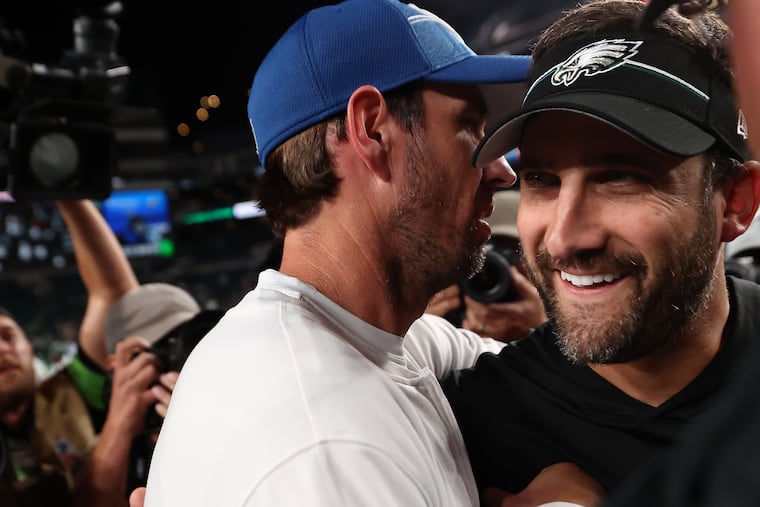
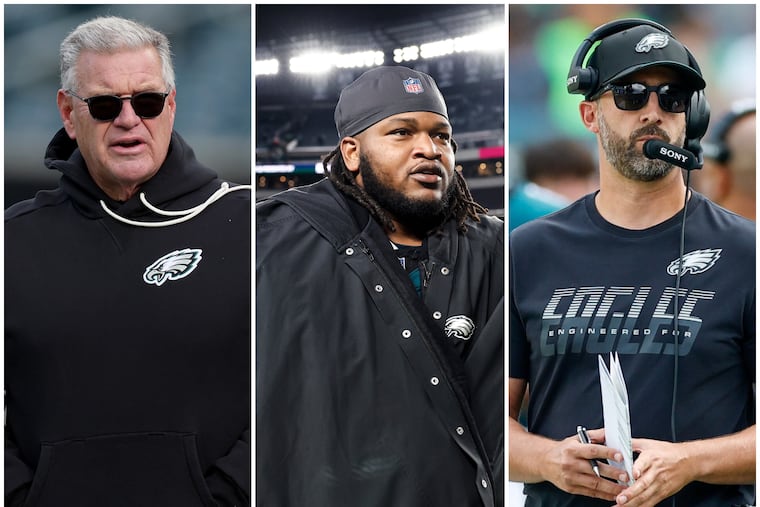
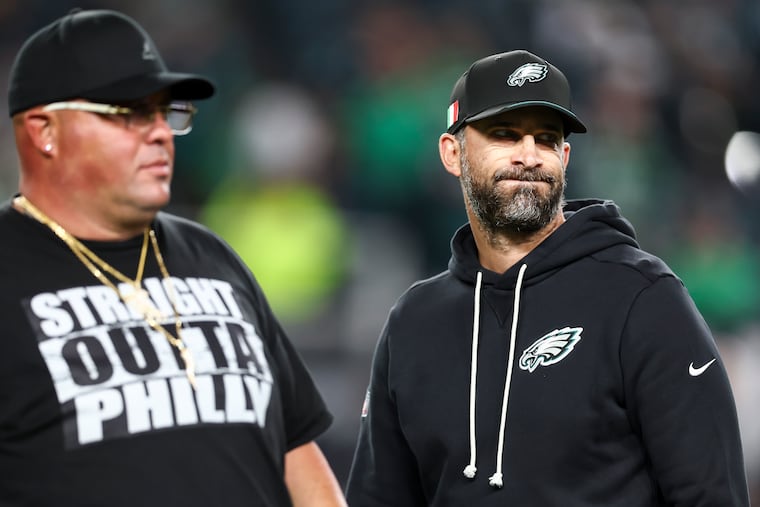
The most interesting game left on the Eagles schedule is one of the least interesting to the NFL at large. In Week 14, the Colts will visit Lincoln Financial Field for a showdown between teams that are currently 2-5 and have combined to lose their last eight games. Come for the backup quarterbacks. Stay for the lame-duck head coaches. Instead of flexing the game to Sunday night, maybe they’ll flex it off the schedule entirely. I’m not sure Nick Sirianni or Shane Steichen would complain.
The postgame handshake between the two coaches will range somewhere between awkward and shameful, depending on each team’s decision-making between now and then. The Colts have already begun the process of cutting Steichen’s legs from beneath him. Guard Quenton Nelson and defensive tackle DeForest Buckner are already out the door. Running back Jonathan Taylor could soon follow. They are three of the team’s longest-tenured players, each a former All-Pro, together the foundation that allowed Steichen to cobble together a slightly below .500 record in his first three seasons with a combination of Gardner Minshew, Anthony Richardson, Daniel Jones, Philip Rivers and Riley Leonard at quarterback. Even if the Colts considered retaining Steichen for a fifth season, why would he want to stay?

David Murphy alerts
It’s a question the Eagles would be wise to consider as they formulate their own strategy for making the most of the ashes of 2026. The agenda is obvious only from the broadest of views. The current season is a sunk cost. Their top priority is to position themselves to compete in 2027 and beyond. All of that is clear.
Less clear are the conclusions the Eagles should draw from those premises. Eagles general manager Howie Roseman is smart enough to know that he must capitalize on whatever future benefit exists from the disposability of 2026. He is also smart enough to understand the limits of the potential draft capital available to him even with a forward-thinking philosophy. It is much more limited than a lot of Eagles fans like to think.
The notion of the trade deadline as a major plot point in the NFL calendar year is mostly a creation of the modern internet content industry. Football is a sport with competitive cycles, roster structures, and financial considerations that render fanciful the traditional buyer-seller framework of leagues like the NBA and MLB. With 22 starters and 53 roster spots and a huge degree of week-to-week and month-to-month variance in injury-related odds, there is a limit to the impact one player can make on a team’s championship hopes. Any singularly impactful player on an expiring contract will almost certainly be in a position to sign a new deal that helps his former team net a late third-round pick. That’s an awfully high floor for fair value in any trade offer.
» READ MORE: Sielski: The Eagles’ lousy season has been full of what-ifs. Let’s answer some of them.
You saw that reflected in the Colts’ return for Nelson. Regarded by many as the NFL’s best interior offensive lineman — and one of the best linemen in general — the Colts landed a 2027 third-round pick that figures to land well outside the draft’s top 75 picks, likely between No. 82 and No. 96. And, let’s keep in mind, the price the Seahawks paid is similar to the one the Eagles paid for Jaelan Phillips last season. Phillips was among the most sought after free agents on the subsequent market. Nelson will be the same.
Here’s the reality: Since 2017, the average NFL season has seen an average of about two first- or second-round picks traded in October or November. A total of 11 second-round picks and seven first-round picks have changed hands in October and November of those nine seasons. Before last year, when the Jets netted a trio of first-round picks by trading superstars Sauce Gardner and Quinnen Williams, there had been one first-round pick traded at the deadline in the previous five seasons. The last three trade deadlines have seen a total of three second-round picks traded.
It’s even overstating things to say that third-round picks are the currency of the trade deadline. The third-rounders that end up traded are usually closer to the start of the fourth round than the end of the second. The most valuable third-round pick traded in the last three years was No. 87 overall, which the Eagles sent to the Dolphins for Phillips. Each of the other four picks traded were between No. 91 and No. 100 overall.
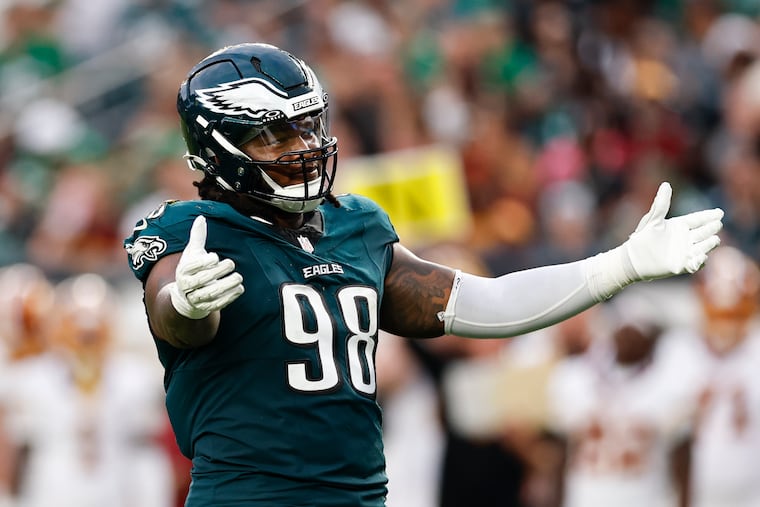
To put that in perspective, consider the players the Eagles most recently drafted immediately outside of the top 40: Eli Stowers (54), Markel Bell (68), Andrew Mukuba (64), Jaylx Hunt (94), Tyler Steen (65), Sydney Brown (66), Nakobe Dean (83). This is a long way away from hoping Quinyon Mitchell falls in the first round and Cooper DeJean gets to you in the second. Even if free-agents-to-be Moro Ojomo and Riq Woolen are as marketable as some Eagles fans like to believe, the return is mostly a scratch-off-ticket, with dividends unlikely to pay off next season. If Ojomo is so valuable, why do people think the Eagles miss Milton Williams?
Really, the currency of the trade deadline is third-round picks that aren’t much more valuable than the compensatory pick a team might receive for a pending free agent who signs elsewhere.
That’s not to say the Eagles shouldn’t be selling for what they can get in certain situations. But those situations are limited. And, in the case of Woolen and Ojomo, they are likely to straddle the line between future and present value. We’ll define present value as the value of continuing to field a football team that can at least hold it’s head high.
» READ MORE: Eagles trade deadline tracker: The latest Birds rumors, potential moves, and top deals from around the NFL
Therein lies the most meaningful calculations that Roseman and the Eagles must make as they look to navigate a path out of the abyss. An organization can get itself into a lot of trouble making sure a crisis doesn’t go to waste. Game theory and analytics are valuable things, but the real key to good general managin’ are the decisions made within the margins of error. Roseman and his predecessor Joe Banner spent a long time capitalizing on inefficient markets. They were competing against a lot of idiots, which meant there was an asymmetry of information. There are a lot less suckers to be had now. Nobody is trading them the next Jason Peters or A.J. Brown.
The more everyone wises up, the more Roseman must decide between marginal gain and its countervailing cost. There is a very real level of dysfunction a team can introduce when it trades veterans like Nelson or Buckner for anything less than clear material gain. Colts wide receiver Josh Downs has already reportedly requested a trade. Culture isn’t merely a concept. Jordan Mailata didn’t play in an NFL game for two straight seasons. He did not develop in a vacuum.
Mailata certainly did not develop in an environment where Lane Johnson retired midseason and the Eagles traded their 27-year-old starting center who was in the concussion protocol and then traded Landon Dickerson for whatever he could theoretically be traded for all while hanging their coach out to dry and entertaining the thought that they might eventually replace him with his former offensive coordinator who got hung out to try by the team the Eagles are playing in Week 14.
That doesn’t necessarily mean it wouldn’t make sense to trade Dickerson for a first-round pick, should some team be willing to offer it in spite of the fact that it hardly ever happens. The point is that the calculation is much deeper than the isolated future value of Dickerson or the hypothetical first-round pick. Like, who is starting at guard for you next season? It’s surely a question that Steichen, or anybody else, would be asking themselves if the Eagles asked them to interview for their head coaching vacancy.
The human element is never just the human element. Organizations are not composed of equal parts humans and robots. To discount the human element is to discount a fundamental component of human performance. The Eagles owe Sirianni and his players more than the Colts are giving Steichen and his locker room. The Jurgens trade was clearly an instance where the return was worth the friction (provided their evaluation and projection of Jurgens proves correct). No-brainers like that are rare.
It has been four years since Sirianni stood next to Steichen and surrendered to Chris Stapleton’s vocals on the pregame Super Bowl sidelines. Their paths will cross six weeks from now. The Eagles’ goal in the interim is to avoid becoming the Colts.

How were we so wrong? Heading into the season, the Eagles’ defense was supposed to be their strength. After Monday’s throttling by the Cowboys, the group reached a new low, especially on the defensive line, where major offseason investments and commitments were made. Why has a unit that showed promise in training camp failed to live up to expectations? And how will the Eagles’ five-game losing streak influence the organization’s approach to the NFL’s impending trade deadline? The Inquirer’s Jeff McLane and David Murphy tackle these topics and more the day after the Eagles’ 38-21 defeat to Dallas. Listen here.
Listen to all episodes here or wherever you get your podcasts.