CB West product Grant Udinski is the Jaguars' offensive coordinator. He'll face his hometown team in London this week.
Udinski has become a hot NFL head coaching candidate at age 30. Those who have coached and worked with him, including his father, Jim, are in awe of his approach.
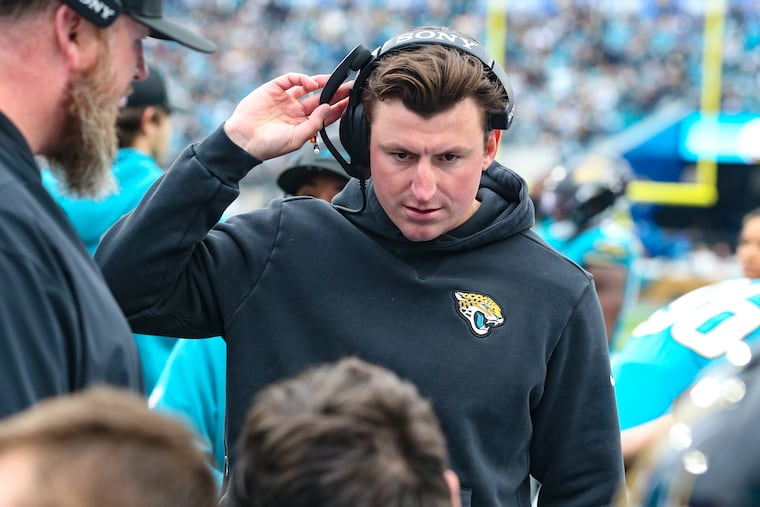
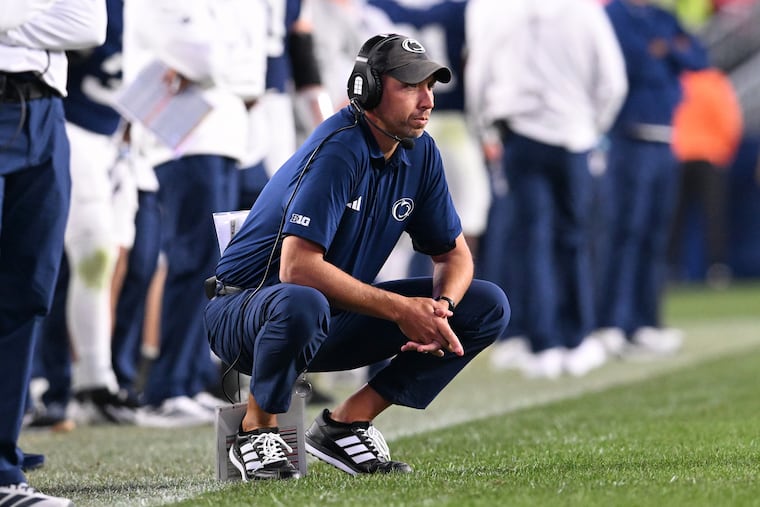
During NFL broadcasts on Sundays, anyone can watch 30-year-old Jacksonville Jaguars offensive coordinator Grant Udinski coach from the sideline, working closely with head coach and offensive play-caller Liam Coen.
But his father, Jim, has a unique vantage point of Udinski on the sideline that he gets to see any day of the week.
Jim keeps a photo in his Doylestown home office that captured Udinski’s first foray on an NFL sideline. On Dec. 19, 1999, a month shy of his third birthday, Udinski attended his first Eagles game with his older brother, Ward, and Jim at Veterans Stadium. Before they watched Koy Detmer lead the Eagles to a 24-9 victory over the New England Patriots, they took a photo together just inches from the field, with Udinski wearing an Eagles cap backward.
Looking back, Udinski recognizes that his up-close view of the many Eagles playoff teams of the Andy Reid era influenced his early fascination with the game. He never could have fathomed, though, that he would have an opportunity to coach from those NFL sidelines, even after he’d first considered getting into coaching when he was in middle school.
“I don’t know that I ever thought I was going to coach in the NFL,” Udinski said. “I don’t know [if] that ever crossed my mind. That probably seemed like such a far stretch or such a reach that I don’t know that I ever would have thought that coaching at that level would be possible.”
He didn’t stretch too far. Twenty-seven years after he attended his first Eagles game, Udinski began his second season in his role with the Jaguars, who currently sit atop the AFC South with a 3-1 record. Last season, he worked with Coen to help lead the team to franchise records in scoring and first downs, reaching 13 wins for the first time since 1999.
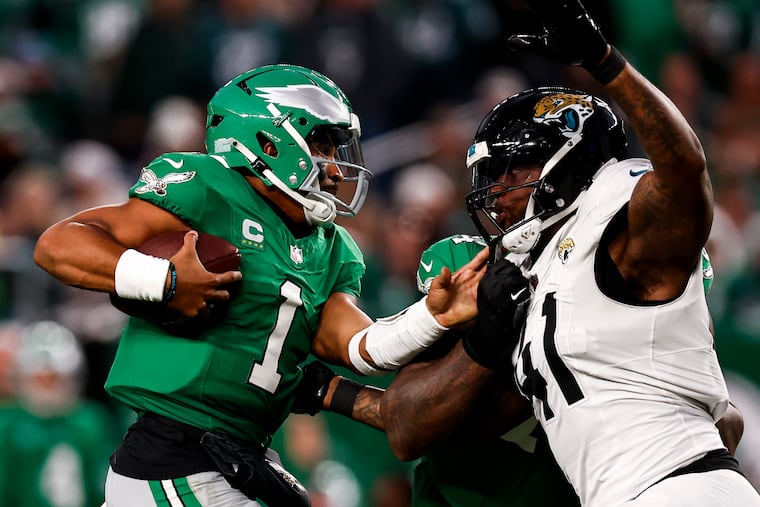
Come Sunday in London, Udinski will stand on the Tottenham Hotspur Stadium sideline opposite the Eagles, coaching against the team he grew up watching.
Udinski’s early love of football wasn’t limited to the Eagles. Growing up in Doylestown, he said, Sundays were for watching the Eagles, and Fridays were for Central Bucks West football. Udinski is the latest CB West product to coach in the NFL, joining longtime former coach Mike Pettine Jr., Seattle Seahawks run game coordinator Justin Outten, and Detroit Lions safeties coach Jim O’Neil.
“People maybe say there’s something in the water in Doylestown,” Pettine said.
Pettine, whose late father, Mike Sr., won four state championships as the head coach of CB West, hesitated to lump Udinski in as an offshoot of a theoretical coaching tree at the school. But his local roots are undeniably at the foundation of his football journey and a fervor for the game that has fueled him throughout it.
“That’s what drives him,” Pettine said of Udinski’s passion. “That’s obviously what has gotten him very quickly to where he is today.”
Father’s coaching style ‘rubbed off’
Udinski’s earliest football memories in the early 2000s were at CB West, where Jim, his seven siblings, and Kerry, Jim’s wife and Grant’s mother went to high school.
He remembers eating Nat’s Pizza before games. He remembers going to the stadium — both at home in Doylestown and on the road at neighboring schools — with his family, including his cousins, who lived down the street.
Most of the specifics are fuzzy, though. Udinski said he was at CB West’s three consecutive state championship wins from 1997-99, even if he doesn’t remember being there. Nonetheless, he was exposed to the success of the program early in his life, and it stuck with him, Jim said.
“He definitely knew of the aura of CB West from those years, because it was still fresh in people’s minds,” Jim said.
Jim played football at CB West for Pettine Sr. He overlapped on the team for a year with Pettine Jr., who was two grades behind him. But for Jim, the joy he derived from his playing career paled in comparison to the pride he took in coaching all three of his sons — Ward, Grant, and Reece, his youngest — in Pop Warner football.
In 1998, Jim got involved with the Lenape Valley Indians, the Pop Warner program based in Chalfont, Bucks County. He estimated the association consisted of a handful of tackle football teams and a couple of flag teams at the time. He took over as president two years later, which he called the “right time,” coinciding with an influx of people moving to the area.
The organization grew rapidly. By the time Udinski was in his later elementary years, Jim said they had upward of 22 tackle teams and 12 flag teams. He saw the parents invest a lot of time and money into the program, so as a volunteer, he wanted to give them something back of equal value. Brian Hensel, the current CB West head coach, met the Udinski family when his son, Brian Jr., played with Udinski and was coached by Jim on the same Pop Warner team when the boys were about eight years old.
“[Jim] took football very seriously and grew up under Coach Pettine Sr.’s tutelage, and he took an approach with the kids when they were young to keep it simple, but also be sharp and execute to the highest level of degrees you could,” Hensel said.
Jim said he viewed himself more as a teacher than a coach. He felt that with his players — not just his own kids — the better he taught them the game, the more they wanted to be part of it. He said he never cared which level his sons were playing, whether it was the top team or the middle team. Getting reps and learning the different concepts in all three phases of the game was more important than getting the ball in their hands, he said.
He coached Grant through the Pop Warner program from third grade through eighth grade. Before Grant, he coached Ward’s teams. After Grant, he coached Reece’s teams. Grant joked that his mother, who ran the snack bar, was “so ready for us to be done” with Lenape Valley football by the time they reached high school.
Kerry said they practically lived at the field. When she went into labor with Reece in 1998, on the same day as Ward’s picture day, they swung by the field before going to the hospital.
“It was part of what we did,” Kerry said.
Their football endeavors weren’t limited to the field. Jim would watch film with his players, too, starting when they were eight years old. He didn’t review film to critique his players’ past performances, though. He said he used it as a tool to prepare for upcoming opponents, especially as the kids got older and reached the “competitive level” of Pop Warner after age 10.
Udinski isn’t sure how many fifth- and sixth-grade Pop Warner teams were watching extra tape together to study an opponent after practice. Nonetheless, his father’s approach to coaching taught him the importance of detail, discipline, and work ethic at an early age.
“I was certainly very thankful to have him as our coach growing up,” Udinski said. “He did a great job with us, and probably more than I would like to admit that he taught me has rubbed off onto how I coach now.”
Earliest ‘coaching’ experience
Ward and Reece both became quarterbacks, playing at CB West and North Penn, respectively, in high school. Ward would play in college at Division III Juniata in central Pennsylvania, while Reece would play at FCS Virginia Military Institute and Richmond as well as a season at Maryland.
Grant was the lone Udinski brother who didn’t play quarterback. Jim noted that he preferred the blocking and tackling aspect of the game, traits that led him to play on the defensive line and at tight end as he got older. Occasionally, though, at the Pop Warner level, his father would call on him to play quarterback if the starter got hurt.
In those instances, Udinski, a gifted student in school, demonstrated his aptitude for the game. Jim would start reading a play to Udinski that he wanted him to run, and he would put his hand up mid-call and run back to the huddle because he already knew the rest. Sometimes, Jim would call the wrong play, and Udinski would run back to the huddle with his father shouting after him.
“He would wave me off, going, ‘I know you called it wrong. I got this,’ and he would correct it,” Jim said.
Udinski displayed that aptitude on the sideline, too. Jim said his first “coaching” experience came when he was 12 years old. Jim was coaching Reece’s team, two age groups behind Grant. Jim had scouted the team in advance, wrote down their signals, and told Grant to study the plays. He asked Grantto stand with him on the sideline on game day, watch the team’s signals, and tell him the play.
Jim estimated the sheet contained approximately 20 signals. He said Grant was “dead on” every play.
“I don’t think he ever looked down,” Jim said. “I think he just memorized them, and then when the other coach would signal them, Grant knew what that signal meant and would tell me the play, and then we would adjust our defense accordingly.”
He took on more responsibility assisting his father when he was in high school. Jim didn’t want to miss Ward’s college games on the weekends, so he would send Grant to scout Reece’s upcoming opponents. Scouting was a common practice at the competitive level of Pop Warner, Jim said, but it wasn’t so common to see a 16-year-old doing it rather than a coach.
Udinski scouted one of the better teams in the league three or four times, Jim recalled. Again, when it came time to play against them, Reece and his teammates were well-prepared.
“We knew every play,” Jim said. “We knew everything, because [Grant] told me everything. He told me their cadence, he told me their audibles, everything. And we, of course, took the time to prepare, and taught the kids on the team what to expect.”
At that point, Udinski already knew he wanted to get into coaching. He said he understood his playing career wouldn’t last long, although he went on to play in college at Davidson at tight end and Towson as a defensive lineman. Even at Towson, Jim recalled watching Udinski shout out the opposing team’s plays in his junior season, both on the field before the snap and as he was rotating out.
When he was in high school and when he would come home for breaks in college, Udinski would watch every college football game on Saturdays, from noon to 2 a.m., when Pac-12 play was ending. Jim knew how much he cared about the game, but he and Kerry weren’t informed of Udinski’s intent to get into coaching until he told them he was going to Baylor in the spring of 2019 to watch practice.
Udinski had been networking, sending emails to schools and attending coaches’ conventions and clinics, and was invited to visit Baylor by then-co-offensive coordinator Jeff Nixon. He drove down to Waco, Texas, without a return date in mind, sleeping in his car in a nearby Walmart parking lot at the end of each day. Kerry assumed Udinski had a temporary housing situation set up, though he hadn’t filled in his parents with many of the details of his trip.
“Honestly, tons of worry,” Kerry said. “I can remember basically being like, ‘Please just respond to my texts and let me know you’re good. Send me an emoji, whatever it takes. I want to know you’re good.’”
Phil Snow, who was Baylor’s defensive coordinator at the time, took Udinski in and gave him a place to stay for the duration of spring practice. That eased his parents’ minds — and so did his eventual acceptance into Baylor’s graduate school and his hiring as a graduate assistant when a spot became available.
Matt Rhule, the former Temple head coach who was then at the helm at Baylor, wasn’t about to let Udinski’s stint in Waco end after spring practice. He said he could tell that Udinski was “kind of a genius,” and he also possessed the requisite “grit and determination” of a promising coach.
“We only let people [in here that] we feel like are one of us, right?” Rhule, now at Nebraska, said. “That are going to bring great value. So the fact that he was willing to do that let me know that, hey, he loves this, and that no job’s going to be too small for him. It’s kind of rare to have someone who has that type of desire and dedication.”
Bringing the ‘it factor’
At Baylor, Udinski was tasked with doing all of what Rhule called the “quality control work” — the game plans, the scouting reports, the opponent breakdowns. Rhule was especially impressed with Udinski’s “unbelievable recall” when relaying information about the opponent and their scheme, while also self-scouting Baylor’s own tendencies.
After Baylor went 11-3 that season and made trips to the Big 12 Championship and the Sugar Bowl, the Carolina Panthers hired Rhule as their head coach. Following the Bill Belichick model, Rhule wanted to fill out the lower ranks of his staff with “really smart, young coaches” at a relatively inexpensive cost, then see if they could work their way up the ranks.
“I thought, ‘Hey, who could be a head coach?’” Rhule said. “Who could be a coordinator? And make them learn kind of from the ground up. Start [at] that entry-level position, and kind of go from there.”
Rhule said Udinski was a natural fit for a coaching assistant position, doing many of the same tasks he handled at Baylor for two seasons with the Panthers. During Udinski’s time with Carolina, he connected with Pettine at the NFL scouting combine over breakfast. While Pettine knew of Udinski because of his parents and Reece, who was the quarterback at North Penn, where Pettine was the head coach at the turn of the century, he hadn’t yet met the middle son.
Pettine left the conversation feeling like they had a shared vision of football and the application of technology within it. He continued to monitor Udinski’s progress through Brian Angelichio, the former Panthers tight ends coach who was on staff with Pettine in Cleveland and Green Bay. When Kevin O’Connell hired Pettine and Angelichio to his Minnesota Vikings staff in 2022, Pettine asked Udinski to send him some of his work, from scouting reports to playbook drawings.
He wasn’t surprised by the quality of Udinski’s work. Shortly after their hiring, both Pettine and Angelichio walked into O’Connell’s office and advocated for Udinski to join the staff. Pettine said they were both “annoying enough” that O’Connell finally agreed to meet with Udinski over Zoom.
“I’m like, ‘Good,’” Pettine recalled. “You won’t be five minutes into the Zoom and you’re going to know that you’re going to want to hire the guy.’”
Udinski joined the Vikings as an assistant to the head coach, which was technically more of an administrative role. He was still giving detailed introductory scouting reports to the offensive staff to begin the week of game preparation. Given his fluency in Excel, he could type the plays into the call sheet for O’Connell. But Pettine said that Udinski wasn’t simply dictating the plays from someone else into the system — he was responsible for checks and balances, ensuring that each play had the right name or was typed in the proper way.
He was also a “very quiet, but calming influence in Kevin’s ear” during games, Pettine said. He would monitor how defenses were responding to the Vikings’ game plan and whether their defensive calls aligned with his expectations.
“He thinks very quickly on his feet, he has excellent recall and can make an adjustment very quickly, and I just think that’s one of the bigger reasons why he’s the rising star that he is,” Pettine said.
That trust led to more responsibility, as he became the assistant quarterbacks coach in 2023 and added assistant offensive coordinator to his title in 2024. As an assistant quarterbacks coach, Udinski played a role in ensuring the backups were ready to play, which was particularly important in 2023 when Kirk Cousins tore his Achilles. But he didn’t solely have an impact in the quarterbacks room, Pettine said.
“A good indicator of a guy who’s a good coach is that the players go to him,” Pettine said. “So everybody would be just like, ‘Oh, ask Grant.’ So a lot of times when the players weren’t clear, obviously starting with the quarterbacks, but even the other positions. ‘Hey, if you weren’t sure,’ because Grant just had such a good feel for not just what the quarterbacks were doing, but just kind of like the concept of the whole plan.”
Now, as the Jaguars offensive coordinator, Udinski is able to make more of an impact on the whole plan. A head coaching opportunity could be next. This summer, Udinski interviewed for the Cleveland Browns and Buffalo Bills head coaching vacancies. He withdrew from the Browns’ coaching search, ultimately deciding to return for his second season with Jacksonville.
Udinski said the interview process was a “great opportunity” to refine and present the philosophies that he believes in as a coach. Pettine said it isn’t a matter of if, but when, as it relates to Udinski’s future as a head coach.
“It first goes back to that ‘it factor,’” Pettine said. “He has a presence about him. He’s so well respected because he knows the information inside and out, and he communicates it well. I think he has excellent people skills, excellent communication skills. A lot of times he would be the quietest guy in the room. But when it comes time to speak, when Grant would speak up, it would carry some weight.
“I think from that standpoint, everybody looked at him as ‘Wow, this guy’s too young. This guy’s too young,’ and I just didn’t see it that way because he was very mature beyond his years.”
Still, Jim said what has impressed him most about Udinski’s fast rise has been his level of focus on the present. He asserted that his son isn’t focused on himself and his own climb.
His parents are just happy to be along for the ride, whether they’re cheering him on from Doylestown, Jacksonville, or London. Jim said their friends, who are Eagles fans, are making the trip across the pond for Sunday’s game and want to go to Eagles bars. Jim and Kerry, who shed their Eagles allegiance long ago, will keep their distance, he said.
“People ask me all the time, ‘What if he went to a team like the Dallas Cowboys,’ and I look at them and say, without hesitation, ‘I would cheer for the Dallas Cowboys,’” Jim said. “It’s my son. So that’s just the way it goes.”

Different year, different offensive coordinator, yet still, it feels like Déjà vu all over again. The Eagles had little margin for error Sunday vs. the Rams because of injuries. They played hard despite being shorthanded, but in the end, couldn’t put the Rams away, mainly because of poor execution on offense. Why hasn’t Sean Mannion's scheme clicked? How culpable are head coach Nick Sirianni and quarterback Jalen Hurts in the offensive rut the Eagles find themselves in? The Inquirer's Jeff McLane and David Murphy analyze the fallout from the 24-20 loss to L.A. Listen here.
Listen to all episodes here or wherever you get your podcasts.