In ‘Dear Lara,’ violinist Lara St. John confronts rampant sex abuse in classical music in Philadelphia and beyond
Since The Inquirer published her story of abuse while a student at Curtis, in 2019, several women came forward with their stories. St. John's documentary "Dear Lara" serves as a searing examination.
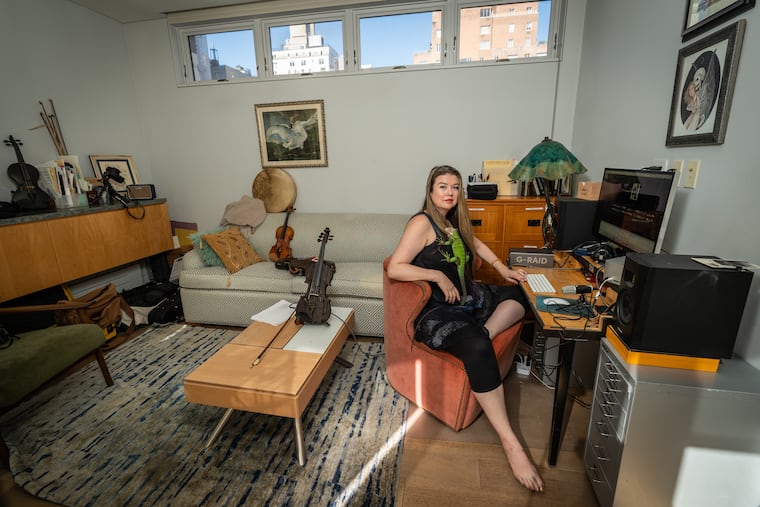
When famed violinist Lara St. John thought about the soundtrack for her new documentary, Dear Lara, she already had a classic composition in mind: Franz Schubert’s Death and the Maiden.
It’s a story about death coming for a young girl who begs him to stay away, but he tells her there’s nothing to fear, his touch won’t hurt. The perilous interaction has long fascinated composers, musicians, and artists who frequently sexualized the relationship in the retelling over some 200 years.
For St. John, the parallels felt strikingly relevant to her film as she completed interview after interview with survivors of sexual assault, most of whom were raped and abused as children by their classical music teachers in conservatories around the world.
It’s her story too.
In 2019, St. John came forward publicly with her experience from her time studying at Philadelphia’s Curtis Institute of Music, alleging in a Philadelphia Inquirer investigation that her violin teacher, Jascha Brodsky, assaulted and raped her.
At the time, Brodsky was 79 years old and she was 14.
Brodsky died in 1997 before accusations of his misconduct from St. John and other students came to light. His family said the alleged behavior was “completely inconsistent with the man we knew and loved.”
After speaking out, the Canadian violinist received a deluge of letters and calls from fellow survivors in the classical music world, primarily from women who were abused as girls by older, powerful men considered too talented to be stopped.
Hundreds of “Maidens” came forward to share their harrowing and haunting encounters with “Death.”
Their stories followed a familiar pattern, painting a horrific picture of systemic abuse and institutional complicity. Bright and skilled young girls enrolled in prestigious, competitive institutions to learn from world-renowned maestros treated with godlike reverence. In private lessons, those men forced themselves onto their students repeatedly, brazenly, and without consequence. They threatened their victims with expulsion or other punishments to keep the children quiet. If a girl did come forward to report her assault, school leadership rarely took disciplinary action against the abuser.
The men continued teaching, founded music programs of their own, racked up awards, and secured illustrious titles. The girls faced ridicule and retaliation, struggled to recover as their lives were derailed, and some stopped playing music entirely. Many attempted suicide. A few died that way.
Rewind, replay.
“It’s a small world, and I knew I wasn’t alone in this, obviously, but I didn’t realize the breadth of it — how global it was and just how endemic it was,” said St. John, 55, who now lives in Manhattan. “Once they knew about me, everybody had their own story that they wanted to share.”
St. John felt a profound responsibility to take action.
Three months after she went public with her own story, she picked up two cameras and began interviewing fellow survivors, starting a seven-year-long filmmaking process.
Dear Lara, which premiered earlier this year at the Santa Barbara Film Festival, features accounts of eight survivors of sexual abuse at the hands of teachers, concertmasters, and once-renowned classical music stars: Pianist Lusiana Lukman, violinist Lisamarie Vana, violinist Mascha van Sloten, double bassist Heather Bird, violinist Zeneba Bowers, oboist Katherine Needleman, opera singer Samuel Shultz, and the late cellist Robie Brown (as told through her widower, Frank Powdermaker).
Their stories are intertwined with archival footage and images as well as interviews with legal experts and journalists (including The Inquirer’s classical music critic, Peter Dobrin) who investigated assaults at various schools and orchestras. The film will have its Pennsylvania premiere on Monday, Oct. 5, with two screenings at the Free Library of Philadelphia on the Parkway.
It arrives amid renewed conversations about women’s safety on school campuses and criticism of educational institutions who shield perpetrators of sexual assault from accountability following the alleged rape of a Cornell University student by members of a fraternity house.
“I certainly never set out to be a filmmaker … It was an ambitious undertaking. I made a lot of rookie mistakes [at first],” said St. John, whose previous film experience consisted of editing her own music videos. “I’m really glad that I set out on my own as early as October 2019 because various situations have changed, and I wouldn’t have gotten some of those stories if I had waited until I had a team together.”
The heart-wrenching film follows St. John on her interview trips to Toronto, Amsterdam, Winston-Salem, N.C., and Philadelphia. In some Zoom interviews, St. John’s pet iguana, Cain, made a cameo. (He died in 2021 but during our interview, St. John introduced her new baby iguana, Octavius.)
Shooting in Philadelphia was especially difficult. While standing in Rittenhouse Square, across the street from Curtis, she felt physically sick as she recounted attempting suicide during her third year. In the aftermath of her allegations, Curtis commissioned a report that concluded St. John was credible.
The school eventually apologized in a statement acknowledging that leadership “failed to provide her with a safe learning environment, failed to carefully investigate her claims, failed to communicate our grave disappointment in how she was treated by Curtis, and repeatedly failed to communicate the steps that were taken to prevent such abuse from occurring in the future.”
Curtis has since implemented policy changes, like disallowing private lessons at teachers’ homes, hired a Title IX coordinator, and established a trauma fund for free counseling for victims of sexual abuse within the Curtis community. In a 2024 statement to The Inquirer, the school said these efforts, among other changes, “have made Curtis an incredibly safe and nurturing place.”
Since the release of Dear Lara, another school was pressured to conduct an investigation.
In the documentary, Lukman, a pianist who left home in Indonesia at 14 to pursue music, detailed allegations of sexual assault by her teacher Boris Berlin at the Royal Conservatory of Music in Toronto in the 1980s. After the documentary screened in Canada, Lukman created a petition demanding an independent investigation into sexual abuse at the institution that earned thousands of signatures; the conservatory has since hired a law firm to investigate. Berlin died in 2001.
“I felt devalued and betrayed, because if anything is worse than being molested, is coming forward about these things and being betrayed by the people that supposedly protect children,” Lukman says in Dear Lara.
Lukman and St. John are continuing to pressure the school to make the report public when it’s completed. Their efforts are part of St. John’s relentless advocacy work beyond the documentary to support survivors and denounce music schools worldwide that have fostered what she calls a culture of silence and abuse.
“We’re trying to create a movement, really, to get rid of this ridiculous — well, honestly, it’s overused now, but — patriarchy in classical music. I believe many, many women have just been abused out of the field, and some men, obviously, as children as well,” said St. John.
The violinist is now deeply familiar with Pennsylvania politics as she’s traveled to Harrisburg three times to advocate for amending the statute of limitations for childhood abuse. In Dear Lara, St. John appears with ChildUSA founder and University of Pennsylvania professor Marci Hamilton at Philadelphia’s City Hall to garner support for House Bill 462, which would provide a two-year window for survivors to file lawsuits that otherwise could not be prosecuted because the statute of limitations has expired. While the bill passed in the House in 2025, it has stalled in the Senate.
“If it’s murder, there’s no statute of limitations. … Child sex abuse is, in many ways, like the murder scenario because the victim is so disempowered as compared to the perpetrator, and the average age to come forward is in the early 50s,” Hamilton explains in the documentary. “Twenty years ago, 15 years ago, there were a lot of states where you had two years from the date of the act. So if you were six years old, you had two years to get a lawyer and press charges.”
St. John hopes that the film will encourage audiences to take action, too.
Dear Lara is a groundbreaking and searing examination of the classical music industry, which rarely is represented on screen.
(The Emmy-nominated Tár, which cast Cate Blanchett as a fictional, predatory lesbian conductor, is one recent and prominent example. St. John thought it was “ridiculous” and “idiotic” that the perpetrator was female. “There are thousands of men Társ out there, and they made this a woman, like come on,” she said.)
After serving as Dear Lara’s director, writer, cinematographer, and participant, St. John also contributed original music. In addition to using her arrangements of Death and the Maiden, she composed a theme song beginning with A and E strings as a nod to how every child first learns the violin.
Some of the featured musicians on the soundtrack include fellow survivors like Needleman, the principal oboist at the Baltimore Symphony Orchestra who discussed her experience of sexual harassment in the film, and Cara Kizer, a French horn player who was allegedly raped by two of her New York Philharmonic colleagues.
St. John plans to release a Dear Lara soundtrack with their recordings, including those she had to cut from the film, like an aria from Shultz, a participant who described being raped as a graduate student in Texas.
Eventually, St. John wants to create a foundation to support survivors pursuing justice against their abusers and the institutions who failed them.
“That will be my life’s work,” she said.
‘Dear Lara’ will screen twice on Oct. 5 at the Free Library of Philadelphia’s Parkway Central Library, 1901 Vine St., Phila., 833-825-5357 or libwww.freelibrary.org.
An earlier version of this article misstated the relationship between Robie Brown and Frank Powdermaker. They were engaged at the time of her death.