Democrats nominate Jeffries as speaker, making history
The vote was 251-11, with two Democrats abstaining, according to a person who attended the confidential session and detailed the results on the condition of anonymity.
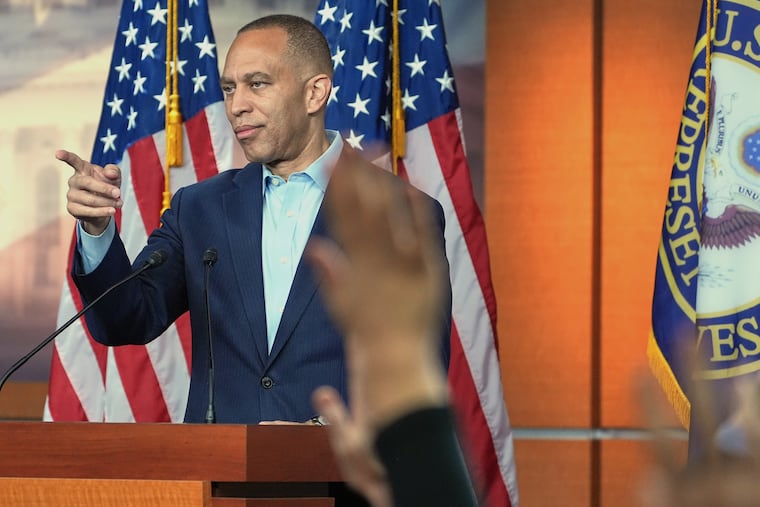
WASHINGTON — House Democrats on Wednesday nominated Rep. Hakeem Jeffries of New York to be speaker, voting overwhelmingly over resistance from the left to put him in line to become the first Black lawmaker to hold the post.
The election by secret ballot came just over two weeks after Jeffries, 56, who has led House Democrats since 2022, presided over sweeping victories for his party, which won a historically large majority in the midterm elections.
The vote was 251-11, with two Democrats abstaining, according to a person who attended the confidential session and detailed the results on the condition of anonymity. The margin demonstrated the breadth of Jeffries’ backing in a large and ideologically diverse caucus.
He will still have to be elected on the House floor in January, when he will need a majority of members in the chamber to rise and say his name to formally win the post that is second in line to the presidency. But the lopsided the secret-ballot vote suggested he will have more than enough support to do so.
Jeffries’ nomination was almost a foregone conclusion; no Democrat emerged to challenge him, and even some of his loudest critics ultimately did not want to publicly oppose the man in line to be the nation’s first Black speaker.
His frictionless ascent counted as a rarity in the House, where party leaders often rise through tumultuous challenges.
“It’s a good day,” Rep. Steny Hoyer of Maryland said as he headed into the closed-door session. “I served with the first woman speaker of the House. Now we’re going to elect the first African American speaker of the House.” Hoyer said it was a testimony to the country’s progress.
Inside the room, according to a person who was present, Rep. Jim Clyburn, D-S.C., gave the final speech nominating Jeffries, invoking the civil rights hero and long-serving Rep. John Lewis of Georgia as he reflected on the significance of elevating a Black man for the job.
Still, Jeffries faced loud grassroots resistance from progressives fed up with the Democratic Party establishment who see Jeffries, a reserved moderate and prodigious fundraiser, as an avatar of the status quo who is beholden to corporate interests.
Progressives who want Democrats to cut off U.S. aid to Israel and who champion “Medicare for All” said they were concerned that Jeffries, a longtime supporter of the Jewish state who they view as too closely aligned with AIPAC, the pro-Israel lobbying group, would stand in the way of their demands.
Jeffries, who in recent days met with almost all members and newly elected Democrats as he sought to wrap up his nomination with as little opposition as possible, is known for his cautious and highly disciplined style.
He likes to host listening sessions and have a caucus “family discussion” before telegraphing his stance on any issue. But he also appears willing to move in response to broad calls for bold action.
On Tuesday, for instance, less than 24 hours before his nomination, Jeffries endorsed a broad expansion of Medicare to cover more Americans and a wider variety of services, edging closer to the Medicare for All proposal championed by progressives.
It was a sign that with a larger majority giving him more room to maneuver and progressives pressing him to take up a bolder agenda, he saw the need and opportunity to take a more ambitious approach.
Jeffries, who grew up in a working-class home in the Crown Heights section of Brooklyn in the 1980s, first ran for the state Legislature at 29. He was always viewed by people around him as a potential national leader, though he had been hesitant to reflect on the significance of his place in history until he had the vote wrapped up.
“Over the last four years, that pressure has already been on me,” he said in an interview earlier this month, when asked if he felt the weight of breaking a racial barrier. “Failure is not an option.”
Despite the sweeping electoral victories, Jeffries has been facing loud resistance to his leadership. Many lawmakers said their phone lines had been blowing up with constituents demanding a new face to lead the party as it takes control of Congress. But even amid that pressure, many of the progressives in Congress said they thought Jeffries deserved a chance to lead them in the majority.