Israel’s election: When will we know the next prime minister?
Early exit polls suggested that Benjamin Netanyahu’s Likud party had won more seats than the leading opposition party.
Israelis headed to the polls Tuesday in the highest turnout in more than a quarter-century for what many say was one of the most consequential elections in the country’s 78-year history.
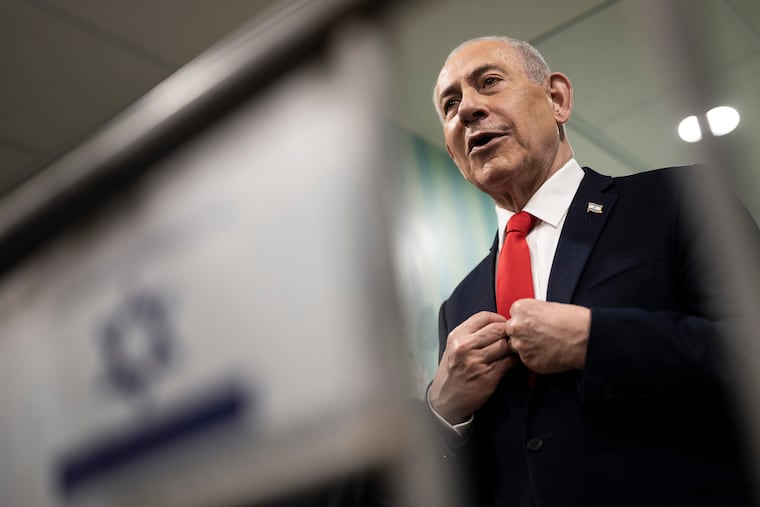
Prime Minister Benjamin Netanyahu of Israel, the country’s longest-serving leader, his party, Likud, and his far-right governing coalition were locked in a tight contest with opposition parties in the country’s first election since the Hamas-led assault on Oct. 7, 2023, that ignited Israel’s devastating war in the Gaza Strip.
In Israel’s parliamentary democracy, every party creates a ranked list of its candidates, and voters choose a party or slate. The leader of the party or list with the most votes could become the country’s next prime minister — though it is not automatic — if that candidate can form a government, but the process is complicated and involves extensive negotiations.
Here’s what to know.
What happened on Election Day?
Election Day is a public holiday in Israel, with schools, government offices and many public services closed. In most of the country, polls opened at 7 a.m. local time and closed at 10 p.m. Turnout nationally was 77.7% when the polls closed, according to the country’s Central Elections Committee, the largest figure since 1999.
Early exit polls published by Israel’s mainstream television networks immediately after the voting ended suggested that Netanyahu’s Likud party had won more seats than the leading opposition party, Yashar. That party is headed by Gadi Eisenkot, a former military chief of staff who lost a son in the war in Gaza.
But overall, the major opposition coalition appeared to be running close to the right-wing bloc. Other parties that opposed the Netanyahu government, the most far-right of any in Israeli’s history, appeared to fare well.
Israel’s Arab citizens make up about 20% of the population, and they turned out in large numbers Tuesday with the stated desire to oust the far right. Mansour Abbas, the leader of the Raam party, told a television interviewer Tuesday night that the turnout showed that “frustration and despair” in Israel’s Arab society had “turned to hope.”
Exit polls suggest the Arab parties may end up with more seats in the Knesset than ever before, making them a potentially important force in any governing coalition regardless of which political leader is ultimately asked to form it by the country’s president, Isaac Herzog.
The opposition bloc led by Eisenkot has been reluctant to embrace Arab parties but may be unable to form a government without their support.
Yair Golan, the leader of the Democrats party, which is part of the lead opposition bloc with Yashar, declared victory for their efforts Tuesday night, saying that exit polls show the Israeli public has “fired Netanyahu and Likud.” He urged opposition leaders to swiftly form a “change government” and expressed a willingness to rely on support from outside the alliance to secure a parliamentary majority, an apparent reference to the Arab parties.
How are votes counted?
Israel’s electoral system uses nationwide proportional representation. Elections to the 120-seat Knesset are held at least every four years, though they can happen more often. In 2022, Israeli elections were held for the fifth time in three years after the Knesset dissolved itself.
Each Israeli voter casts a single ballot for a list of candidates affiliated with one or more parties or slates. Invalid votes are removed from the count, and then each list receives the number of Knesset seats proportionate to its share of the national vote, so long as it received at least 3.25% of valid votes. About 10 parties are expected to clear that electoral threshold.
Votes for lists that did not pass the threshold are subtracted from the total eligible votes and do not count in subsequent stages.
The number of total valid votes given to the qualifying lists is divided by the number of seats in the Knesset, yielding the number of votes required to win a seat. The 120 seats are then allocated according to each list’s share of the vote.
There are often seats remaining after this calculation; if so, there is another stage of allocations determined by a formula that aims to ensure that the final seat allocations are as proportional as possible.
In addition, parties can make agreements in advance to share what are referred to as “surpluses” in this part of the process. And only when all of these calculations have been made is the final seat allocation clear.
The calculations and seat allocations are based on official results, which are expected by Nov. 4.
How is a government formed?
No single party has ever won a majority of votes, which means that parties must form factions and that party leaders must forge a governing coalition, aiming to build a majority in the Knesset of at least 61 lawmakers.
Within seven days of the announcement of the official election results, Israel’s president, who otherwise plays a mostly symbolic role, meets with elected representatives from the parliamentary factions. He can take recommendations and is not obligated to select a potential prime minister from the party that won the most votes, though that is often the case. He may instead determine that another leader is more likely to be able to form a governing coalition that can win a vote of confidence in the Knesset.
The president will then ask his choice to try to form a government. That candidate has 28 days to negotiate with other factions and forge alliances to cobble together a government. That person can request a 14-day extension to the deadline.
If that effort fails, the president can select another candidate, who also has 28 days to try to form a government but has no option of an extension. If the second attempt fails, a majority of Knesset members can ask the president to have a third candidate try. That person would be granted 14 days to form a government, and if that fails, new elections are announced.
If a candidate succeeds at forging a governing coalition and creates a policy agenda, and if the proposal wins a plurality of votes in the Knesset, the government is formally invested, and that candidate becomes the prime minister.
Technically, the law allows for a minority government if the relative majority supporting it is larger than the minority opposing, but governments established after elections have almost always enjoyed the confidence of a majority of the 120 Knesset members.
Historically, it has taken about 20 to 100 days to form a government, and no government has been sworn in less than 50 days after an election, according to the Israel Democracy Institute, a nonpartisan think tank in Israel.
Who will likely lead Israel?
The initial exit polls do not always give an accurate sense of the final results, so it may be some time before the picture becomes clear. For example, exit polls do not reflect the votes of hundreds of thousands of Israelis who cast ballots at special polling stations, including on military bases, in hospitals, prisons and embassies.
What does seem apparent from the exit polls, however, is that both of the significant coalitions — the far-right bloc led by Netanyahu and the center-right bloc led by Eisenkot — will not have a majority that ensures they can easily form a government without significant compromises and negotiations with smaller players.
This article originally appeared in The New York Times.