Environmentalists rally against New Jersey plan to restore Atlantic white cedars
The trees, which stand up to 80 feet and give Pinelands’ rivers their signature tea color, hover at a tipping point.
Bob Williams, a rangy 77-year-old forester, pulled his pickup truck over on a sand road in Wharton State Forest, stepped out, and pointed to a wide pond.
“This was once an old cranberry bog with a nice stream running down the middle,” he said.
In just eight months, beavers transformed the stream into a sprawling pond that’s currently drowning Atlantic white cedar trees and inviting invasive phragmites reeds to takeover.
“You can see them dying,” he said, pointing to discolored cedar. “See those in the distance? They’ll soon be gone.”
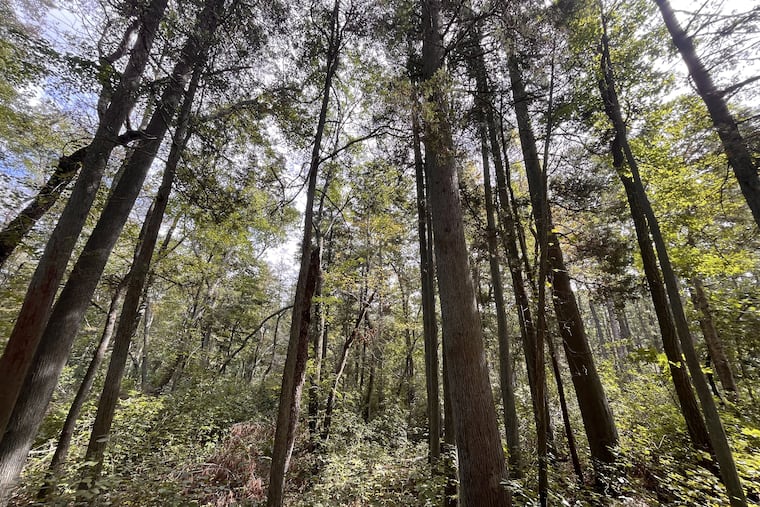
The majestic cedars, which soar up to 80 feet and give Pinelands’ rivers their signature tea color, hover at a tipping point.
New Jersey harbors the East Coast’s last major concentrations of Atlantic white cedar, holding roughly half its remaining stock. Yet the state’s historical 115,000 acres have collapsed to just 25,000.
State officials have a $19 million plan to reverse the decay by jump-starting restoration of 10,000 acres. The first phase targets 171 upland acres off Sandy Causeway in Waterford Township and was crafted by Williams. New Jersey’s Pinelands Commission will vote on the proposal Friday.
However, environmentalists, even those who support restoration, are challenging the strategy, directing the most ire at the part calling for culling mature, healthy trees. They spoke out against the plan at a Sept. 11 Pinelands Commission meeting. They’ve rallied against it on social media and blogs.
“It is about asking whether the state is choosing the least destructive way to create the conditions cedar needs,” Jeff Tittel, retired director of the New Jersey Sierra Club, wrote in the Jersey Vindicator, an online publication. “There is a difference between ecological restoration and an industrial logging operation wearing a green hat.”
‘Collaboration with nature’
Atlantic white cedar was logged for centuries before the federal Pinelands Protection Act of 1979 was enacted to save New Jersey’s forests and massive underground aquifers from rapid sprawl. Freshwater swamps were drained for development. Beavers built dams. Fires burned through life-sustaining peat.
In recent decades, climate change has worsened severe weather combining with sea level rise to push in damaging salt water from the coast, leaving behind so-called ghost forests, vast tracts of spindly, dead cedar trees.
» READ MORE: Rising seas could be turning Jersey’s coastal cedars into ghost forests
Williams drew up the plan with Lawrenceville-based engineering firm, WSP U.S. He says time is of the essence to carry it out and believes in active management of state forests, which includes cutting some trees, rather than a hands-off approach.
“The time of let’s leave it to nature is passed,” Williams said. “We need to apply our energy, our resources, and knowledge to start a collaboration with nature.”
‘Most beautiful white cedar forest’
Jason Howell, an advocate with the Pinelands Alliance, is skeptical, fearing that the plan is a step toward logging in the protected Pinelands National Reserve.
“What they’re defining as the area to be restored is, the majority, among the most beautiful white cedar forest in Wharton State Forest,” Howell said as he walked through the trees recently, noting tall, mature cedar.
“I’m not denying there’s a need to restore Atlantic white cedar,” he said. “But this is a timber harvest logging plan. They have 20 or so log loading areas in the plan. They are going to go in there with giant machines.”
The plan calls for removing up to 2,475 cords of cedar. That could amount to 64% of the cords of cedar in the project area. There are an estimated 12,000 cedar in the 171-acre area.
“This is the beginning of a plan to log and clear-cut most of the river corridors in Wharton State Forest (10,000 acres), including the Batsto, the Mullica, the Wading, and more,” Howell wrote on a recent Facebook post with hundreds of comments.
A ‘selective harvest’
New Jersey State Forester Todd Wyckoff says there is a misunderstanding of the plan, and that the goal is not to clear-cut woods for loggers, but to save the forests.
Wyckoff said there must be healthy cedars present for restoration to work. Some will have to be cut, he said, so others can thrive and grow. He said it would not make sense to try to restore cedar in a section of Wharton where there are none.
“Given the type of tree and the type of forest that Atlantic white cedar forests are, they just aren’t competitive in shade,” Wyckoff said. “They need that competing vegetation to be removed to have an open, full sunlight.”
Temperature in dark cedar forests and swamps can run 15 degrees cooler just a few feet within.
Wyckoff said existing healthy, wind-resistant cedars will be retained to drop seeds, rather than relying on costly and labor-intensive seeding by hand.
“This is often framed as a clear-cut, but it’s really a selective harvest,” he said. “The reason to act now is that the sites we’ve selected have cedar in the canopy.”
Once sunlight hits the forest floor, cedars reseed aggressively, sprouting a carpet of “800 to over 1,500 seedlings” per area, he said.
In addition, Wyckoff said it is critical that restoration areas be in uplands outside of areas that face saltwater intrusion, further limiting available areas.
New Jersey’s Pinelands National Reserve spans about 1.1 million acres with a roughly 300,000 acre core where virtually all development is banned.
Gregory McLaughlin, New Jersey’s Forest and Natural Lands administrator, dismissed beliefs that there’s a profit-driven incentive to log the land. In fact, he said, restoration is costly.
“The New Jersey Forest Service is not in the commercial logging business,” McLaughlin said. “We’re not approaching this from a standpoint of a profit margin … In protecting these forests and restoring these forests and creating healthy forests, we have to cut some trees.”
State officials said no contracts had been awarded for tree removal or logging.
Once, hundreds of small sawmills dotted the Pinelands, but now only a handful survive. Owners who support the plan note that they are part of the Pinelands historic culture.
Ed Sherwood, who owns a small cedar forest in Forked River, appeared during a recent Pinelands Commission meeting and spoke in favor the plan.
“I don’t make a lot of money in it,” he told the commissioners — but protecting the cedar, he said, is vital.