Peco made series of blunders ahead of Bristol nursing home gas explosion, new documents contend
A 3,000-page document release outlines what happened before the 2025 nursing home explosion that killed three people.
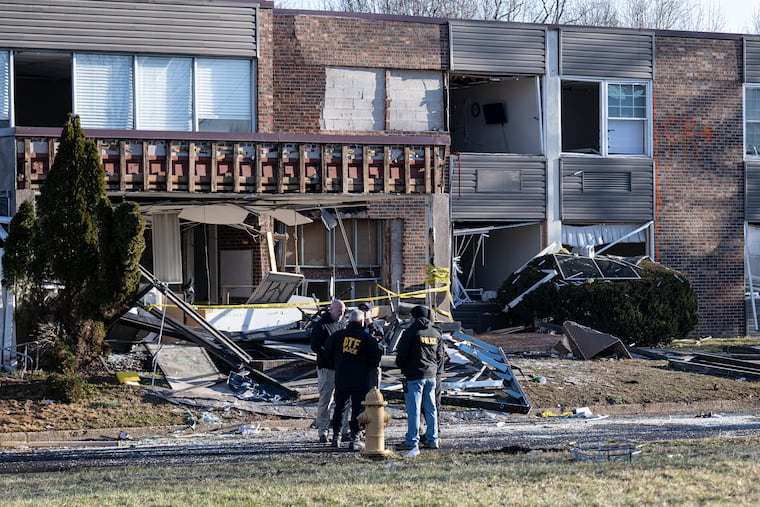
A Peco technician sent to halt the gas leak before the deadly Bristol nursing home explosion last year encountered an indoor valve that the utility company never trained him to handle, and another technician reported that Peco managers made him “fabricate” a report in the hours after the blast, according to newly released federal documents.
The National Transportation and Safety Board, in a 3,000-page trove of records released Thursday, offered a detailed portrait of the events leading up to the Dec. 23 explosion at Bristol Health & Rehab Center in lower Bucks County.
While investigators stopped short of assigning blame, their documents offer new insight into the flawed emergency response and infrastructural issues surrounding a blast that killed three people and injured 20 others just before Christmas. A nurse at the facility and two nursing home residents were killed.
Peco said in a statement that it made several safety improvements in response to the NTSB’s investigation, including changes to training and response procedures. A representative for Saber Healthcare Group, the nursing home operator, said the company was still reviewing the documents.
In an initial report released in January, the NTSB said that Peco technicians arrived at 11:50 a.m. and found a gas valve leak in the basement of the 174-bed nursing home on Tower Road, but that the workers were unable to stop the flow of gas until an hour and a half after an explosion leveled part of the facility.
But the problems started before Peco arrived, according to the newly released documents.
After a nursing home worker called to report the smell of gas at 11:07 a.m., Peco’s response team struggled to quickly locate the source of the leak. The utility company had a bad address in its system, and technicians had to scramble to locate the gas lines when they arrived.
Then, the responding technician was not prepared to deal with the problem he found — a gas leak coming from an unfamiliar, 82-year-old meter valve in the basement of the nursing home, according to the NTSB.
The documents show Peco had serviced and repaired the same gas meter for a high-priority leak just two months prior.
But it was worse now. The responding technician, who was not named in the records, had not been trained on this type of equipment and described it as “the first time he had seen a valve that looked like the leaking valve.” And the valve itself, manufactured by Mueller in 1943, was an obsolete model with no service history, the records show.
“The only thing I remember feeling when I arrived is just that this set is really old and it shouldn’t be indoors in the room that it was in,” the technician told investigators, according to an interview transcript. “I was like, ‘Well, I am here now. Let’s just get it done and make sure everything is good.’”
Peco has “reprioritized relocation of indoor meters to outdoor locations” since the explosion, the company said in its statement.
The report detailed other issues concerning the technicians, including one who had never greased a valve or repaired an indoor meter leak before. He was dispatched without the proper safety briefs and did not have a grease gun needed for the task, the NTSB records stated.
The technician told investigators he had requested a grease gun from Peco “a few months before the accident.” Peco, in turn, accused the technician of failing to tell his supervisor that he did not have the required tool.
Bristol nursing home workers told investigators that minutes before the explosion, they heard the technician in the basement swearing loudly and loud noises “like someone banging on a pipe.” The technician said the valve repair leak should have been a two-person job. He was hurt in the blast but able to help a nearby man who was trapped under debris, he said.
Peco technicians also did not dig into the ground outside the nursing home to test gas levels before attempting to fix the leak, the report states.
As first responders searched for bodies in the rubble, Peco managers assigned other technicians to dig in the grass near the gas service line, where they observed gas levels in the ground as high as 100%. But the subsequent report from the scene that technicians assembled for Peco management was flawed, according to one technician.
Because Peco did not have the nursing home’s correct address in its system — which contains geoinformation about Peco’s gas lines and other infrastructure — the technician attempted to make a rudimentary map without official measurements. He said he “drew the building and street using Google Maps on my phone” in order to create the report for his manager.
“The leak sheet that [we] were instructed to draw was a completely fabricated piece of evidence for the company,” the technician told investigators. “It was not an accurate document … this raised concerns with me and [another technician] as we essentially forged a company document to satisfy someone with the Peco management onsite.”
It was not immediately clear in the documents if the quickly made report had any real impact on Peco’s response efforts after the blast.
Attorneys representing victims of the explosion said the documents raised serious questions about Peco’s handling of events.
“Peco was warned about safety concerns years before the explosion, and serious questions remain about the handling of the gas leak that day,” said Jordan Strokovsky, a lawyer who represents Susie Gubitosi, who was severely hurt in the blast.
The blast knocked Gubitosi, who is blind, out of her wheelchair and covered her in debris.
After the explosion, residents and their families accused Saber Healthcare Group of negligence for failing to evacuate as gas poured through the facility that morning. Some experts have questioned why residents were not evacuated at the first smell of gas, in accordance with Peco’s own directives.
Saber, a privately run for-profit company, had acquired the Bristol nursing home three weeks before the explosion.

The Inquirer’s journalism is supported, in part, by the Lenfest Institute for Journalism and readers like you. News and editorial content are created independently of The Inquirer’s donors. Gifts to support The Inquirer’s high-impact journalism can be made at inquirer.com/donate. A list of Lenfest Institute donors can be found at lenfestinstitute.org/supporters.