For grieving people, walking with goats can provide a quiet respite in Germantown
At the Philly Goat Project’s winter grief walk, attendees find healing and community.
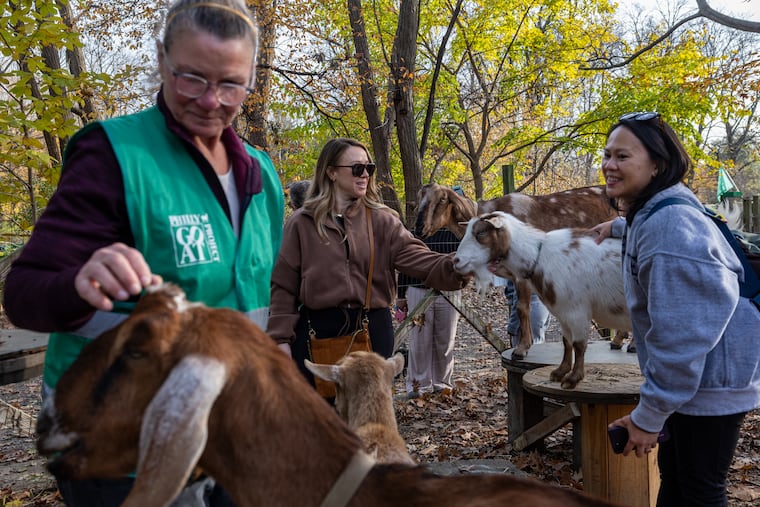
A little before noon, more than 150 people milled about near a large wooden pavilion by the entrance to Awbury Arboretum in East Germantown. They were joined by several goats.
So began the Philly Goat Project’s winter grief walk — an event meant to provide an opportunity for those who have experienced loss to process their emotions, connect with others, and, perhaps, make some new four-legged friends.
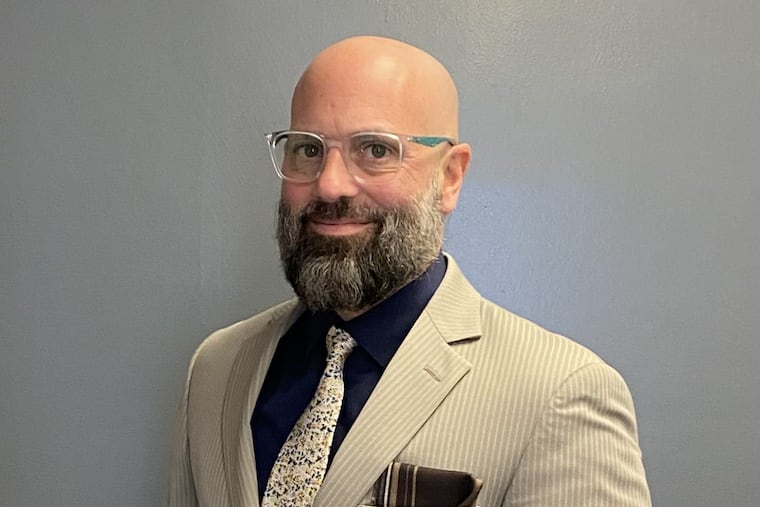
As he petted Ray, a three-legged Nubian goat whose recovery became a story in its own right, Ven Schmidt said he had come to his first grief walk Saturday after the death of his husband three weeks earlier from pancreatic cancer.
His husband, Mark “Chumley” Singer, was an events producer and activist and a well-known figure in Philadelphia’s gay community.
His therapist suggested several options for grief counseling. Schmidt, who loves animals, picked the grief walk.
He marveled at the turnout.
“When somebody dies that’s that close to you, you feel so alone,” Schmidt said. “And then when you see how many people are also going through it, you feel less alone.”
Grieving in community
Karen Krivit, a former social worker, founded the nonprofit project in 2018 with three goats she kept in her backyard in Narberth.
“As a social worker, I saw thousands of people over my 30 years, and the pervasive issue that people were struggling with was isolation,” Krivit said. “Community is foremost the thing that guides us in everything that we do.”
The organization now has 13 goats and runs several programs aimed at providing community wellness through animal therapy.
Naila Francis, a local grief coach, reached out to Krivit in early 2023 about starting the walks. The timing was right.
“There was a lot of sadness — a lot of grief — after COVID,” Krivit said. “People were really isolated.”
Francis led the first walk that November. They are held quarterly now.
“Grief is such a natural human experience, and it needs to have that connection and that sense of being witnessed and that sense of affirmation,” Francis said. “Being in community, just at its core, helps us feel less alone and less isolated in our grief.”
Goats, Krivit explained, may have a bad rap, but they are actually ideal for therapy work.
“You can walk with them and put your hand on them, and they’re very touchable,” Krivit said, repeatedly referring to the animals as versatile, “people-sized” companions for humans whose presence can bring a sense of levity to what is otherwise a heavy occasion.
The walks fill a need for grief-focused community programs, said Julie Drendall, a volunteer and board member.
“As strange as it might sound, these are my favorite of the Goat Project’s programs, because it’s just so beautiful to see people come together and to recognize how many different things people are grieving,” Drendall said.
“I think the goats can be super comforting to people,” Drendall said.
She remembered one of her first goat walks as a volunteer. A woman had taken a particular interest in Drendall’s goat. She had recently lost her father, who had grown up near the arboretum.
“She said, ‘I feel like my dad is here with me,’ and that’s beautiful,” Drendall said.
‘These people get it’
Francis opened the event with a guided meditation, encouraging attendees to “show up authentically and honestly in a culture where we don’t get enough of these spaces.”
After the meditation, Krivit led the walk alongside 7-year-old Holiday the goat, named after Billie Holiday (“Really born in Philly even though people say Baltimore”).
The mostly unpaved path runs about a quarter of a mile, and the roughly 200 attendees and volunteers ambled at a leisurely pace.
While the project does offer some accommodations for individuals with limited mobility, Krivit hopes to eventually secure funding to pave the entirety of the path.
After a short while, the group made its way to East Washington Lane. A motorist in a passing car offered the group a friendly honk and a wave.
“People will stop their cars and come out” to pet the goats, Krivit said.
After a couple more stops and guided meditations led by Francis, the group eventually made its way to the final part of the event: the grief circle — a collection of chairs and benches around a fire — and Francis invited attendees to share.
Many did.
One woman spoke about the loss of her father. Another woman told attendees how she lost her son to gun violence and then, just four months later, lost her brother.
Schmidt, too, chose to share in the circle. He found the experience cathartic and planned to bring his friend to the next one.
“It’s such a visceral thing, and it’s so hard to explain to people who don’t get it,” Schmidt said of the acute pain of losing his husband. “But these people all get it.”
Tacony resident Nyeemah Wright’s father died in February, a day after her 29th birthday. She traded numbers with a few other attendees and wanted to create “my own sort of family of people who know what it feels like, so I don’t feel so alone.”
“Being 29, I’m glad not many of my friends know what it feels like to lose a parent,” Wright said. “[But] it almost feels isolating sometimes, so I wanted to feel a sense of community, and I really got that today.”
At one point on the walk, she recalled coming across a huge, orange tree that reminded Wright of her dad.
“I just stood there for a second and I looked up at that big tree and it was beautiful, and it made me think, ‘I’m standing under him again.’”