Exonerated, then charged, Part I: How a South Philadelphia man was convicted of murder
New interviews and a review of court records show how prosecutors built their case against Jahmir Harris in a 2012 killing — and how it later unraveled.
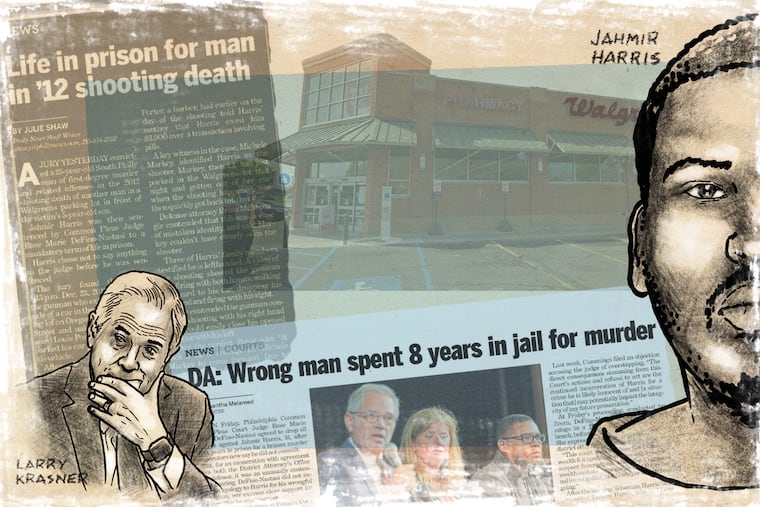

This is Part I of “Exonerated, then charged: Inside a murder case that tests Larry Krasner’s reform agenda,” a look at a prosecution at the center of the debate over how the district attorney handles wrongful convictions. Part II will publish Sunday, Nov. 29.
In 2021, District Attorney Larry Krasner announced his office was dropping murder charges against Jahmir Harris, a suspected drug dealer who had been convicted of gunning down a South Philadelphia man in a hail of 17 bullets while his 5-year-old son watched.
Harris had served eight years in prison when he was released after prosecutors in Krasner’s office determined evidence pointing to another possible suspect — evidence that might have led to a not-guilty verdict at trial — was withheld from his defense attorneys.
In announcing Harris’ release, Krasner trumpeted the work of his Conviction Integrity Unit, which he created shortly after taking office four years earlier as part of a campaign pledge to review old cases and ferret out any miscarriages of justice.
Krasner called his CIU a national model. At the time, Harris was the 19th person released from prison after the district attorney offered what is known as a concession, whereby prosecutors agree with the defense that new evidence shows a conviction was unconstitutional and move to vacate the sentence.
The number of concessions during Krasner’s tenure has grown to 75, according to the National Registry of Exonerations.
Many of the men who have been released have sued the city for the time spent in prison. So far, Philadelphia has paid out nearly $144 million to 46 men who received settlements ranging from $200,000 to nearly $13 million, according to data the law department gave me.
In August 2021, five months after his release, Harris filed a suit of his own, alleging malicious prosecution against five police officers who took part in the investigation that led to his arrest.
Fourteen months later, Harris found himself in court — not for the hearing on his lawsuit, but because he had been charged for his role in a new murder. He is currently in federal prison awaiting trial on that charge.
In recent months, as the effort by the district attorney’s office to concede cases has come under fire, Krasner’s critics point to the Harris episode as emblematic of what they say is the office’s rushed, careless, and slipshod approach to pursuing the reversals of wrongful convictions. State and federal judges have found that prosecutors have repeatedly lied and cut corners in several cases.
A federal judge disbarred one assistant district attorney in Krasner’s office, and a panel of federal judges suspended the law license of another for three years for their roles in misleading a judge while seeking to overturn the death sentence of a man convicted of killing a couple in the 1980s.
The state Supreme Court found “numerous instances of untrustworthy concessions, lack of candor, misrepresentations of fact, lack of adequate investigation, and avoidance of hearings,” and granted the state attorney general the right to intervene in any future concessions by Krasner’s office.
Another federal judge referred Krasner and a supervisor to the U.S. Attorney’s Office in Philadelphia after testimony at an evidentiary hearing this summer raised the specter of obstruction, conspiracy, and perjury.
» READ MORE: The day Larry Krasner’s office was put on trial — by his own prosecutors | Paul Davies
The fallout from that case prompted three assistant district attorneys in Krasner’s office to resign. Meanwhile, federal prosecutors reportedly have launched an inquiry and sent subpoenas to the district attorney’s office.
Krasner maintains he has done nothing wrong and the pushback is politically motivated. “There is not a jury in the world that is going to find me guilty of anything,” he said.
But amid all the legal maneuvering is the main question: Has Krasner’s stated quest to end mass incarceration helped to balance the scales of justice or resulted in the release of actual killers?
Harris’ case has not been part of the recent legal scrutiny into Krasner’s exoneration efforts. But given the deadly consequences following his release, I decided to take a closer look at what happened. While each exoneration is different, the Harris case provides a window into how Krasner’s office has gone about reversing jury convictions.
For his part, Krasner remains unapologetic about how his office has handled the matter. “Harris is likely innocent of the first murder and more than likely guilty of the second, in my view,” he wrote in response to questions I emailed to him.
Krasner added that both the police investigation and the prosecution — which he made clear occurred before he became DA — were “deeply flawed.”
But a review of the record and interviews indicates that Krasner’s office may well have let a man convicted of one murder go free, only to see him get charged with another murder.
The case against Harris
Harris’ legal trouble began two days before Christmas 2012 when Louis Porter, 45, drove to Walgreens on Oregon Avenue near 23rd Street to buy diapers for his granddaughter, while his 5-year-old son sat in the backseat.
As Porter exited his vehicle around 8:15 p.m., a second car pulled into the parking lot. The driver climbed out and fired 17 shots. Porter was struck in his left arm, hand, and head, and died several days later after being on life support.
A security guard heard Porter’s son scream: “My dad! My dad!”
Michele Markey, then 22, stopped at Walgreens to pick up photos and was getting out of her car as the gunshots were fired. She gave police a statement that night in which she described the shooter and the passenger in his car. At one point, she said the man doing the shooting told her to get back into her car “and don’t call!”
But Markey called 911. After police learned about an earlier beef between Porter and Harris over a drug deal, Markey met with the detectives the day after Christmas and identified Harris from an eight-person photo array. In June 2013, she picked Harris from a live lineup.
Security video captured the incident, but the shooter’s face was not clearly visible. Based on Markey’s identification and other information police gathered, Harris was charged with Porter’s murder.
Harris was represented by Brian McMonagle, a top defense attorney in Philadelphia who did not respond to a request to discuss the case.
The transcript from Harris’ six-day trial was sealed after he was exonerated under Pennsylvania’s Clean Slate Law, but a source provided me access to the more than 700 pages of testimony, as well as several filings from his post-conviction appeals.
Reviewing the transcript highlighted the messiness that often surrounds murder cases. But it was also maddening. On the one hand, police failed to pursue the second suspect before charging Harris.
But Krasner’s office also never questioned the other man before moving to undo Harris’ conviction. While Krasner’s office used the evidence that linked another suspect to the crime to bolster its decision to release Harris, the evidence against him remained strong.
If anything, some of the details gathered by investigators — but not presented to the jury — made the case against Harris overwhelming. Namely, in the middle of the trial, Harris agreed to take a lie-detector test, which was conducted at the DA’s office.
Harris failed the test.
“The defendant failed that test and it was determined he was deceptive about his claim of innocence in this case,” former Assistant District Attorney Erin Boyle, who handled the prosecution, informed the judge.
During the opening argument, McMonagle’s main defense was that the case against Harris involved a “horrible mistaken identity.” He seized on a detail in which Markey told police that “two Black males were shooting at a parked car.” But the video only showed one shooter.
“I have no axe to grind against Miss Markey,” McMonagle said in his opening statement. “I can only tell you she ain’t right.”
A main defense argument was that the case against Harris involved a “horrible mistaken identity.”
Meanwhile, Boyle connected Harris to the victim and provided a motive. She told the jurors Harris and Porter knew each other from growing up in the same South Philadelphia neighborhood. Their families were friends. Harris sold Porter fake pain pills for $3,900. Porter, who worked at a barbershop, resold them and was apparently dealing with unhappy buyers.
The case largely rested on the credibility of Markey, who had several years of experience working in security at a university, as the main eyewitness. In her statement to police, she referenced two Black males and said “they” were shooting and “they” got back in the car.
But when Markey testified, she clarified that there was only one shooter. She said her use of “they” stemmed from the fact that a second man was a passenger in the car. That man was never identified or questioned.
But other details supported what Markey witnessed. In her 911 call that was played in court, Markey told the dispatcher there was one shooter. She also gave a description of the car and a partial license plate number.
Markey told police she was about 10 feet away from the shooter and that the shots were so close she could feel them. Markey described the shooter as “dark-skinned, really big, he was very tall and had a very large build; not fat” and the passenger as “medium complexion” and “smaller than the driver.”
A second witness, who did not testify at the trial, told police the shooter was “a heavy-set Black male” between 5-foot-9 and 5-foot-10. But that witness was unable to make an identification from the photo array presented by Philadelphia police detectives.
For his part, Harris told police he is 6-foot-3 and weighed 350 pounds. (The other potential suspect Krasner’s office later pointed to is 5-foot-8 and 285 pounds.)
When Boyle asked Markey if the shooter was in the courtroom, she said yes and pointed to Harris.
Boyle called Harris’ mother, Tammy, then 45, who detailed her family’s ties to Porter. She told jurors she and the victim grew up together in South Philadelphia and were friends. She added she was also lifelong friends with Porter’s sister, Yvonne.
Tammy Harris explained that Porter had been trying to contact her, so she went to see him at his barbershop. He explained that her son had sold him fake pain pills, which he resold. Porter told Tammy he needed $3,900 to repay the buyer because his “life was threatened.”
Harris’ mom offered to try to get the money. But that night Porter was shot.
Porter’s sister, Yvonne, called Tammy and said her brother had been shot and she was on her way to the hospital. Harris’ mom gave confusing and conflicting testimony in court and to police regarding the conversations with her son.
Tammy testified she spoke with her son before the shooting, and he told her he didn’t owe Porter any money. After learning about the shooting from Yvonne, she said, she tried to call her son, but he didn’t answer.
Boyle asked Tammy why her first call upon learning about the shooting was to her son.
“I’m calling to see what was going on with him to confirm,” she said.
“To confirm what?” Boyle asked.
“To confirm what [Porter’s sister] said, he got shot, whatever was going on,” Tammy Harris said.
Boyle asked if she called her son to ask if he shot Porter.
Harris’ mom said, “No.”
Tammy Harris testified that she didn’t see her son until a few days after Christmas. She said he told her he didn’t owe Porter any money and didn’t know anything about the shooting. But in an earlier statement to police, she said that, when she asked her son about the events, he was “real vague.”
During cross-examination, McMonagle showed cell phone records that indicated two cell phones used by Harris were not at the crime scene at the time of the shooting. McMonagle used the records to argue that Harris’ mom was on a call with her son when the shooting took place at 8:16 p.m.
McMonagle: “You were on the phone with your son for about 10 minutes on the night of the incident on December the 23rd between 8:09:18 until 8:20:31, weren’t you?”
“Yes,” Tammy Harris said.
That would appear to offer Harris a strong alibi. But when Boyle pressed his mom on this point, it became less convincing.
“Miss Harris, did you ever tell police [or] the DA’s office that you were on the phone with your son at the time of the murder that he is being charged with committing?”
“No,” Harris’ mom answered.
Cell phone records that indicated two phones used by Harris — were not at the crime scene at the time of the shooting.
In fact, in her statement to police, Tammy Harris said that, after learning Porter was shot, she tried to call her son, but he did not answer.
A police detective who specializes in cell phone technology was called to state the obvious: The records did not show who was in possession of the phones when the calls were made.
Harris’ mom also told McMonagle her son was left-handed, but the video of the incident showed the shooter fired the gun with his right hand.
Porter’s sister, Yvonne, then 41, told jurors she called Tammy Harris immediately after learning her brother had been shot. She also testified that after watching a video of the shooting — which was shown on the local news and was posted on YouTube — she called Harris’ mom again.
But the judge did not allow jurors to hear what they discussed. I contacted Yvonne Porter, who has since moved out of the state, and she told me about her call to Harris’ mom, who was her friend.
“I told her, ‘I know and you know that’s your son on the video,’” she told me.
The judge also did not allow jurors to hear what Yvonne had told police about Jahmir Harris, whose nickname is Mirzy. “On [Dec. 24, 2012], I watched the shooting of my brother on YouTube,” she told police. “I immediately believed it to be Mirzy shooting at my brother.”
When I spoke to Yvonne, she was emphatic about what she told police.
“I said, ‘That’s Mirzy, that’s Mirzy,’” Yvonne said. “When I seen him on that video, I knew exactly who it was. I’ve known him since he was a baby. I could tell by the way he walks because he has a bum leg from getting shot.”
Yvonne said she believed Harris was the shooter because the person in the video matched his build and had a distinctive walk from the prior shooting incident.
Jurors also didn’t hear two other compelling pieces of evidence.
In January 2013, roughly one month after the shooting, the Philadelphia Police Department tip line received a call from a man who provided his name and phone number. The caller identified Harris as the shooter and gave a description of his height and weight.
Harris was left-handed, but the video of the incident showed the shooter fired the gun with his right hand.
On March 15, 2013, detectives interviewed a man who knew Porter and Harris. He said Harris told him he had sold fake pills to Porter, but denied having anything to do with the shooting. When detectives showed the man the video from the shooting, he said: “The person shooting the gun looks like Mirzy. I can’t really see his face, but he’s the same size and walks like him.”
The next day, police charged Harris with the murder.
During closing arguments, McMonagle reemphasized the prosecutors had the wrong guy. He said the phone records indicated Harris was not at the crime scene — but added a big if.
“If the defendant had either one of his phones … he wasn’t at the crime scene at the time of the shooting,” McMonagle said.
He also wondered why investigators didn’t look for the person Porter owed money to.
“You get the pills. You move the pills. Who did [Porter] owe for those pills?” McMonagle asked the jury. “We will never know because there wasn’t one single piece of investigation done into this crime whatsoever.”
During her closing, Boyle played the video for the jurors again and walked them through what Markey saw. She reminded the jurors that Markey identified Harris through the photo array, the live lineup, at the preliminary hearing and at the trial.
Boyle also addressed the issue of whether Markey said there were one or two shooters. “She explained from the beginning and says, ‘Look, I am talking about the car. I am talking about them as they … They are the shooters, one actual shooter but I see them together as one, as a joint enterprise.’”
Boyle added that Markey told the 911 operator there was one shooter. Boyle told the jurors that despite any confusion, common sense indicates Markey got it right.
“If she made a mistake and this is not the right person, well, you know, the person that she picked out probably would have been somebody who was not from South Philadelphia, and didn’t grow up in that neighborhood, and didn’t know the victim, and didn’t have a beef with the victim … but that is not the case here.”
Boyle then used the testimony from Harris’ mom to bolster the case. Boyle pointed out that when Porter said her son “burnt” him on the pill transaction and owed him money, Harris’ mom did not push back.
“Does she say, ‘No, not my son’?” Boyle asked the jurors.
Boyle also raised doubt regarding Harris’ alibi that he was on the phone with his mom at the time of the killing — a detail that first emerged at the trial.
“Yesterday was the first day that she has ever told anybody that she was on the phone with her son,” Boyle said. “Look if they are talking, he knows it and she knows it. He was arrested [two years ago]. All this time no one has been like, hey, we were on the phone together.”
Boyle added that many details pointed to Harris: “Out of the billions and billions of people that could have been identified as being the shooter … the person that Miss Markey picked out is [Harris]. And he just so happens to live a few blocks from the shooting. He just so happens to live a block away from the victim. He just so happens to match exactly the person’s build that we see … on this video. It just so happens that he is in the middle of a beef over money with the victim. It just so happens that he disappears for a few days right around the holidays and misses Christmas with his family and completely disconnects from his mother for about five days. It just so happens that when he suddenly turns up and he is asked by his mother whether or not he killed somebody, he gives a vague answer.”
The jury deliberated for a day and a half. On Monday, Jan. 12, 2015, the jury found Harris, then 25, guilty of first-degree murder as well as conspiracy and other gun charges.
That same day, Common Pleas Judge Rose Marie DeFino-Nastasi sentenced Harris to life without parole. In her written opinion upholding the verdict, the judge found the “evidence of guilt was overwhelming.”
About our columnists
In contrast to news reporters, who operate within an independent, nonpartisan framework, columnists are charged with including their perspectives, opinions, and viewpoints when presenting their reporting. Inquirer columnists include Jenice Armstrong, Will Bunch, Luis F. Carrasco, Paul Davies, Daniel Pearson, Trudy Rubin, and Sabrina Vourvoulias.