A workforce training program at Congreso de Latinos Unidos helps students build economic self-sufficiency | Philly Gives
In any given year, 250 students are enrolled in Congreso’s many workforce development programs, part of an array of offerings meant to promote financial well-being.


About Philly Gives

Luckily, Janice Roman and Jonathan Perez have each other.
And luckily for them, they both have Congreso de Latinos Unidos.
Because after years of bouncing around, doing about almost any job to make ends meet (and sometimes barely succeeding), they are embarking on what will be a new life for them and their four children.
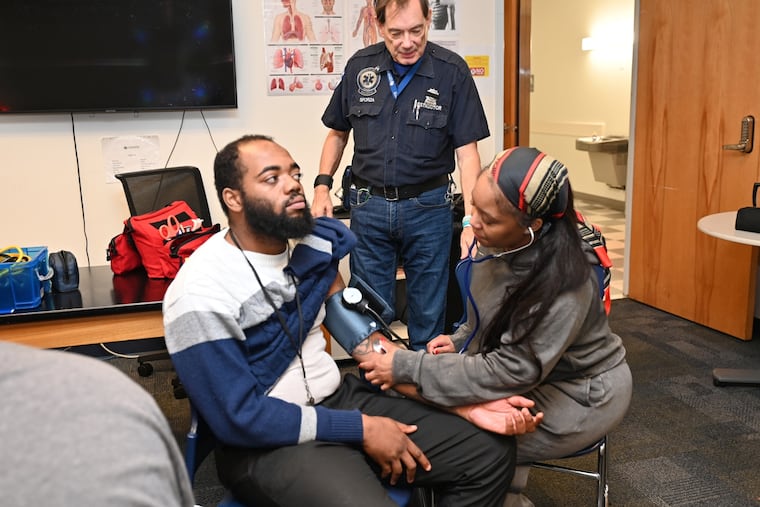
Roman began EMT training at Congreso in late October. Perez is enrolled in Congreso’s commercial driver’s license (CDL) training. Beyond that, both of them have joined Congreso’s program for first-time homebuyers.
“It will be a major step,” Roman said. “It’s exciting and, at the same time, a little scary — going back to study and being around people.
“We’re looking forward to everything.”
In any given year, 250 students are enrolled in Congreso’s many workforce development programs, part of an array of offerings from family services to educational and cultural programs, all meant to build economic self-sufficiency and well-being.
Aspiring truck drivers, emergency medical technicians, childcare development associates, medical assistants, sterile processors, and dental assistants come to Congreso’s North Philadelphia headquarters to learn what they need to launch careers and boost themselves out of poverty. If they didn’t graduate from high school, they can study for their high school equivalency diplomas, as well.

Help Support This Work

But there’s something Kimberly Cromer, director of Congreso’s workforce initiatives, wants donors to know.
At Congreso, she said, it’s not just about the classes and the certificates, although, of course, those are important.
“This is workforce training with a human-centered learning management approach,” she said. “We want to humanize the experience. We assess what else is going on in their lives.”
Some come to the classroom facing evictions. Some are about to lose electricity, or heat, or water. “We need to alleviate those barriers so they can concentrate on school,” Cromer said.
Flexible funding from the William Penn Foundation allows Congreso to help with a rental payment or a utility bill, or to hand out gift cards for groceries and gas. Almost every course includes a session on credit repair taught by a financial counselor. Some students have experienced domestic violence. Congreso will get them counseling, help them move to a safer place, and also will teach students in the various programs how to recognize signs of domestic abuse.
The people Congreso serves “are used to empty promises and lip service,” Cromer said. “We need to restore their faith in humanity by offering them empathy and compassion so this place can be a beacon of hope. It’s important to be that hope for them.”
Hope is what Roman was experiencing on her first day of EMT class. “I grew up in a low, low-income family,” she said. “We had to struggle on a daily basis to pay bills.” Alcoholism and abuse were part of her childhood. She dropped out of high school. Perez’s situation was similar, she said.
Neither of them had the strong family support that might have helped them in their early years, as they both worked odd jobs to cobble together the money they needed for themselves and their kids.
“I’m trying to give my kids a different environment,” Roman said. “I want them to have everything I didn’t have.”
Their teacher understands. Tina McKee, a newly retired fire department paramedic who has taught these kinds of courses for years, grew up in the neighborhood where Congreso is based. “I was born and raised on welfare,” she said. Four kids and a divorce meant just scraping by, like many of her students.
So when her students pass what really amounts to an early step on a medical career ladder, she can see what they may not be able to envision — a stable life with stable employment, a stable paycheck, and a future. “I have had students that are now doctors,” she said.
It’s the vision thing that has engaged Abraham Medina, a former White House medical officer and military medic who grew up in Congreso’s neighborhood and now serves on the organization’s board. He’s been instrumental in encouraging Congreso to embark on the EMT program, which was officially government-certified in September.
“Most of my childhood friends are in jail or have passed away from gun violence and drugs,” he said. A high school dropout, Medina eventually joined the Army, excited about the idea of parachuting out of airplanes. But the recruiter suggested he undergo training as a medic — a medic who could also jump out of airplanes. Medina took the qualifying test and scored high.

Make Your Year-End Gift

“I never imagined myself that I could be in the medical profession,” he said. “That was probably the first time that I saw I had some potential myself, that I had some smarts.”
When Medina looks around, he sees others like him — high school dropouts who just can’t envision themselves as people in the medical profession. Because of that one moment of clarity during recruiting, he took training after training and kept advancing. And it’s that kind of career ladder he wants for the people at Congreso.
“There’s a lot of potential here that we don’t tap into,” he said.
Congreso’s EMT program partners with local employers so graduates can typically get jobs as soon as they are finished, provided they pass a national certifying exam.
The program includes many certifications such as the Emergency Vehicle Operator Certificate, which qualifies them to drive an ambulance, and training on the Incident Command System, which is a national disaster management communications protocol, said Tim Hinchcliff, Congreso’s consultant for emergency medical programs.
The training includes a visit to the Philadelphia Medical Examiner’s Office, where students can witness an autopsy. They experience clinical practice in hospitals and on ambulances on all shifts.
It can be daunting, said Saul Garcia Robles, who finished Congreso’s first EMT cohort under the government certification. Like some of the others, he dropped out of high school, in his case frightened by gang violence and deeply depressed because of struggles in his family.
Eventually, though, through church, he came out of it. He earned his high school equivalency diploma at Congreso before joining the EMT program. He came back to Congreso as a motivational speaker for the second cohort of EMT students on their first day of classes.
“Time flies. If you don’t do it now, when is it going to happen?” he said, saying that years passed with work that was going nowhere and was too physically demanding. He had to make changes for his wife and two daughters.
So he urged the students to persevere even when the coursework is challenging. Even if they want to give up, just come back for one more day, day after day, he advised.
“You might be going through a lot of issues like I was,” Garcia Robles said.
But, he said, “put that aside right now. Focus on your future, because your family needs you.”
About Congreso de Latinos Unidos
Mission: To enable individuals and families in predominantly Latino neighborhoods to achieve economic self-sufficiency and well-being.
People served: 14,005 unique clients served in fiscal year 2026
Annual Spend: $31 million
Point of Pride: Congreso has been named a Top Workplace for seven consecutive years by The Inquirer. The organization is also home to a trademarked Primary Client Model that drives Congreso’s bilingual and bicultural approach to delivering services in a client-centered, data-informed, and culturally appreciative way, whether a community member is receiving support in education, workforce development, housing, health, or family services.
You can help: Become a monthly donor or a volunteer in the Congreso Cares Program. Volunteers help by participating in program initiatives like Congreso’s free tax preparation, toy drives, back-to-school, and agency events.
To get help: 215-763-8870
What your Congreso donation can do:
$25 can help provide food baskets to individuals living with HIV.
$50 can help cover past-due utility bills and prevent shutoffs for a family to stay safe in their home.
$100 covers an immunization visit at the Congreso Health Center for a child entering the school system.
$200 provides a new uniform or professional wardrobe for a community member entering the workforce.
$250 provides a semester of after-school programming for a high school student.
About guest essays
Guest essays, or op-eds, are commentary pieces that present the opinion or perspective of the author. Many are submitted to us by Inquirer readers and writers with insight on the news, but we also solicit op-eds from authors on specific topics. For more information visit our guidelines.