Are the secrets to a Trump postelection coup locked in a White House safe?
What two ex-high-ranking U.S. government officials fear about a presidential emergency should terrify all Americans.

Americans have a lot of questions these days, and not just about how the Eagles botched Jalen Hurts’ blood clot, or when are the showtimes for that new Elizabeth Holmes movie. No, the No. 1 thing I hear about from folks are their fears about what Donald Trump might do if, and almost certainly when, Democrats gain power in November’s midterms.
It’s hard to get answers from a mainstream media that struggles to describe what’s happening in real time, let alone speculate about our nation’s very uncertain future.
But two former high-ranking government officials — with experience going all the way back to the Jimmy Carter administration — have devoted themselves to warning the public about the vast emergency powers that the White House has accrued in the nuclear age, and urging citizens to be prepared for the worst.
“It’s hard to educate people,” Joel McCleary, who was a special assistant to Carter and a top official at the Democratic National Committee before becoming a consultant, told me last week. “They don’t want to go into that negative space and contemplate all of this.”
“All of this” — in essence, the emergency powers that a rogue president could invoke to override Congress, the courts, and the will of the people — has been the subject of a run of articles by McCleary and his co-author, Mark Medish, a former White House aide under Bill Clinton and top official on the National Security Council.
Their most recent piece in a series they call “Dancing in the Dark” — “It’s the Power, Stupid” — appeared in the Washington Spectator in August, and while it didn’t get much attention at the time, I would urge every voter who is concerned about election interference by Trump to read it.
Their newest article builds on their earlier work to stress that Trump looks increasingly backed into a corner, because a Democratic Congress would threaten the only two things that matter to the 47th president — his own unimpeded power as a personalist strongman ruler, and his ability to amass incredible wealth.
It leads off with a quote from former White House aide and Trump whisperer Steve Bannon, who said in a July interview, “The president will do it” — meaning invoke his extraordinary emergency powers. “The predicate is being laid perfectly.”
The ensuing article from McCleary and Medish does the best job I’ve seen so far in spelling out exactly what “it” could be when it comes to those extraordinary powers in the toolbox of a commander-in-chief.
They run through all of the predicate — to use Bannon’s word — that Trump has laid since beginning his second term with much greater direct control over key agencies like the Pentagon, the FBI and the Justice Department. These include the GOP-led gerrymandering, the push to scrub state’s voter rolls, the unsupported “China election fraud” speech, the Georgia raid on 2020 voting records, federal election monitors, and growing fears about deploying immigration agents or troops at polling places.
Medish and McCleary also focus on another predicate that hasn’t received enough attention: The National Security Presidential Memorandum 7 (NSPM-7) that Trump signed in September 2025 aiming to bring the full force of the federal government down on leftists it defined as “anti-Americanism, anti-capitalism, and anti-Christianity …”
That’s a lot of predicate, but how could an aggrieved president apply it? The authors noted that more than two centuries of law have given the White House extraordinary powers, including the ability to send out troops into American cities under the Insurrection Act of 1807 and, theoretically, shut down the internet by invoking the federal Communications Act of 1934. And while the logistics are tricky, GOP leaders on Capitol Hill could also work with the White House to try to stop the certification and swearing-in of some elected Democrats on Jan. 3, 2027.
But the most frightening presidential powers are the ones that neither you nor I nor Medish and McCleary have seen — the so-called Presidential Emergency Action Documents (PEADs) that, according to some reports, are kept locked inside a White House safe. These were created mainly to ensure continuity of government in the event of a highly destructive nuclear war, but the authors are rightly worried that a panicked Trump could apply these to a domestic crisis — real or invented.
There are believed to be as many as 56 PEADs that have never been seen by the American people, the authors noted, and they apply to such matters as “suspension of habeas corpus, martial law, censorship, the detention of citizens ‘considered dangerous,’ [and] the seizure of property and communications.”
They add:
“A TIME investigation in 2024 described the physical object: a book of drafts kept in a safe on the White House grounds, some with blanks left for the date and the circumstances; the career official who kept it called it ‘the Mad Libs for the most extreme measures of government,’ and added: ‘[Trump]’s going to be surrounded by a set of people that would say, ”You have the power to do this.“ Frankly, if he says, ”Yes,“ and there are people that say go do it, what’s to stop him?’”
» READ MORE: We need to find the words for Trump’s madness before things blow up | Will Bunch
Yes, this is the real question before the United States right now. What is to stop the president from playing dictatorial Mad Libs? I would argue that it increasingly looks like there’s no reason why the president who already attempted one type of coup on Jan. 6, 2021, wouldn’t try a more forceful one this time.
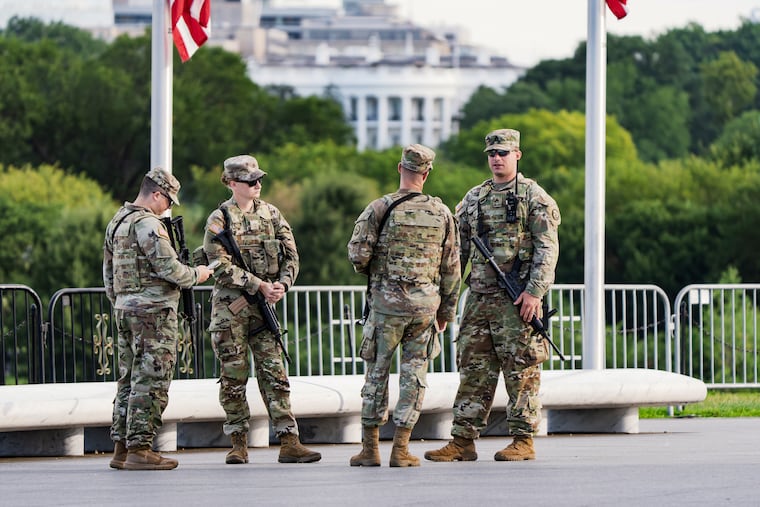
If anything, the Trump regime’s efforts to establish a predicate for election interference have dramatically accelerated in recent days, from official efforts to make the demonstrably false case that states such as California have noncitizens on their voting rolls, to stationing National Guard troops at ballot drop-off locations in Washington, D.C., to get voters used to the idea. And why the purge of so many free-thinking generals and admirals, replaced with Trump loyalists?
The shocking raid against Minnesota U.S. Rep. Ilhan Omar and reported probe into her citizenship status certainly looks like an effort to establish a predicate for challenging the election of certain Democrats. Likewise, the White House’s dramatic tilt toward Moscow and against Kyiv in the ongoing Ukraine war — defying the will of Congress and U.S. public opinion — makes more sense when you remember that Russia has also repeatedly sought to interfere in our elections on Trump’s side.
All of this from an 80-year-old president who seems increasingly mindful of his ever-closer mortality, and who also seems determined to remind all of us with his rambling, unhinged speeches. Although a trivial matter when compared with the fate of American democracy, Trump’s ability to go around his more grounded top aides to hire wildly unqualified press-secretary-for-five-days Katie Zacharia revealed a president who’s already doing whatever he wants, with no adults in the room.
The figures like Mike Pence, William Barr, or Mark Milley who — whatever their other flaws — resisted Trump’s first coup efforts in 2020-21 are long gone. Today, Trump listens to apocalyptic top advisers like Stephen Miller, has one election denier, Heather Honey, as the elections point person in the Department of Homeland Security, and has met with another in Colorado’s Tina Peters.
McCleary and Medish argue that mainstream journalists make a big mistake when they try to judge Trump’s moves on matters from Ukraine policy to tariffs as anything other than tactics that serve the only thing that matters to him: amassing, and holding onto, power.
“For the first time,” they write, “we are governed by a President who cannot afford to become a private citizen again — and who has, in the [Supreme Court’s presidential] immunity ruling, the pardon power, and the machinery … the means to insure he never has to again” risk the consequences of leaving office.
Of course, the knowledge of the president’s extraordinary powers doesn’t answer the most important question: What can be done to stop a Trump-led coup from taking place?
The first step is simply for people to understand that it — a serious effort to end American democracy as we know it — can happen here. Certainly, pro-democracy advocates, grassroots movements like the No Kings protests, and leaders of the Democratic Party are doing more than ever before in preparing election observers and legal responses.
But will that be enough to stop a president who seems increasingly likely to attempt a coup with the stroke of a pen? Even a right-leaning Supreme Court might be inclined to block a presidential emergency declared on specious or fictitious grounds. But if Trump is willing to defy the results of an election, why would he listen to the courts?
It was just a couple of years ago that a democratically elected president of South Korea with dim political prospects sought to declare martial law, and was thwarted by a huge throng of citizens surrounding the capital in Seoul. Could Americans, inculcated to faith in elections with a peaceful transfer of power, act en masse, and at great personal risk, to save our 250-year-old democracy?
The idea is unthinkable, but so are the questions raised by McCleary and Medish.
It’s time to start thinking.
» READ MORE: SIGN UP: The Will Bunch Newsletter
About our columnists
In contrast to news reporters, who operate within an independent, nonpartisan framework, columnists are charged with including their perspectives, opinions, and viewpoints when presenting their reporting. Inquirer columnists include Jenice Armstrong, Will Bunch, Luis F. Carrasco, Paul Davies, Daniel Pearson, Trudy Rubin, and Sabrina Vourvoulias.