Rowan University is ending its 40-year MLK Day breakfast in a cost-cutting move
The goal is to save money. Some community members were unhappy.
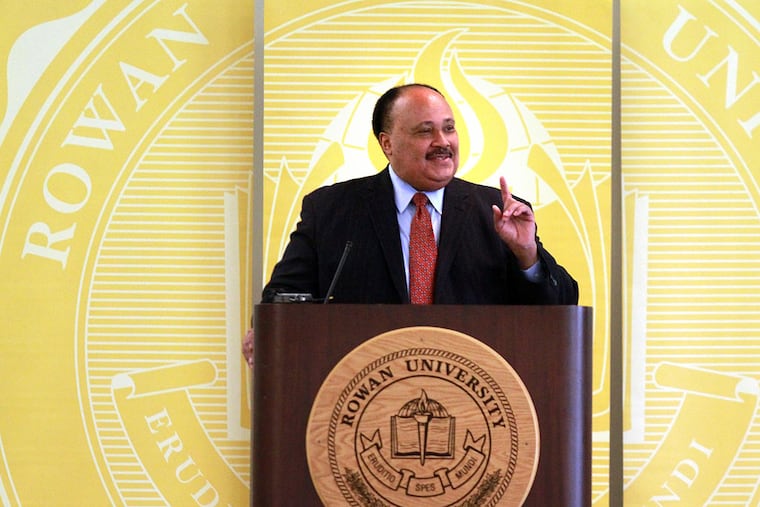
For the last 40 years, Rowan University has celebrated Martin Luther King Jr. Day with an annual breakfast and speeches by the country’s leading civil rights leaders. It once included King’s son, Martin Luther King III.
But in a cost-cutting measure, the public university is ending its breakfast tradition, said Joe Cardona, a university spokesperson. Some Black community members who have long attended the breakfast say the change is a loss.
The breakfast is one of several cuts the university is making to prepare for a future with a potential shrinking student body and tighter budgets, Cardona said. Other “internal and external events” were also scaled back, he said, but did not name them.
“We’re looking at expenses because we don’t know what’s going to happen tomorrow,” Cardona said. “We see a decline in the next 15 years of the amount of students coming to higher education. … What are the things we need to do now to prepare ourselves for the future? The breakfast fell into that category.”
Last year, the breakfast cost $79,600, Cardona said, and made about $53,300. The university was responsible for filling the gap, with various college departments volunteering money to help out.
It has also been harder to recruit recognizable names for the breakfast, especially people affiliated with King, which has hurt attendance.
Last year, 259 people attended the breakfast, Cardona said, fewer than in prior years, and 70 of those tickets went to students for free. When comedian and actor Dick Gregory spoke in 2004, 400 people were there to listen, The Inquirer reported at the time.
Tickets for the breakfast, $75 each, went toward the William H. Myers scholarship endowment fund, which supports high-achieving students. Myers, who died in 2003, was assistant dean of students, a mentor for numerous student groups and student leadership programs, and a recipient of Rowan’s Joseph A. Barnes Award, a recognition for outstanding service to the college.
“We were passing the hat around the college more than in the past just to make ends meet and keep money flowing to the scholarship fund,” Cardona said.
Instead of the breakfast, Rowan, which has an $814 million budget for 2026, will host community service events on the Saturday after the holiday. The university will ask corporate donors to support the Myers scholarship fund, including the breakfast’s longstanding sponsors, PSE&G and Atlantic City Electric.
The school announced the change in a September email. The Rowan University Black Alumni Network, one of Rowan’s largest affinity groups, was not notified in advance, which Cardona said led to an influx of messages to university administration.
Jeannine Frisby LaRue, an activist, Rowan alumna, and chair of the university’s Education Advisory Board, said she understands that the school is under financial pressure, but she wishes that the university had notified Black alumni well in advance.
Now, LaRue said she and others want to host their own Gloucester County King breakfast with more affordable, local speakers. She said she would pitch in $5,000 to get them started.
“I believe there will be an event in January,” LaRue said. “We have 60 days to make a tradition, to find other donors.”
‘The spirit of Dr. King’
The Rev. Keith Dickens, who retired from Rowan’s admissions department in 2025, helped lead the breakfast for more than two decades.
Dickens remembers securing Civil Rights Movement legends — the Rev. Walter Fauntroy, entertainer and activist Harry Belafonte, and lawyer Clarence B. Jones, King’s friend and draft speech writer — to speak to the hundreds who would attend the breakfast.
Rowan’s breakfast was one of the best King celebrations in the country, Dickens said, adding that it provided an opportunity to hear stories from people who knew King, like Fred Shuttlesworth, who had invited King to Birmingham, Ala., in 1963, and Gregory, an activist who confronted racism with his comedy.
“People are not paying $75 for shrimp and grits. They’re paying $75 to see Dick Gregory, Martin Luther King III,” Dickens said. “They wanted to be able to feel the spirit of Dr. King and be inspired and encouraged to continue their work.”
Community service is not new to Rowan’s annual King celebrations. In recent years, service activities have immediately followed the breakfast, but Cardona said Rowan struggled to get people to show up because many students leave campus for the long weekend. He hopes moving the community service event to the following weekend will boost attendance.
Dickens said while service events play an important role, they should not be the only acknowledgment of King.
“It’s not an ‘either-or.’ It’s a ‘both-and.’ Dr. King was about word and deed,” Dickens said. “I don’t want to throw that out the window, but people can do good things without Dr. King.”
Hopes for the future
Edith Myers Spearman, the sister of William Myers, whose name is on the scholarship fund, said her main hope is preserving her brother’s legacy.
“I’m sorry to see any celebrations change, but … I know things are changing financially, and I’m cognizant of that. It’s their decision,” said Spearman, who graduated from Rowan in 1972 when it was Glassboro State College.
The scholarship fund currently has $175,000 in it, and the fund continues to grow through investments every year, Cardona said. Rowan spends 4.5% of the fund annually for scholarships.
Cardona said the school should have no problem giving out the scholarship “in perpetuity.”
For some, the breakfast was about more than raising money.
Loretta Winters, president of the Gloucester County NAACP, has not gone to Rowan on the holiday in recent years because she volunteers at Habitat for Humanity, collecting bags of winter clothes and dropping them off at local shelters.
But she said South Jersey needs events that keep history alive and offer a sentiment of inclusion.
“You have to find somewhere to cut, but it’s sad that they’re cutting things under the umbrella of diversity, equity, and inclusion,” Winters said.
Winters said she hopes Rowan includes local activists like herself in ongoing conversations about what a day of service in Gloucester County should look like.
“I’m anxious to find out what they’re doing,” Winters said, “and I would love to be a part of it.”

Inquirer South Jersey