This South Jersey principal made chess a mandatory class for middle schoolers
It first started as an extracurricular activity for sixth graders at Benjamin Banneker Preparatory Charter School during recess.
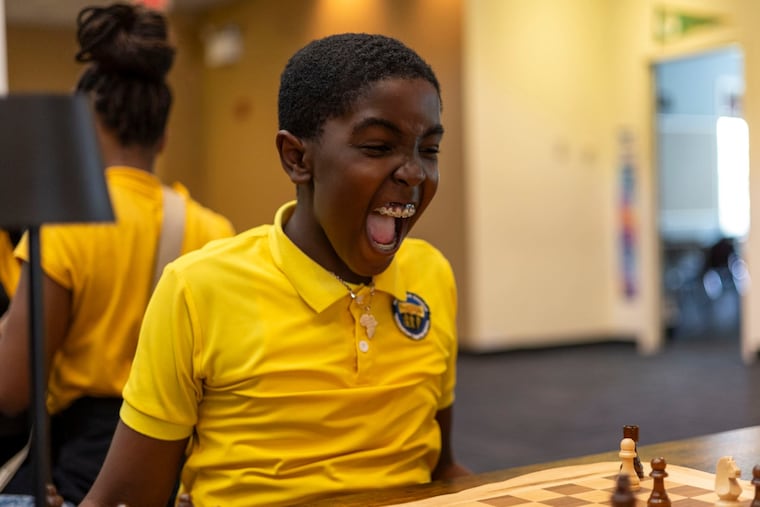
Twice a week, sixth graders at both campuses of the Benjamin Banneker Preparatory Charter School take a break from their regular classes to play chess.
Learning chess is a new requirement this fall for middle schoolers at the South Jersey school, which has campuses in Westampton and Willingboro. By the end of the school year, all sixth graders must know how to play.
Principal Richard L. Wilson Jr. incorporated chess into the school day to foster critical thinking and ultimately, he hopes, to improve test scores, too.
“I just want them to be excited about playing chess,” said Wilson, who opened the school in 2007 with his wife, Stacey. “Anything to get them enthused.”
Banneker students have struggled academically, although they have fared slightly better on state standardized tests than some of their counterparts in traditional public schools.
For the 2024-25 school year, 37.5% of the school’s students were proficient in language arts, and about 16.4% were proficient in math. The state averages for public schools during the same time period were 53% proficiency for language arts and 42% for math.
In addition to adding the chess program, Wilson said, the school has offered tutoring before and after school, beefed up its curriculum, and hired more specialists to improve student achievement.
Wilson got the idea for a chess program from a private school in North Jersey. At Banneker, it began as an extracurricular activity for sixth graders during recess.
It became so popular that students were opting to skip recess to play chess, Wilson said. Other grades wanted to learn, so Wilson opened an afterschool program and invited seventh and eighth graders, too.
“They love the chess program,” said Kourtney Bridges, director of the school’s Westampton campus. “They really get into it.”
On a Thursday morning in September, a group of sixth graders were brought to an atrium where about a dozen chessboards were set up on wooden tables.
Each student paired up with a classmate and started a game. They received instructions in class on chess etiquette, the board pieces, terminology, and strategic moves. Some were skilled players, while others were beginners.
“You can learn a lot from it, like patience. It also helps you become more strategic,” said Arianna Sucki, 11. “It just feels good.”
Wilson said chess not only helps students with math, but also teaches other skills like problem-solving, good sportsmanship, respect, and discipline, and it boosts confidence. He credits chess for a sharp decline in disciplinary incidents last year.
There was little talking as the students concentrated on their moves, heads bent as they looked intensely at their boards. Chess coach Joseph Lurie offered assistance and a lesson when they ran into difficulty.
“Is it checkmate or a stalemate?” Lurie asked Avery Jackson when he found himself with only one piece remaining, his king.
Avery and Ayden Charli-Comb, both 11, shook hands and started a new game.
“That was a good game. It was fun,” Avery said. “I love it.”
Wilson said the students will spend several months learning chess basics through www.chesskid.com, mainly how the pieces move and how to set up the board. Eventually, a timer will be added for moves.
There is no grade for the class, Wilson said. Teachers will monitor students’ skill level to see if they are catching on, he said.
Wilson occasionally sits in on a game. The students jump at a chance to try beating the principal. He has a waiting list of opponents. On the rare times that Wilson loses, the student’s name is announced on the public announcement system.
“It gives me an opportunity to bond with them,” Wilson said.
Students also have the option to participate in a chess tournament at the end of the year. Besides bragging rights, the winner gets a trophy and a $300 cash prize.
The school is among only a handful of charter schools in New Jersey located outside urban districts like Camden, Newark, and Trenton, where parents seeking other options for their children have fled traditional public schools. It enrolls 360 students.
It is named for Benjamin Banneker, son of a once-enslaved man, who was a self-educated astronomer and mathematician and a civil rights activist. The school focuses on math and science.
Wilson refers to the students as scholars. Every classroom is named for a college or university — meant to place the students in the mindset to pursue higher education.
» READ MORE: Backgammon clubs in Philadelphia are on life support. This Gen Zer wants to change that.

Inquirer South Jersey