In 1976, famous artists were asked what independence meant. The answers endure.
Lasting art can both question and honor the nation.
Like the Bicentennial 50 years ago, the nation’s 250th birthday arrived during a time of public distrust and political division. Here in Philadelphia, the National Park Service was forced by the Trump administration to remove panels about the people George Washington enslaved at the President’s House Site, over the objections of the city and advocacy groups.
Yet the desire to find meaning in the anniversary has not disappeared, with artists and institutions using the semiquincentennial to ask what the country’s ideals mean for Americans who the founders did not have in mind. For example, Mural Arts Philadelphia asked more than 1,000 residents “What does freedom require today?,” and their answers went on view at the Free Library this spring in the exhibition “Printmaking by the People: Posters for a Reimagined Declaration of Independence.”
That project has a precedent in 1975, when Lorillard, the maker of Kent cigarettes, invited 12 prominent American artists to answer a single prompt: “What does independence mean to me?” The company issued the results in an edition of 125 and donated the sets of prints, known as the “Kent Bicentennial Portfolio: Spirit of Independence,” to nearly 100 American museums. Most of the prints have been in storage for decades. But this year, museums from Juneau to Orlando have brought them out again, and some of the portfolio can be seen close to home at the New Jersey State Museum in Trenton and the Princeton University Art Museum. The Kent Portfolio has become an unplanned nationwide exhibition. Seen half a century later, the prints show that the Bicentennial’s most lasting art held patriotism and critique side by side.
The Bicentennial that inspired these prints was conceived in a more optimistic era. Congress created the American Revolution Bicentennial Commission in 1966, and Philadelphia boosters imagined a world’s fair that would rival the celebrated Centennial Exposition of 1876. But by the time the anniversary arrived, many Americans had lost faith in their government. The 1973 oil embargo and subsequent recession pushed unemployment to 9 percent. Watergate drove Richard Nixon from office in 1974, and the fall of Saigon in April 1975 ended a war that divided the country for a decade, though not in terms of the grief and recrimination it left behind.
Philadelphia’s exposition floundered over disputes about sites and money, and by 1972 the plan was scrapped. Without a world’s fair to anchor the celebration, commerce and local initiative stepped up. Manufacturers promoted the anniversary on everything from Pez dispensers to beer cans, leading critics to dub the spectacle as the “buycentennial sellabration.” At the same time, federal planners encouraged communities to stage their own celebrations. More than 12,000 towns and neighborhoods were recognized as official Bicentennial Communities, and many of them used grants to support local programming across the country.
The anniversary also provoked dissenters, notably in Philadelphia. On July 4, 1976, an estimated 40,000 people marched through North Philadelphia to demand a “Bicentennial without colonies” and independence for Puerto Rico. Other activists pushed for the Equal Rights Amendment, which fell three states short of ratification, as well as for Native sovereignty, a cause the American Indian Movement brought to national attention at Wounded Knee in 1973. The struggle for civil rights necessarily continued; in Boston in April 1976, a white protester opposing school desegregation used an American flag to attack a Black lawyer. Many Americans wanted to hold the nation to its founding promises, and several of the Kent Portfolio’s artists shared that goal.
Lorillard’s project belonged to the commercial side of the Bicentennial. The company spent $250,000 on the commission, which, as its arts consultant told The New York Times, offered a chance to build up the company’s image while supporting the arts. Artists were required only to answer the question with either a lithograph or a screenprint. The roster mixed generations and styles, from the Pop art of Robert Indiana to the Photorealism of Audrey Flack to the Social Realist work of Joseph Hirsch.
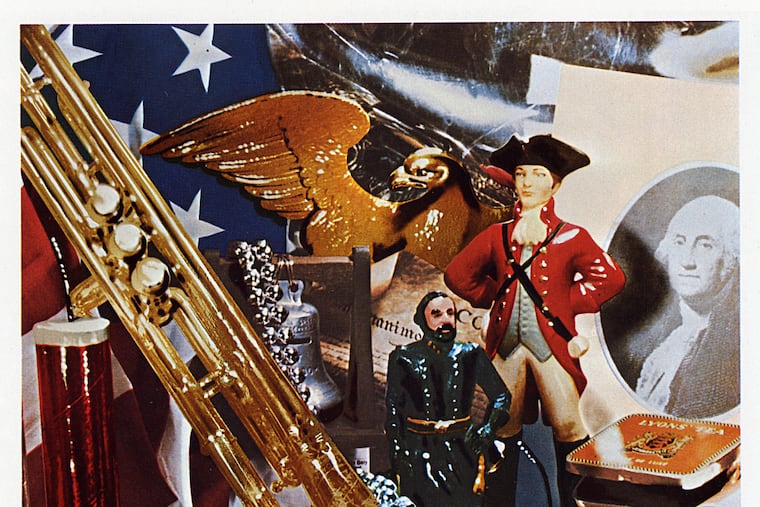
Some of the artists treated Lorillard’s question as an invitation to celebrate the nation’s founders and symbols. Alex Katz rendered George Washington with the cool, flat clarity he brought to his portraits, and Hirsch depicted the Boston Tea Party because, he wrote, “The vigilant activism that fed the spirit of our forebears is nowhere more tellingly expressed . . . than in the events of that December night in Boston Harbor.” Flack translated the holiday into the luminous precision of photorealism in Fourth of July Still Life, which gathered kitschy patriotic objects in excess, including an engraved portrait of George Washington, a Liberty Bell bank and a Revolutionary soldier statuette amid red, white and blue bunting. Flack said she “tried to create an absolutely American still life.”
Other artists asked who had been left out of independence. Jacob Lawrence, who had chronicled the Great Migration in the 1940s, returned to that history in his signature style with The 1920’s… The Migrants Arrive and Cast Their Ballots, which shows Black migrants from the South casting ballots in the North. The print honors the vote as the essence of citizenship and also reminds viewers that millions of Black Americans had to leave the South to exercise it. Marisol paired the suffragists and abolitionists Elizabeth Cady Stanton and Lucretia Mott in Women’s Equality, a pointed choice as the ERA faltered. Fritz Scholder, a Luiseño (Payómkawichum) artist, wrapped a seated warrior in the American flag and called the print Bicentennial Indian. Made two years after the standoff at Wounded Knee, the image celebrated the nation while acknowledging that the United States was built on land taken from indigenous peoples.
Ed Ruscha’s contribution was the most sardonic of the 12 pieces. He titled his print America, Her Best Product and emphatically lettered “Made in U.S.A.” across it, a can’t-miss irony considering the sponsor’s product came from a crop built on enslaved labor.
The portfolio’s ambivalence was clear from the start. In the accompanying catalogue, John I. H. Baur, Director Emeritus of the Whitney Museum of American Art, wrote that some of the artists saw American history “through their own painful understanding of how elusive freedom has been for ethnic minorities, women, and immigrants, and how difficult the fight for independence was, and is, in these areas.” The American Federation of Arts circulated the prints to museums at home, and the United States Information Agency sent them to be displayed in Europe, Africa and Asia. Large audiences saw the portfolio during the Bicentennial, but the museums that received the gift soon put it away in flat files.
Fifty years later, the semiquincentennial has produced its own balance of celebration and reckoning. Earlier this year, the Virginia Museum of Fine Arts paired works by African American artist Titus Kaphar with Junius Brutus Stearns’ 19th-century renderings of George Washington. In Shadows of Liberty, Kaphar nailed strips of canvas showing the names of enslaved people across an equestrian portrait of Washington. Today, at the National Gallery of Art, “American Icon: The U.S. Flag in Art” includes Faith Ringgold’s 1967 The Flag Is Bleeding, which she painted during the civil rights movement. The exhibition also features Dorothea Lange’s 1942 photograph of Japanese American schoolchildren reciting the Pledge of Allegiance shortly before their incarceration.
In 1976, when Lorillard commissioned art that both questioned and honored the nation, neither the company nor the government treated that dichotomy as unpatriotic. As audiences in Trenton, Princeton, and far beyond look at the Kent Portfolio 50 years later, they are reminded that the most resilient national art addresses unresolved questions—and that when federal officials pressure art museums and historic sites to censor this kind of work, they are breaking with a precedent that even a cigarette company once respected.
Samantha Baskind is Distinguished Professor of Art History at Cleveland State University. She is the author of six books, most recently Moses Jacob Ezekiel: Jewish, Confederate, Expatriate Sculptor.
Made by History takes readers beyond the headlines with articles written and edited by professional historians. Opinions expressed do not necessarily reflect the views of The Inquirer.