Philly mom wants to help parents sell their kids’ old clothes, inspired by her experience at Urban Outfitters and eBay
Parents say they're overwhelmed by figuring out what to do with their kids' old clothes. This Philly mom has a solution.
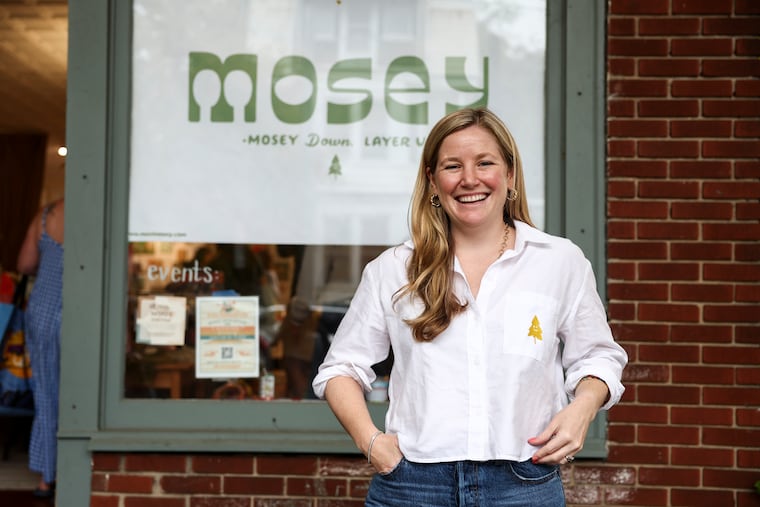
Throughout her career in online auctions and resale marketplaces, Leslie Jacoby Hack, 36, of Wyndmoor, has been in love with a question: “Why sell something once?”
“It is one of those core values that kind of takes me day-to-day through my work,” she said.
Hack works for eBay’s toy department. Before that, she worked for Philadelphia-based Urban Outfitters, focusing on the company’s Reclectic brand, which sells secondhand clothing.
Now, Hack is using her career insight to address a problem all parents face: children outgrowing clothing.
“After having my first baby, I was blown away by how quickly kids grow out of their clothes,” she said.
At the end of July she launched Mosey with cofounder Lou Lou Goss-Woliner, who works for a family trust advisory firm in Jackson, Wyo.
The company aims to solve a common problem parents face when trying to get rid of children’s clothing: It takes time and effort to find the right place for each item amid brick-and-mortar consignment shops, resale platforms, community giveaway groups, and in-person donation sites.
Mosey’s solution to eliminate the overwhelming decision process? A $25 bag. Customers buy it to fill with clothing their children no longer wear, then they mail it to Mosey, which lists the items online for sale.
In return, customers get at least $30 in online store credit to purchase secondhand items sent by other parents. Customers that send in premium brands or items such as outerwear and fleeces can get up to $50 in credit per bag.
Hack declined to share financial figures, noting the business is in early stages and “very much bootstrapped through friends and family.”
The business has two part-time employees, and no physical space yet, but the goal is to have a warehouse in Philadelphia by next year.
Since launching, Mosey has received hundreds of clothing items, Hack said.
“Parents all over, both in the U.S. and globally, share the same issue,” she said. “Where do I put these things ... that my kids only wore once?”
Trash bags full of clothes
On a recent Sunday in September, a steady stream of people stopped into Little Wares in Chestnut Hill for a children’s clothing swap hosted by Mosey.
Sandra Hwang, 34, from Wissahickon, showed up with clothes her 15-month-old son had recently outgrown. She sifted through tables full of clothing organized into piles by age, and found a few gems: a vintage snowsuit from Canadian brand Deux par Deux, some pieces from Hanna Andersson, and a denim overall from OshKosh B’gosh.
Hwang said roughly 95% of her own wardrobe is secondhand. She usually takes her son’s used apparel to Nesting House, a children’s consignment shop in West Mount Airy, but the store is selective, she’s found, preferring not to sell certain brands or more worn items.
That leaves her “driving around with this clothing, trying to find the outlet for it that will increase the lifespan as long as possible,” she said.
She might hand it off to friends or family, but that still takes time and effort.
“We have ourselves gotten huge contractor-grade trash bags of clothing in our neighborhood that [are] just being passed around,” she said. “People have kids, and then they go through tons and tons of clothing. It’s very overwhelming to go through this process.”
While Mosey aims to be an online marketplace with no brick-and-mortar store, connecting with potential customers like Hwang in person is important. It helps “drive word-of-mouth interest,” Hack said. She hopes to make clothing swaps and other events a regular part of the business.
Store credit up front
Platforms abound for those looking to sell their clothing online, including Poshmark, Depop, Vinted, and ThredUp.
Philadelphia-area sellers have brought in hundreds of dollars a month by peddling their possessions online.
Mosey’s business model is not entirely new, but it stands out because of its focus on kids, says Chris Baeza, associate program director of the fashion industry and merchandising program at Drexel University. Mosey’s guaranteed store credit encourages givers to become buyers, she says, and differs from consignment platforms that only pay once an item sells.
» READ MORE: These Philly-area residents bring in hundreds of dollars a month selling stuff online. Here’s how.
On a recent day in September, items for sale online included a Mini Boden button-down shirt with printed colorful sharks for $20, red Baby Gap shorts for $9, and a Hanna Andersson skirt with fruit designs for $16. The company also sells a selection of new items.
Mosey asks customers to launder the clothing before sending it in. But if something needs “a little bit of love, we will try to take that extra step to make sure it’s clean,” says cofounder Hack. Shoes, bibs, and a few other categories of children’s goods are not accepted.
Erica Lyon, 39, who lives outside Boston, ordered her first Mosey bag in July. As of late September she had sent in four bags of outgrown clothing from her daughters, ages 5 and 1.
Between the price of the bag, the credits she received, and buying four new-to-her items, she recalls spending roughly $20.
“I’m sending in nice stuff that at one point I did spend a substantial amount of money on, but otherwise there would have been zero return,” Lyon said. She learned about the company because she used to work with Hack, years ago at online art marketplace Artsy.
Before discovering Mosey, Lyon said, it felt overwhelming to sift through her children’s clothing to find things that could be donated or given to a friend.
Lyon is excited for more secondhand clothing to be available on Mosey. In the early days, she would pester Hack, saying, “I’m ready to buy stuff. She’s already noticed an increase in inventory since then, she said.
Selling more than used clothing
The secondhand industry is already booming.
Online consignment store ThredUp estimates the secondhand apparel market will reach $78.8 billion by 2030 in the U.S. and that the online resale market will to continue to grow in the coming years.
Hack said she believes there’s “a lot more willingness to participate in secondhand, for kids specifically” than there once was.
» READ MORE: Shopping secondhand for kids’ stuff is getting more popular in Philly
Consumers want to know what happens to their clothing after they get rid of it, says Baeza of Drexel.
“One thing people are getting really keen about is transparency and authenticity, and really understanding where things are going,” she said.
Mosey could have access to a generation that’s already used to buying secondhand too, says Baeza. More Gen Zers, known for their affinity for thrifting, will soon become parents.
Mosey could face challenges as they get more clothing if it leads to a bottleneck of items that need to be photographed for the website, says Baeza.
Meeting customers’ quality and inventory expectations can be a challenge for secondhand sellers, because they can’t control what people send in, said Sheri Lambert a marketing professor at Temple University.
The goal, Lambert said: “make resell feel as easy and dependable as buying new.”
“Mosey is selling more than used clothing. They win ... if they’re stressing more than that,” says Lambert. “They’re selling convenience, financial value, and a simplified shopping experience.”