Whole Foods workers picketed outside a Logan Square store nearly two years after a union election
Whole Foods workers at the store on Pennsylvania Avenue voted to unionize in January 2025. The company is still battling the election.
It’s been nearly two years since workers at the Whole Foods store on Pennsylvania Avenue in Philadelphia voted to unionize. But they still haven’t begun bargaining for a contract.
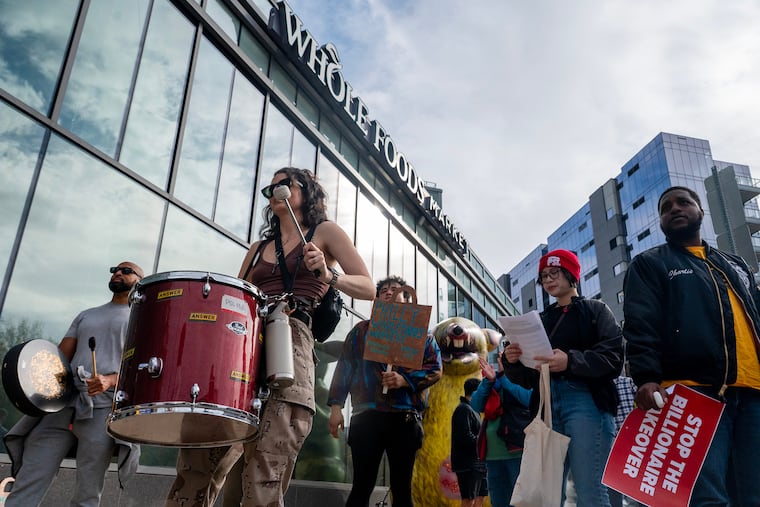
On Sunday, about 40 employees and union supporters chanted, beat drums, held up signs, and handed out flyers outside the store. It was all part of an awareness campaign. They said Whole Foods has been refusing to come to the bargaining table, in violation of labor law.
“Whole Foods, we are here to remind you that we won, and we have a union,” Alexandra Piper, 28, told the crowd. Piper, who works in customer service at the grocery store, said employees are demanding fair wages and healthcare, as well as protection from retaliation.
Morgan Fields, who joined the company this year said being part of the unionization effort has been “genuinely transformational.”
“We’re also fundamentally fighting against the idea that to live well, there must be someone below, and above,” Fields said.
Whole Foods workers voted to unionize in January 2025, electing to join United Food and Commercial Workers International Union Local 1776, which also represents other local grocery store employees.
Whole Foods has contested the union election, and a back-and-forth dispute between the company and the union has stalled negotiations for a first union contract. The grocery chain had multiple objections, including allegations that the union promised employees they would get a raise if they voted for a union.
For some time, the National Labor Relations Board (NLRB) was also without the necessary number of members to issue rulings, stalling the resolution process. Today, the dispute continues to play out at the NLRB.
Whole Foods declined to discuss the details of this conflict. The company has emphasized that it recently invested $230 million nationally in raising employee wages and benefits.
In September, it increased worker compensation to $29 per hour, when including benefits, the company said online. Starting next year, “new health, family, and financial support,” as well as an education benefit, will take effect.
“While we respect the right to peacefully assemble, it’s important to note that this demonstration was largely attended by people outside our company,” Whole Foods Market spokesperson Kristen Orsborn said in an email Sunday. “We’re grateful to our Center City team members for continuing to do what they do best: serving customers.”
Edward Dupree, 35, who has worked at Whole Foods for a decade, said that with NLRB carrying out legal procedures, the negotiation process has felt drawn out.
“You kind of learn the ways that these companies and these large corporations implement legal maneuvers to kind of delay the process and just absolve themselves of any real responsibility,” said Dupree, who picketed outside the store Sunday.
Still, he remains hopeful.
“Fundamentally everyone is still feeling overworked, they’re still feeling underpaid,” he said. “That still presents hope for the union, and it still gives us room to kind of organize and galvanize people around it.”
What has happened so far?
This summer, the union cleared the latest hurdle in its legal battle with Whole Foods. The company had raised multiple objections against the union election, which the NLRB regional director dismissed in 2025. The full board agreed with the regional director’s decision in June.
The union said it had reached out to Whole Foods several times to begin bargaining. In August, the UFCW 1776 filed an unfair labor practice charge, alleging that the company isn’t recognizing the union and bargaining in good faith.
In response, Whole Foods representatives said in a legal document in October that the company had not recognized the union or begun bargaining as it has been “exercising its legal right to test the Union’s certification.” The company has said it hasn’t “unlawfully refused to bargain” given that Whole Foods contends the union is not entitled to bargain on behalf of the workers.
The charge for not bargaining is awaiting a decision by the NLRB, the union said.
“We definitely could have already had a whole contract by now, but [Whole Foods’ parent company] Amazon is playing this legal game that they’re unfortunately really good at,” said Piper. “I try not to get too bogged down in it because it is kind of sad.”
Despite not being able to bargain, workers have been getting together to outline what’s important to them in a first union contract.
Wendell Young IV, president of UFCW Local 1776, said the requests they’re discussing aren’t unreasonable.
“[Whole Foods] can afford to sit down and bargain a contract and have a process for grievances and have a reasonable, affordable healthcare plan, and a decent retirement plan,” said Young. “They can afford this stuff. They can afford a better wage package overall.”
When workers filed a petition to organize in 2024, they noted they were seeking better wages, working conditions, and healthcare benefits.
Dupree said workers have been organizing because they “deserve to have a decent standard of living.”
“Right now, the company is not providing that for the vast majority of its employees,” he said.
Beyond the legal challenges, Dupree noted that the “the workplace is a lot more hostile than it used to be.”
“There’s a lot more like, ’Hey, keep your head down, try to do your work,’” he said.
Since the union election, he says there’s been more surveillance, adding that policies around job performance can be enforced unequally, he added.
“They definitely pick and choose to enforce certain policies,” he said. “It often will come down on workers who are open union supporters.”
Proposed federal legislation, the Protecting the Right to Organize (PRO) Act, would require contract negotiations to begin within 10 days of a unionization vote being certified. It has been introduced in the last four sessions of Congresses, but has stalled due to opposition from Republicans, who say it would hurt the economy.
The process of trying to get a first contract has been frustrating, says Mascio Venuy, 28, a part-time worker in the produce department at the store, who added that the company hasn’t recognized the union despite workers winning the election “fair and square.”
But he is committed to continuing the work.
“At the store, people were scared to do this. People didn’t know what to expect, but they still voted yes,” he said. “I have to see it through.”