Threats, insults, settlements: How Jensen Huang made humiliation routine
The Nvidia cofounder’s belittling behavior toward employees goes back decades. It once led to a confidential settlement agreement with an executive who said Huang “terrorized” staff.
As Nvidia became wealthier and wealthier in recent years, Jensen Huang grew increasingly frustrated with his staff.
He told groups of subordinates that they had become so rich that he couldn’t motivate them simply with money, according to three people who spoke on the condition of anonymity to discuss confidential conversations. The only way he could grind more work out of them, he added, was through humiliation.
This was an extension of a philosophy that went back decades. Huang had for years been berating his employees, documents and interviews show. His tongue lashings were savage and inventive. He told one executive that his mother should have aborted him, according to one witness. He said he would rip both arms off a subordinate and beat the person over the head to death with them. And he told another employee he would rip off the top of their head and “pee on your brain.”
The tirades were a centerpiece of the culture at Nvidia throughout its meteoric rise to a $5 trillion company and cornerstone of the artificial intelligence revolution. They were also foundational to Huang’s management style.
“I’d rather torture you into greatness, because I believe in you,” he once said.
He has long used humiliation as a tool, excoriating employees in front of their peers with insults, personal attacks and violent comments, while telling them it was good for them or for the business, according to more than a dozen current and former employees, who spoke on the condition of anonymity for fear of reprisal, and to a review of hundreds of pages of court records and other documents spanning more than 20 years. The behavior kept Nvidia’s human resources department busy fielding workplace complaints, but some employees said the department did not take them seriously.
Huang also inspired love and reverence from many of his employees. Thousands have signed a letter asking for his return. Some have tattoos of Nvidia’s logo. Both those who liked Huang and those who disliked him described Nvidia as cultish. He cultivated loyalty through not just his technical mastery but also acts of personal compassion and praise. But he ruled through fear.
Huang’s behavior began long before Nvidia became one of the most valuable companies in the world. In at least two cases originating in the mid-2000s, the company struck settlements with former senior leaders, both of whom had raised concerns about Huang’s conduct, saying it was unlawful and exposed Nvidia to liability.
Michael Winston, a former senior vice president of human resources, threatened to sue Nvidia in 2005, saying that he had been fired after objecting to Huang’s conduct, which he described as “the most verbally abusive, threatening, and intimidating behavior” he had witnessed in his career. Huang “thinks he can get away with anything,” Winston wrote in notes he made around that time, which were reviewed by the New York Times.
Nvidia reached a confidential settlement agreement with Winston for more than $1 million, which has not been previously reported.
Huang resigned from Nvidia last week, after revelations of multiple extramarital relationships, including one with a subordinate and another with a woman whom U.S. intelligence believes to be a Chinese intelligence asset. But his imprint remains on the culture of the company he cofounded in 1993.
Some managers followed Huang’s lead, six current and former employees said — including his own daughter, Madison, who as his de facto chief of staff often yelled at people, including executives senior to her. (She continues to work at Nvidia.)
Huang denied Winston’s allegations in a statement from his spokesperson, John Fisher, saying they are from an employee who was fired. They are “fabrications that are now impossible to disprove specifically, and the thousands of Nvidia employees who continue to speak out for Jensen show they’re false,” Fisher said. Fisher declined to answer other questions regarding Huang’s behavior.
Nvidia declined to comment. Its board and Colette Kress, its interim chief executive, must now decide if the company will continue in the mold of Huang or forge a new way forward. She will do so in the face of pressure from Huang and his supporters, who are agitating for his return to the company. Huang once belittled Kress in a meeting with top executives, the Wall Street Journal reported.
Harvey C. Jones, the chair of Nvidia’s board, said Tuesday that it “does not intend to reinstate Jensen as CEO.” Earlier this month, the board opened an investigation into Huang.
‘It pained me’
Silicon Valley has a long history of founders and chief executives with caustic management styles. Steve Jobs, the cofounder and chief executive of Apple, was infamous for screaming at and insulting employees who did not meet his exacting standards. He was also beloved. Employees credited his approach with helping to create culture-changing products like the iPod and iPhone.
Huang had a similar effect on his staff. He created a flat organizational structure where he interacted with employees at almost every level of the business. He impressed them with his vision for the future of technology, his command of business strategy and the speed at which he tackled and seemed to conquer new areas of importance, leading the company to the forefront of the AI boom.
Many of the company’s senior leaders have worked for Huang for more than a decade. Some shared Huang’s belief that mediocrity should be stamped out and excellence pursued, said four current and former employees. If employees didn’t like it, they could leave.
But in the eyes of some, Huang’s behavior was extreme, even by Silicon Valley standards.
In September 2004, Winston joined Nvidia to lead human resources. A longtime human resources executive who previously worked at Merrill Lynch and Motorola, Winston was soon taken aback by the disarray of the HR department and the cultural norms of Nvidia. This account of his time at the company is based on interviews and Winston’s notes and emails, as well as drafts of a lawsuit and other legal documents reviewed by the Times.
In his first days at Nvidia, he learned that two key human resources leaders had just quit and others were on the verge of resigning.
That October, at a two-day off-site meeting attended by about 50 employees, Winston said Huang unleashed graphic violent threats.
“You have to do this, or I will rip your f— heart out and stomp on it,” Huang said at one point.
“I watched them helpless, as they were publicly humiliated, indeed tormented, for extended periods of time, by this lunatic!” Winston said in his notes. “It pained me physically, intellectually and emotionally to be in the room.”
Winston said other attendees were “terrorized” and pleaded with him to intervene. Days later, he voiced his concerns during a meeting with top executives. One told him that the conduct was typical but could be a liability for the company. Another advised him to “toughen up.”
Winston said he then confronted Huang, warning him that he had “crossed the line” and that mistreating employees could expose Nvidia to lawsuits. He said Huang dismissed the concerns and defended public humiliation as a “rite of passage.” Winston said Huang bragged to him that he subjected new employees to it during their first six months at the company to test whether they would stand for it.
Winston said Huang told him that he would not stop. “It has good entertainment value,” Huang told him.
That November, Winston was called into a meeting with Huang and another executive, who then fired him. Huang told Winston that he was “not a good fit.” If Winston sued Nvidia, Huang said he would make sure Winston never worked in Silicon Valley again.
“To say Nvidia fired me because it just was not ‘a fit’ is nothing more than a smokescreen,” Winston said in his notes. “The real issue,” he wrote, was Huang’s “unconscionable behavior.”
In the months that followed, Winston filed a formal complaint against Nvidia with California’s Department of Fair Employment and Housing, making allegations that he was fired for opposing Huang’s treatment of employees, including what he said constituted sexual harassment. Winston then drafted a lawsuit against Nvidia and Huang.
But before the complaint was filed, both sides reached a settlement. Neither side admitted liability or wrongdoing.
Winston rejoined the banking industry, and later blew the whistle against Countrywide Financial Corp. for its conduct during the buildup to the financial crisis. He died earlier this year.
In 2007, Stephen Pettigrew, a former lawyer for the company, sued Nvidia over claims that included age discrimination and retaliation for reporting Winston’s allegations of sexual harassment. Pettigrew reported in a complaint filed with the California Department of Fair Employment and Housing that he sought “emergency medical attention for severe nervous tension and anxiety, as a direct result of the actions of Nvidia.”
Pettigrew discussed Winston’s complaint during depositions for his own lawsuit, citing Winston’s allegations as evidence of misconduct that exposed Nvidia to legal risk. Nvidia’s general counsel at the time, David Shannon, confirmed during another deposition in the case that Winston’s dispute was resolved in a pre-litigation financial settlement.
Nvidia denied all wrongdoing, and said that Pettigrew was fired for poor performance. The company countersued, saying that he breached his contract and misused company documents. The case ultimately settled out of court in 2009.
‘Thank you, Jensen’
After Nvidia’s chips were used in 2012 to train an early artificial intelligence system, Huang concluded that the future of computing would be AI. Employees recall receiving his email on a Friday saying the company was pivoting its business from graphics to deep learning, a precursor to AI. He froze hiring for anybody but experts in that field, and Nvidia became an AI chipmaker overnight.
A decade later, Huang’s bet paid off when ChatGPT arrived, kick-starting frenzied interest and investment in AI. Demand for Nvidia’s chips skyrocketed, and the company’s value soared. Many of the company’s 42,000 employees became fabulously wealthy and were exhilarated to be at the forefront of a technology Huang referred to as the next Industrial Revolution.
In the wake of Huang’s resignation, some employees have shared stories of a boss who went out of his way to support them. Last week, Vartika Singh, who works on strategy at Nvidia, recalled Huang’s support when her sister had brain cancer.
“Thank you, Jensen,” Singh wrote in a social media post. “For your guidance, for believing in people and ideas long before the rest of us understood them, and above all, for your extraordinary humanity.”
Huang’s mix of disparagement and motivation created something akin to Stockholm syndrome, six current and former employees said. The phenomenon, in which somebody held captive develops an emotional bond with their abuser, mirrored their relationship with Huang, they said.
Rather than fire people, Huang sometimes preferred to further humiliate them. When Ned Finkle, his former vice president of strategic marketing, faltered in a meeting with a major customer, Huang chewed him out in front of executives from the other company, said two people who spoke anonymously about the private exchange.
Huang then named Finkle vice president of external affairs, or government relations. At the time, Huang considered it one of the least important jobs at Nvidia, the two people said. Finkle did not respond to requests for comment.
Power plays
Huang’s tirades continued until the end.
He usually did not meet one-on-one with subordinates because, he has publicly said, such meetings reduced transparency within Nvidia. But top executives considered the move a power play that gave Huang more control. If anyone disagreed with Huang, they would have to do so in front of a group. Huang could then fire back, ridiculing that person in front of everyone else.
Huang also ripped into longtime leaders in front of their own teams, telling them their boss was incompetent and unqualified, two people said.
In one instance, Huang went around a room, telling managers he would kill them, according to one person with knowledge of the incident. When he reached a person in their 70s, Huang said that the person was really old and everyone hoped they would drop dead.
Huang also made personal attacks. He once made fun of an executive who had taken his children camping and said he needed to find a more committed employee for the job, according to one person. He often mocked another executive for enjoying aviation as a hobby, two people said.
In 2019, after Nvidia lost a bid to help build a U.S. government supercomputer, Huang castigated a sales executive in front of government officials for missing out on part of a contract worth hundreds of millions of dollars. The executive then threw his employee badge at Huang, who said he accepted the executive’s resignation on the spot, according to two people with knowledge of the incident.
Huang’s behavior rubbed off on other senior leaders at the company, including his daughter, Madison. On one call last year with Nvidia’s marketing team, Madison Huang repeatedly berated a vice president, who then left the call, according to a recording of the meeting reviewed by the Times.
“I’m having an anxiety attack,” the vice president said. “I’m going to drop off. I’m sorry.”
Madison Huang did not respond to requests for comment.
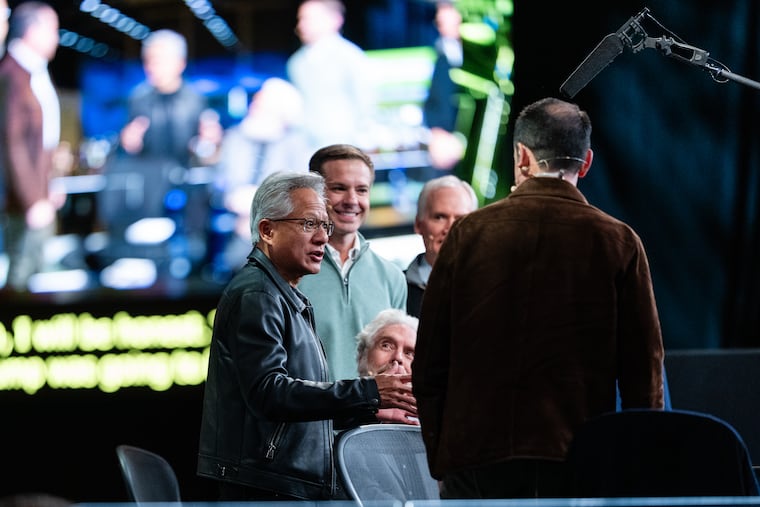
As Nvidia became the linchpin of the AI boom, Huang’s conduct started to spill outside the company. At Nvidia’s developer conference earlier this year, Huang moderated a panel with business partners, including Arthur Mensch, the CEO of the French AI startup Mistral.
During the panel, Huang interrupted Mensch several times, apparently taking issue with his French accent, according to two people who watched the talk.
“You’re not even speaking human,” Huang said at one point, before another panelist intervened. A spokesperson for Mistral declined to comment.
Daniel Gutierrez, an AI researcher and longtime “Jensen fan” who was watching the panel, said the interaction changed his perspective on Huang.
“I thought in the moment, what is happening right now that’s causing you to attack this poor guy?” Gutierrez said. “When all the new stuff happened in the last week, I go, wait a minute now. Maybe Jensen isn’t the guy I thought I revered.”
This article originally appeared in The New York Times.