The Eagles are doing something scarier than tanking, rebuilding, or going all in. They’ll be better for it.
The important thing for Eagles fans is that Howie Roseman’s head is in the right place. The unprecedented nature of the Cam Jurgens trade is a sign that the process is sound.
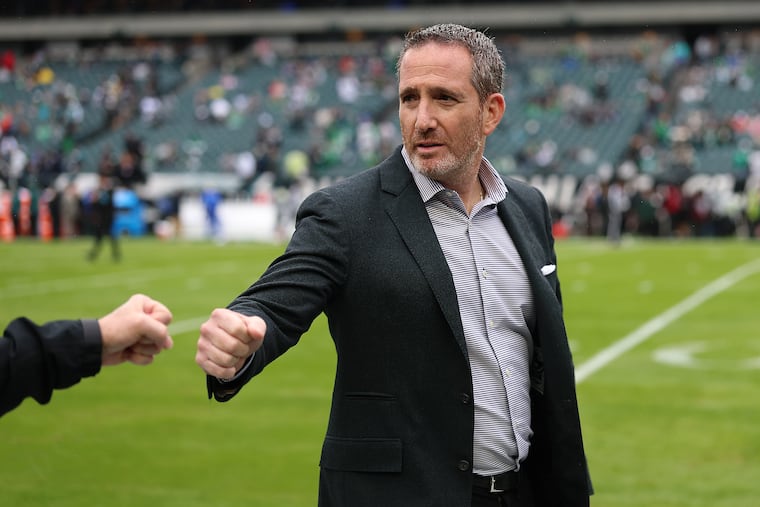
You’d rather a general manager do what Howie Roseman did than refuse to do it on principle.
I’ve been searching for something more definitive to say about one of the more discomfiting weeks in recent Eagles history. But all I have are first principles.
It is better to be a year early than to be a year late.
It is harder to get unstuck than it is to avoid getting stuck in the first place.
Never let a crisis go to waste.
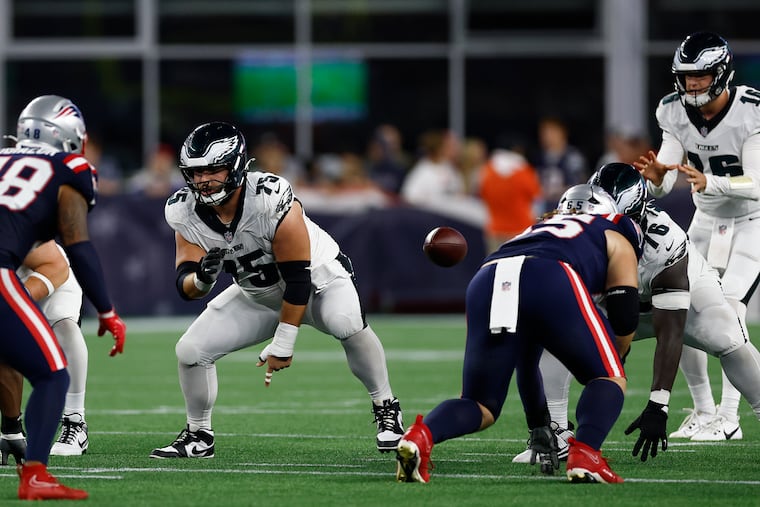
All three of these principles apply to the Eagles’ decision to trade starting offensive lineman and one-time long-term fixture Cam Jurgens to the Ravens. What really matters, though, is how these principles apply to all of Roseman’s decisions and in the preceding six months. That framework will tell you a lot about where the Eagles think they are, and their mindset for the rest of the 2026 season.
» READ MORE: In less than 24 hours, the Eagles’ offensive line succession plan was expedited for Markel Bell, Willie Lampkin
It would be easy to look at the events of the last six months and wonder if anybody in the Eagles’ building knows what they are doing. Turbulent does not begin to describe the current state of play at One NovaCare Jefferson Way. Even for a team that has spent close to a decade riding a zero-sum yo-yo between Super Bowl and complete dysfunction, the 2026 season is off to a hell of a start.
Just this week, the Eagles had seen:
Their second-most important offensive player ruled a surprise inactive an hour before kickoff.
Their starting running back suffer a potential multiweek hamstring injury and his backup suffer a multiweek core muscle injury.
Their starting quarterback complete 12 passes for 93 yards in a game.
Their second-most important offensive player retire.
And that was all before Tuesday.
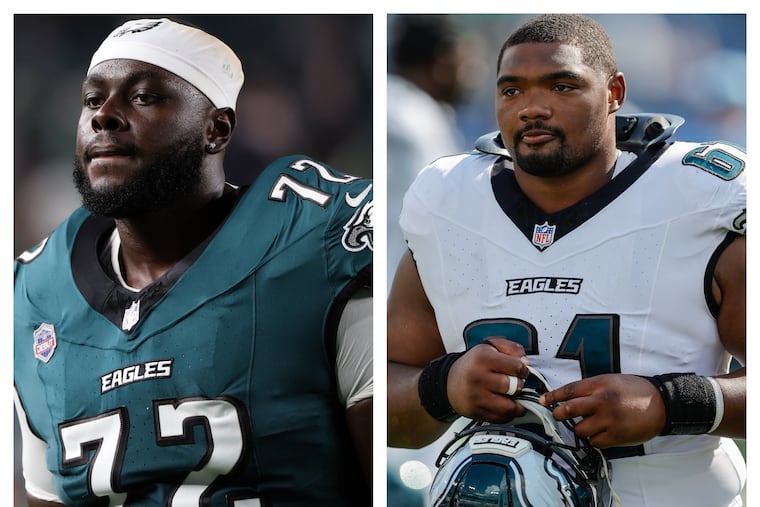
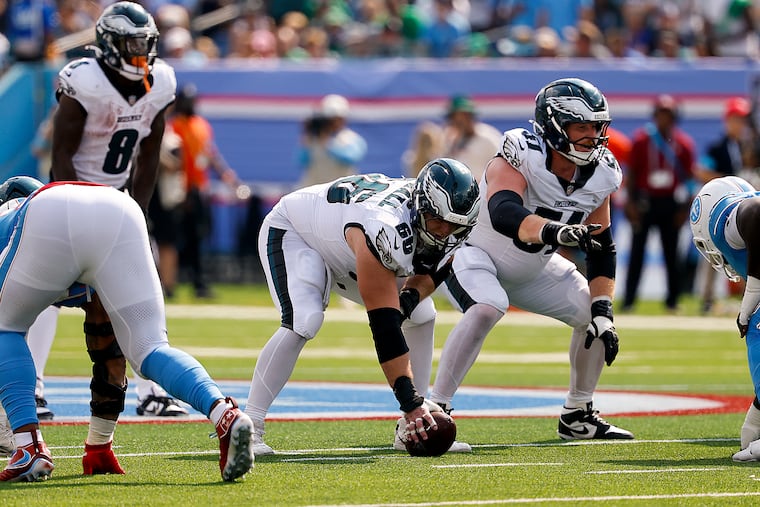
So it says something that the real stunner came on Wednesday. Just four weeks into the season, the Eagles traded one of the two remaining starters from one of the best offensive lines in NFL history. Not only that, but they traded him to a fellow Super Bowl hopeful that was more than willing to part with a second-round pick for a two-time reigning Pro Bowl center who just turned 27 years old.
In less than five years, Cam Jurgens went from a rookie Super Bowl starter and heir apparent to franchise legend Jason Kelce, to a Super Bowl winner with a fat contract extension, to a Baltimore Raven. You could call it a fall from grace, except the Ravens are currently the third betting favorite to win the Super Bowl. The Eagles are 16th.
The move is almost entirely without precedent. The Eagles’ return for Jurgens — a 2028 second-round pick and a move up from the seventh to fifth round in 2027 — has been unanimously heralded as significant. One factoid making the round is that Jurgens is the first interior lineman traded for a first- or second-round pick since 2011, per Spotrac.

David Murphy alerts
The framing is doing a lot of work. After all, it’s been nearly three years since a quarterback was traded for a first- or second-round pick. One can just as easily say the Eagles are the first team since 2011 to trade an interior lineman who was worth a first- or second-round pick. Reality is, good interior linemen tend to play for good teams, and good teams tend not to be interested in trading away established offensive line talent for draft picks.
All of which leads to a rather obvious question: Do the Eagles no longer view themselves as a good team? At least, one that isn’t good enough to prioritize present value over future value?
Are they tanking? Rebuilding? Packing it in?
Not according to the bossman.
“We’re trying to win this year,” Roseman told reporters. “I think, from my perspective, just looking at what is the ultimate goal, which is to win the last game of the year, and then to have a run like we’ve had.”
Except, there are different levels of “trying.” And “trying” is not something that a good organization can limit to one season. Ask any personnel executive in any sport about time horizons and you’ll get a different answer. The bad executives are the ones who look at you cross-eyed and say nothing. The good ones all phrase things differently, but the basic common goal is to maximize championships per year between here and infinity. The longer your time horizon, the tougher the task. Achieving it in the NFL requires transcending the natural four- to five-year talent cycle created by its draft and contract structures. The hardest thing isn’t to go from bad to good or from good to great. It’s to remain in that space between good and great.
Doing so requires first and foremost a keen understanding of oneself. You need to evaluate who you are, and also what you are going to need in order to be who you want to be. Those two things often come into conflict. The best decision-makers are those who know which to prioritize in any given moment.
» READ MORE: Eagles should treat London like a ‘scheduled loss,’ leave Quinyon Mitchell, Jalen Carter, et al in Philly
The Chiefs have done it better than anybody. They traded Tyreek Hill in a deal that helped them draft Trent McDuffie and now they’ve traded McDuffie. In between they traded Joe Thuney and L’Jarius Sneed. They are now 4-0 with a team that includes three defensive contributors (Nohl Williams, Ashton Gillotte, Peter Woods) and one offensive contributor (Rashee Rice) they acquired using the draft capital they acquired. They gave running back Kenneth Walker III the contract and the role he desired.
For more than a year, the Eagles have been telling us both where they think they are and where they think they need to go. Their decision to trade A.J. Brown. Their decision to let Milton Williams and then Jaelan Phillips walk. Their decision to keep four quarterbacks on the roster. Their decision to fill out their offensive skill positions with short-term, low-risk deals. The goal is to transcend the notion of rebuilding. There are windows. And there are transitions. If you do it right.
The important thing for Eagles fans is that Roseman’s head is in the right place. The unprecedented nature of the Jurgens move is a sign that the process is sound.
There is a time element involved in good decision-making. It’s why good quarterbacks are so few and far between. Life moves slower on film. There is a pause button. Accuracy and arm strength would be the only differentiators if each play were a take-home test. The game isn’t knowing the right read. It’s knowing the right read before the opportunity window closes. The Eagles saw Drew Kendall as their center. They saw Jurgens as replaceable at guard. They had a chance to sell high. They took it. Which is exactly what you need to do in a time of diminishing resources.

Different year, different offensive coordinator, yet still, it feels like Déjà vu all over again. The Eagles had little margin for error Sunday vs. the Rams because of injuries. They played hard despite being shorthanded, but in the end, couldn’t put the Rams away, mainly because of poor execution on offense. Why hasn’t Sean Mannion's scheme clicked? How culpable are head coach Nick Sirianni and quarterback Jalen Hurts in the offensive rut the Eagles find themselves in? The Inquirer's Jeff McLane and David Murphy analyze the fallout from the 24-20 loss to L.A. Listen here.
Listen to all episodes here or wherever you get your podcasts.