A Delaware hub dedicated to ‘Human-AI cooperation’ launches with $21.5 million to study AI in healthcare
Based at the University of Delaware, the NSF-funded institute will focus on applications of AI in healthcare. “We want to make sure that the human is in the driver’s seat," director Cathy Wu said.

Scientists at a new Delaware research hub envision a future where AI-powered sensors assess a patient’s injury from the moment they enter an exam room.
As the patient climbs onto the table, the system detects a subtle tremor that might otherwise go unnoticed.
Backed by a five-year, $21.5 million federal grant, the NSF AI Institute for Human-AI Cooperation (HAIC) will focus specifically on applications like these in physical therapy and healthcare.
The team includes researchers from the University of Pennsylvania and the University of Delaware who are working to design AI technologies that can help with decision-making, monitoring of symptoms, and other aspects of care.
They imagine a clinical environment where the provider, patient, and AI system are all working together.
“We are not trying to replace people in any way,” said Eric Eaton, the managing director of the institute and a research associate professor at Penn. “This is an opportunity to really explore how AI can become an adaptive teammate.”
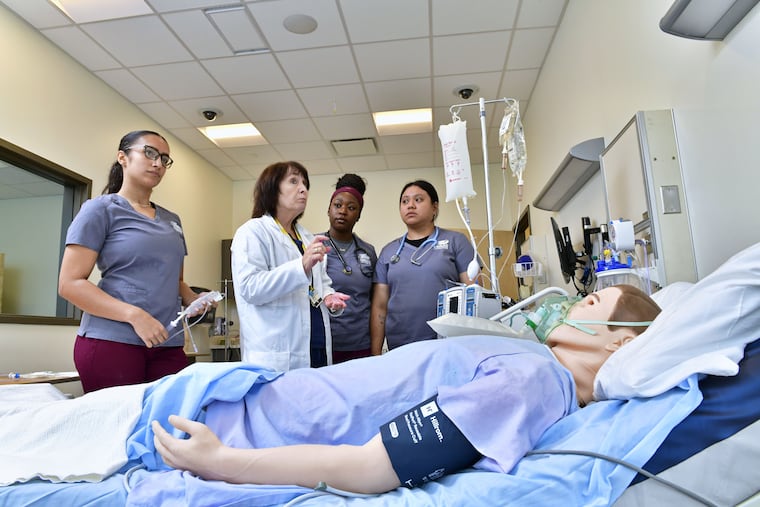
Experts in computer science, AI, robotics, physical therapy, medicine and ethics work in tandem at the institute, which celebrated its launch with a ribbon-cutting last Wednesday. The collaboration also includes Delaware State University, Princeton University, and the University of Florida.
Headquartered at the University of Delaware’s Newark campus, it is the 30th AI research institute nationwide established by the U.S. National Science Foundation.
The institute will also focus on workforce development and designing courses and degree programs at the intersection of AI and health.
“We want to achieve the ultimate goal of personalized healthcare,” said Cathy Wu, the director of HAIC and a professor in the computer & information sciences department at the University of Delaware.
Learning to cooperate
In the field of AI, “alignment” refers to the practice of designing AI to match human goals, intentions, and decision-making.
“We want to make sure that the human is in the driver’s seat,” Wu said.
The researchers envision AI getting incorporated as a partner, rather than a replacement for clinicians.
In physical therapy, AI-powered sensors could help the physical therapist recommend the best set of exercises, and adapt those exercises as the patient recovers.
AI could also monitor patients as they perform exercises independently, to “get the complete picture,” Eaton said. A physical therapist managing multiple patients at once may be unable to monitor each one throughout a session.
As a patient walks on a treadmill, for example, AI-powered motion-tracking cameras could continuously evaluate their movements.
In the exam room, sensors could measure how well a patient’s knee injury is healing, starting when the patient enters the room. As the patient climbs onto the bed, the sensors could detect a subtle tremor that might indicate Parkinson’s disease.
“If no one else was in the room with you, that would never have been noticed at all,” he said.
By tracking changes over time, an AI system could help assess cognitive decline or signs of depression.
AI could also identify a patient’s concerns and ensure that the provider addresses each one before the visit ends. It could pull up relevant medical records in real time — for example, locating a test the patient had two years ago that could be relevant.
The researchers will work on developing the foundational AI technologies to support these scenarios. At the same time, they will work with stakeholders and ethicists on AI guardrails.
“I don’t want to build a system that I wouldn’t be comfortable using in a clinical exam room,” Eaton said.
Guardrails
The institute will study how to integrate AI into healthcare without compromising patient privacy or the doctor-patient relationship.
For example, the system could convert the image of a person walking into a privacy-preserving skeleton or wire-frame.
Researchers may also develop training to help healthcare workers understand the nuances of AI, including “when to trust it, when not to,” Eaton said.
An AI tool that provides recommendations or decision support for the clinician must be clear on its level of confidence and access to relevant medical information, as well as any uncertainty in its recommendation.
Doctors should be able to examine the system’s decision-making process and verify that it is auditable, Eaton said.
The same principle applies to the need for patients to understand how AI reaches its conclusions.
Stakeholder advisory boards will help the institute ensure its technologies address these concerns.
“We need to bring a lot of checks and balances,” Wu said.