Birding takes flight
Once a niche hobby, birdwatching is drawing a new generation of enthusiasts eager to explore nature, build community, and spot something extraordinary.
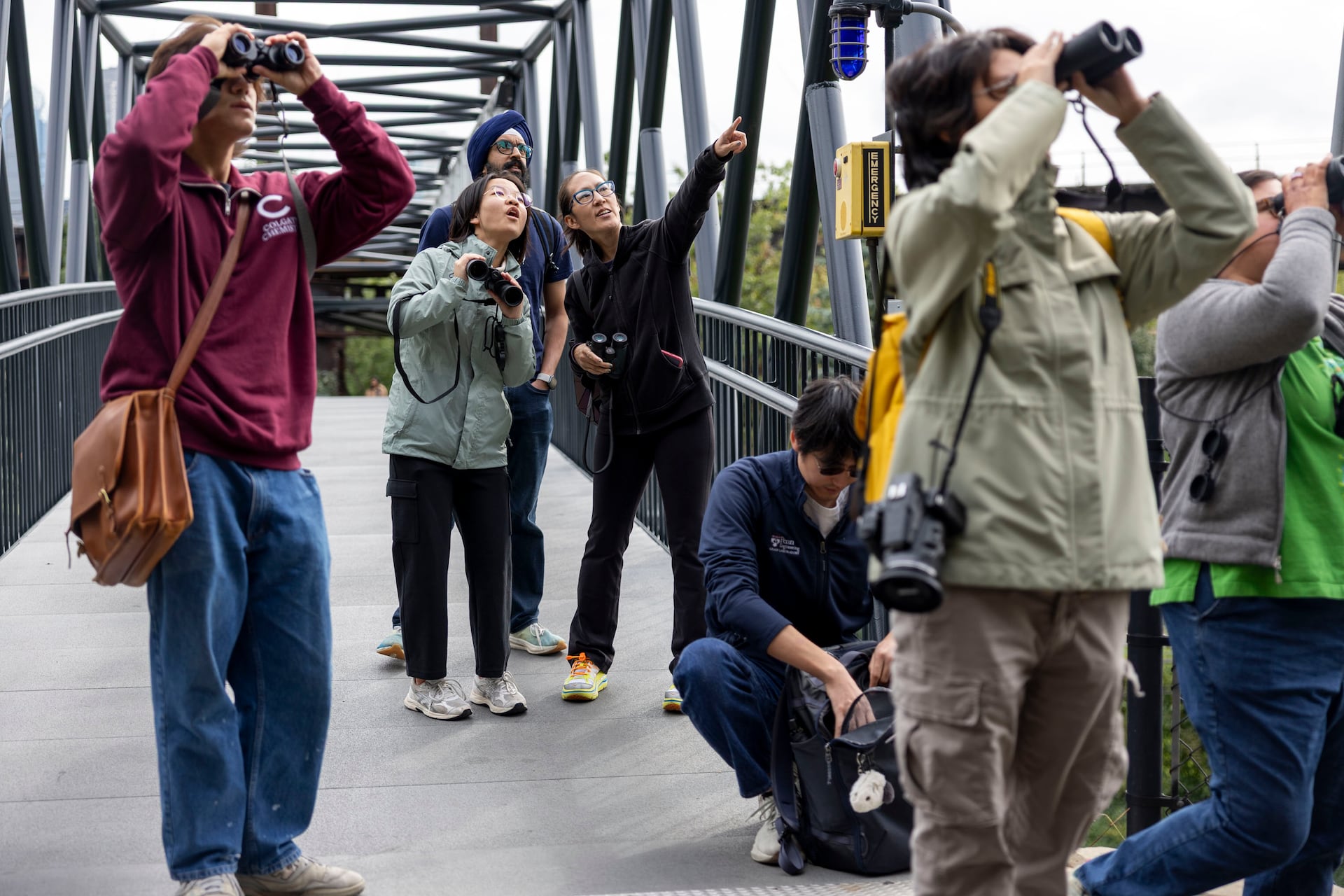
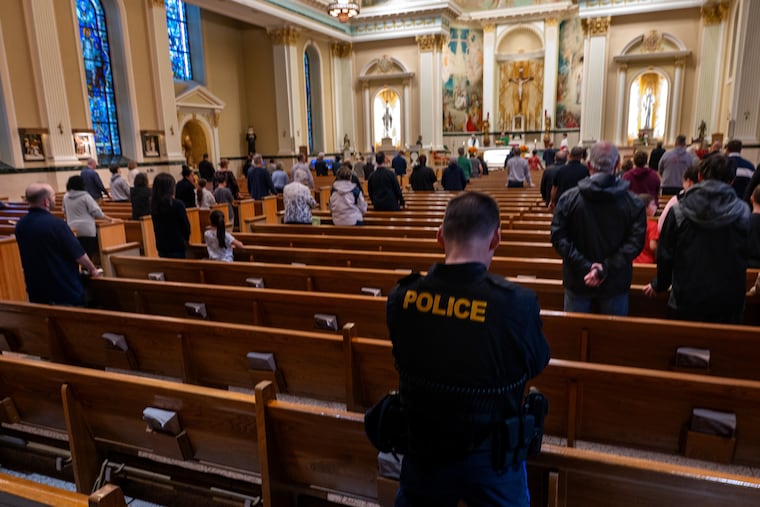
Victoria Sindlinger led a six-member flock from the Quackers Bird Club across the University of Pennsylvania campus, peering into hundreds of trees and shrubs along the way.
Binoculars dangling, the crew navigated past Franklin Field, traversed a steel bridge, skirted past tennis courts, and ducked into a pocket park.
For two hours on a recent walk they tracked a northern mockingbird tucked into a willow oak, caught a yellow warbler mid-hunt, pinpointed a monarch butterfly resting on goldenrod, and observed other flora and fauna, including a giant hornet nest.
Sindlinger, a 22-year-old senior environmental science major from West Philadelphia, launched the club during her freshman year, pitching it to a small group chat of classmates. The group has grown to 120 members and is an official university organization.
The Quackers are part of an expanding wave of young, city-dwelling birders reshaping the hobby with a distinct urban tilt. While regional sanctuaries like Cape May and Berks County’s Hawk Mountain draw international recognition, the popularity of urban birding across Philadelphia and its dense suburbs is soaring, according to some of the region’s most enthusiastic bird-watchers.
» READ MORE: Where to see cool birds near Philly, according to some of the region’s most enthusiastic bird watchers
“I think there’s been more interest in birds and more research and more activity around birds here in the Philly area than any other place in the Western Hemisphere,” said Keith Russell, program manager for urban conservation at Audubon Mid-Atlantic.
The convergence of COVID-19 isolation and modern nature applications helped trigger a surge in urban birding. Campus clubs are multiplying, groups of like-minded people are gathering, and loose local networks are banding together through informal meetups.
“The really nice thing about birding in general — and running a bird club — is that it’s actually pretty easy to do,” Sindlinger said. Her club takes excursions by SEPTA, via rented car, or even by foot.
“The birds are out there. Especially on Penn’s campus, which is so beautifully green.”
Indeed, the growth of birding in the region, and particularly Philadelphia, has been extraordinary, according to data from eBird, a citizen-science project by Cornell University’s Lab of Ornithology that allows birders to log the species they see and the locations.
Consider:
In 2020, Pennsylvania had 9,559 eBird users. In 2025, it had 15,830, a 66% increase.
New Jersey had 6,098 users in 2020. It had 11,082 by the end of last year, an 82% increase.
And Philadelphia went from 1,035 eBird users in 2020 to 2,754 last year — a 166% increase.
Add to that, the growth of Philly Birding Weekend, which celebrated its fifth year on Oct. 10 and 11. About 140 people registered for 10 trips. Birders spotted 36 species during one of those outings at the Discovery Center in Fairmount Park.
A tech-fueled birding boom
For Russell, of Audubon Mid-Atlantic, urban birding should rarely require a personal vehicle, trips to remote coastal reserves, or thousands of dollars in camera gear.
“When I was a kid here in Philly, I couldn’t drive. I had to walk, so I had to just go in my neighborhood,” Russell said.
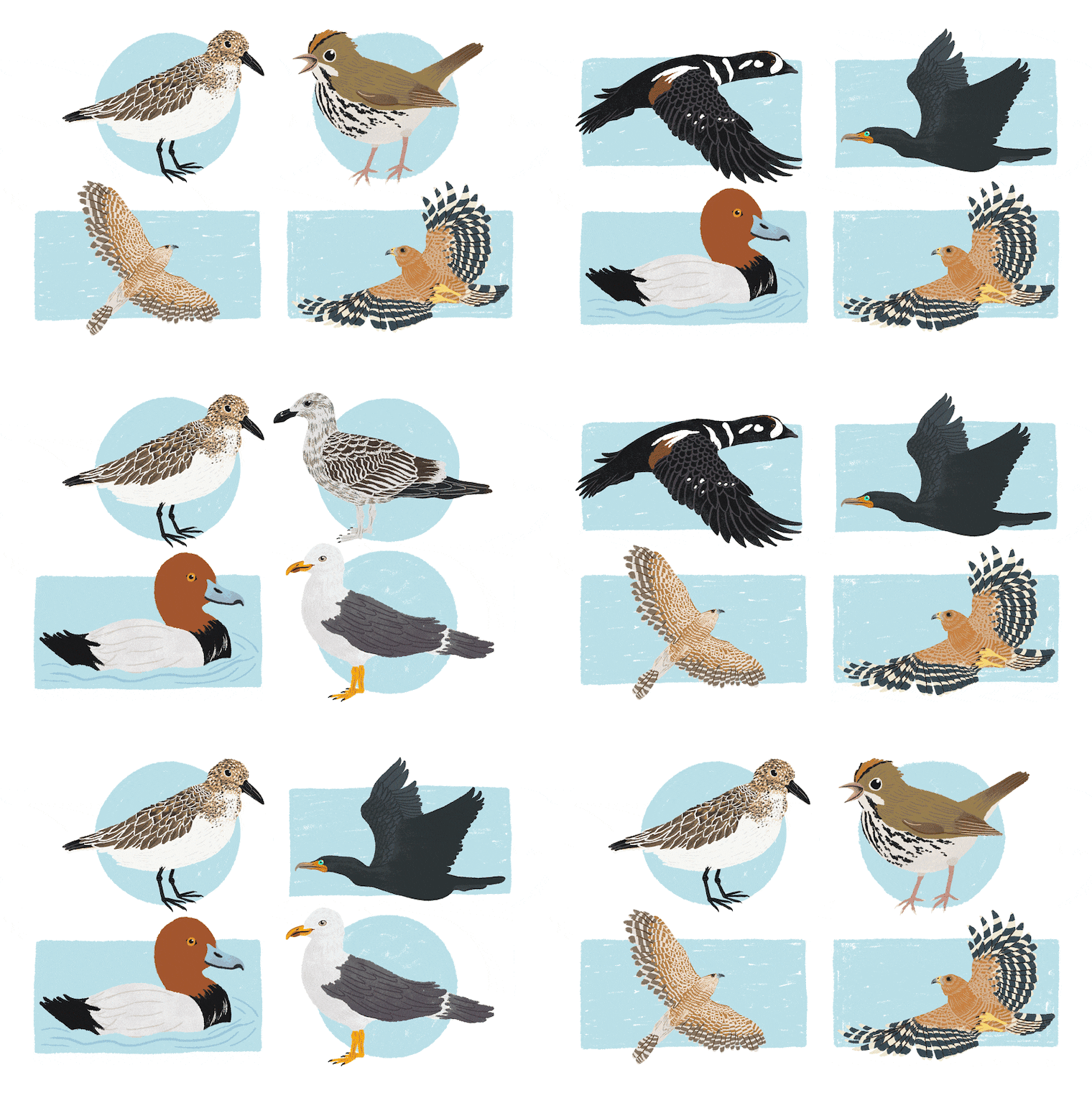
He champions unheralded urban pockets, like a stormwater retention pond off 51st Street near Bartram’s Garden, accessible by public transit. That single basin routinely attracts rare shorebirds, including red knots, phalaropes, and Baird’s sandpipers.
“Studies show that people who observe birds become healthier, happier, and more content,” Russell said. “We live in a very stressful time and a very stressful world.”
The Delaware Valley Ornithological Club, founded in 1890, helps link birding groups in the region through its jam-packed calendar of walks and events.
Services like eBird lower the entry bar, opening direct channels to the natural world. eBird, launched in 2002, lets users tap a global database.
Merlin, an app also developed by the Cornell ornithology lab, helps users identify birds. Merlin introduced photo identification in 2014 and audio identification in 2021.
Pennsylvanians logged 32,000 checklists — digital records of birds spotted during field trips — into eBird in August alone, said Kathi Borgmann, a spokesperson for the Cornell lab.
“We are seeing month-over-month growth of 10% to 20%,” Borgmann said of the service.
Though Cornell does not officially track user demographics, Borgmann added, “We see all these young people on social media talking about eBird and Merlin.”
Driven by curiosity
For Katrina Clark, a 47-year-old literacy specialist from Cobbs Creek, eBird helped draw her to the urban birding scene.
She first picked up binoculars during the 2020 lockdowns. Strolling through her neighborhood, a friend pointed out a gray catbird, a species Clark assumed belonged in a zoo, not a neighborhood of concrete.
Driven by curiosity, she checked eBird, studied local maps, and eventually joined the board of the In Color Birding Club, a group founded in 2020 to cultivate a safe, inclusive environment for Black birders.
“I did not think about birds except that they were far away, not connected to the city,” Clark said.
While large sanctuaries like the John Heinz National Wildlife Refuge offer massive species tallies, Clark finds equal satisfaction watching a downy woodpecker work a solitary tree along Cobbs Creek while city trolleys rattle past.
Finding community
Elise Greenberg, 35, founded Philly Queer Birders in 2021 to merge her background in biology with a desire for community during the pandemic.
“I wanted to get outside, I wanted to be around other people, and I was missing the queer community and missing birding,” Greenberg said.
What began as a small outing quickly exploded. Today, her informal walks draw up to 100 people, backed by an Instagram community of over 7,000 followers. Her group draws an intergenerational mix that leans heavily toward young adults and young families.
Greenberg focuses the itinerary on transit-accessible locations like the Woodlands and the Discovery Center, with occasional trips out to Chanticleer Garden or Tyler Arboretum.
Unusual sightings often spark massive interest. When a rare tundra bean goose landed near Fairmount Park along the Schuylkill in 2021, birders from across the region flooded the riverbanks.
“The joy they found seeing it provided a spark,” Greenberg recalled.
It is a sentiment shared by other bird-watchers.
‘Outlets that bring us together’
Jonah Perelman, a 22-year-old biophysics major at Penn, moved from suburban New Jersey to Philadelphia, assuming his passion for birding would be put on hold. But a poster hung by Sindlinger in a dining hall pointed him toward the Quackers.
Now he helps coordinate the group’s outings to locations such as Cape May, Middle Creek Wildlife Management Area in Lancaster County, and an owl-banding site in Chester County.
Yet their core routine includes one distinctly local stop: the campus Biopond at James G. Kaskey Memorial Park.
For a generation raised on screens, Perelman views birding as a vital offline sanctuary.
“We are now really one of the first generations who grew up with iPhones and iPads,” Perelman said. “A lot of us realize we don’t want to be so technologically plugged in. We want outlets that bring us together and offer new ways to connect with the world.”
Data editor Stephen Stirling contributed to this article.