Pa. police are rushing to help ICE with immigration enforcement. Formal agreements have nearly doubled in six months.
The police-ICE alliances are part of a controversial agency initiative known as 287(g), named for a section of a 1996 immigration act
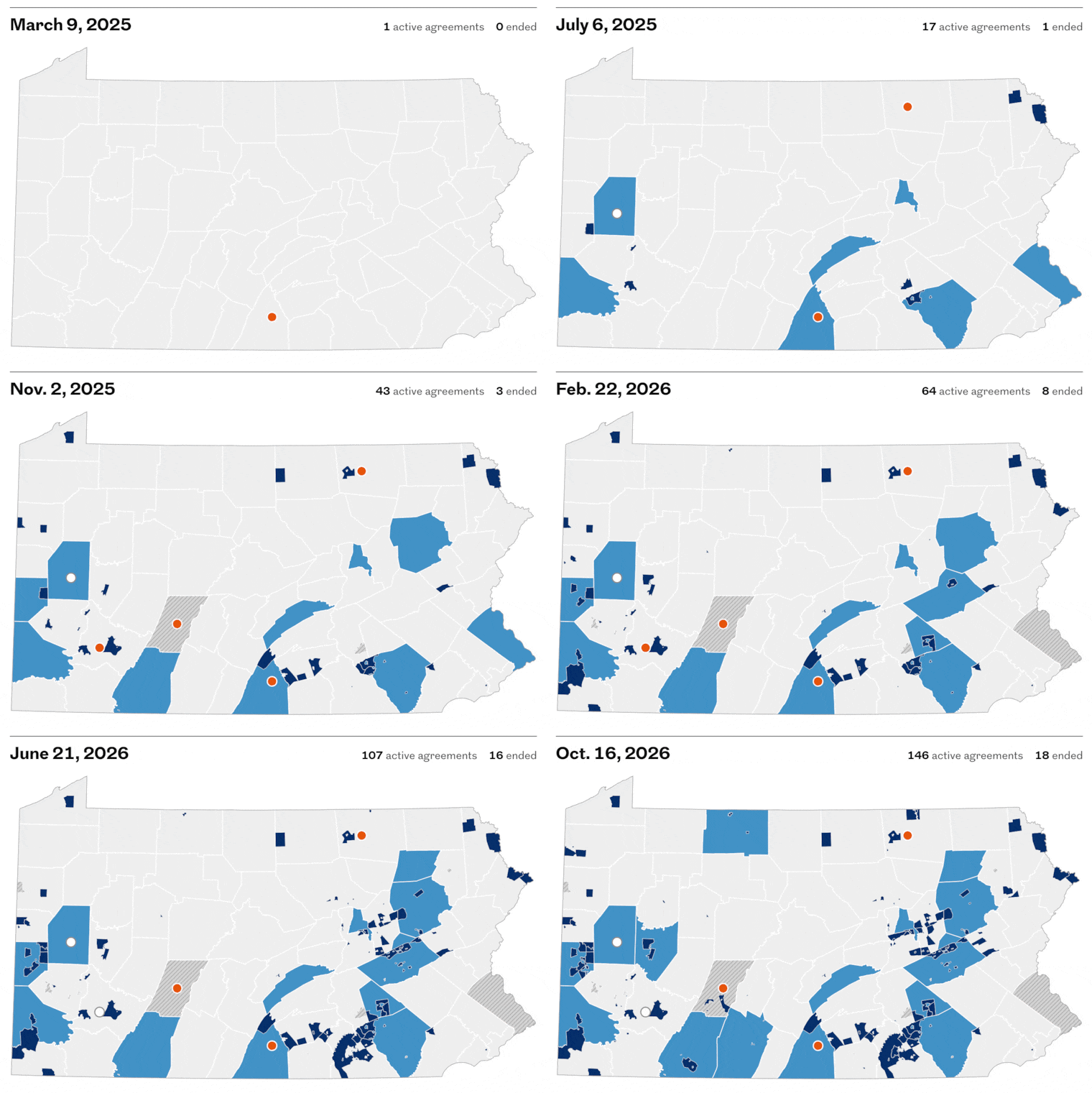
The number of Pennsylvania police agencies signing up to help ICE enforce federal immigration law has nearly doubled in the last six months.
That is on top of a big, earlier increase that took place in winter and spring.
Today 146 local agencies have inked formal agreements to assist U.S. Immigration and Customs Enforcement in its work, up to and including arresting immigrants and turning them over for deportation proceedings.
That is up from 78 in April.
The police-ICE alliances are part of a controversial agency initiative known as 287(g), named for a section of a 1996 immigration act, in which state and local police assist the agency in identifying, arresting, and removing immigrants. The Trump administration says the agreements make Americans safer, acting as a force multiplier for immigration enforcement.
“Under the Biden Administration, Pennsylvania had zero 287(g) partnerships with ICE,” a spokesperson for the Department of Homeland Security said in a statement. “Under President Trump’s leadership, they are surging because state and local law enforcement want to help make America safe again.”
Nationally, as of Oct. 20, the number of program partnerships had increased nearly 1,900% since the beginning of Trump’s second term ― from 135 agreements to 2,698, according to the department.
“Our 287(g) partners work with ICE to protect the public safety of the communities in which they live and serve, without fear, favor, or prejudice, and they should be commended for doing so,” the department said. “Partnerships with law enforcement are critical to having the resources we need to arrest criminal illegal aliens. … When politicians bar local law enforcement from working with DHS, our law enforcement officers must have a more visible presence so that we can find and apprehend the criminals let out of jails and back into communities.”
Some of the agencies that recently signed up in Pennsylvania include the district attorneys’ offices in Bedford, Armstrong, and McKean Counties, the Butler Township Police Department, the Pottsville City Police Department, the Lehigh Township Police Department, and regional police departments in Northern York County, Eastern Pike County, and Conneaut Lake, which serves Conneaut Lake Borough, Sadsbury Township, North Shenango Township, and Linesville Borough.
They join other municipal police departments, county sheriff’s offices, and constables’ offices that work with ICE to serve the president’s push for mass deportations of immigrants.
During the first 18 months of Trump’s second term, DHS completed about 980,000 deportations ― a faster pace than under the Biden and first Trump administrations, though still below early-2000s levels, according to a new analysis by the Migration Policy Institute in Washington.
“It’s a very harmful program, because it’s turning local police into ICE agents,” said Patty Torres Vera, co-executive director of the immigrant rights group Make the Road Pennsylvania. “It erodes the trust that the community should have in police. People become afraid, afraid to report crimes, to help in investigations, because they fear consequences.”
The agreements foster racial profiling of Black and brown people, she said, while putting local communities at risk of paying big legal settlements.
“Local police, they’re not required to enforce local immigration laws ― they’re choosing to sign these agreements,” Torres Vera said. “Their limited resources should be focused on keeping their communities safe, not carrying out the duties of federal authorities.”
The new statistics come from the Deportation Data Project, a group of attorneys and academics committed to transparency in immigration enforcement data. The organization used government statistics, provided by ICE in response to a Freedom of Information Act request, that were then processed by the project and analyzed by The Inquirer.
The figures show not just the overall number of agreements, but also how local alliances with ICE are shaping immigration arrests in Pennsylvania.
The first Pennsylvania arrest under the program occurred in July 2025. Since then, 1,342 people have been arrested under 287(g), about 13% of the 10,163 ICE arrests in the state.
Program arrests hit a monthly high of 414 in July, constituting one out of three ICE arrests that month. While arrests under the program are making up a larger share of all immigration arrests in the state, the geographic distribution varies widely.
In dozens of cities, arrests under 287(g) make up more than 90% of all ICE arrests. In hundreds of other places, however, they account for less than 10%.
The arrests data are current as of Aug. 5.
The program designates three main models under which local authorities can help ICE:
The Task Force model, the most expansive, which enables local police to enforce federal immigration laws during routine patrols. That includes arresting people who police suspect are not citizens.
The Jail Enforcement model, where local officers identify and process for possible immigration offenses those who have been arrested on criminal charges.
The Warrant Service Officer program, which authorizes local police to execute ICE administrative warrants at jails.
All but three of the 146 agreements in the state fall under the task force model.
Some police departments and local governments, including those in Philadelphia, not only avoid the agreements but also deliberately limit their cooperation with ICE. They say that their sanctuary and welcoming policies create trust in immigrant communities, and that undocumented crime victims and witnesses will not come forward if they fear being arrested for lack of legal status.
ICE says the program adds staff strength to an agency workforce that numbers an estimated 21,000 nationwide. DHS Secretary Markwayne Mullin encourages local officials to join forces with ICE, saying they can be key partners in keeping Americans safe.
ICE provides incentives for local police including stipends, equipment, and financial reimbursements.
Opponents insist that turning police officers into immigration agents hurts local economies, including at farms and restaurants, as communities use their own tax dollars to help drive away the workforce on which they depend.
New Jersey has long barred local collaboration with ICE, first by directive and, as of March, by law, after Gov. Mikie Sherrill signed legislation prohibiting those agreements.
Pennsylvania has no such restrictions.
Nationally, the number of agencies signing on to help ICE grows nearly every day, covering 38 states and two U.S. territories.
Vanessa Stine, a senior staff attorney for immigrants’ rights at the ACLU of Pennsylvania, said she sees the federal government aggressively pushing the expansion of 287(g) ― increasing racial profiling and legal risk for local taxpayers.
“It’s shameful and squarely wrong for so many law enforcement agencies in Pennsylvania to enter into 287(g) agreements, and really calls into question their core mission and values, when they voluntarily choose to do a job that is not actually their job,” she said. “Pennsylvanians should be upset about that.”