What can the Phillies and the rest of MLB expect from Teruaki Sato? We asked a former teammate.
The Japanese star’s power and age make him a hot commodity on the free agent market. But there are questions about Sato — and the Phillies’ pursuit of him — as well.
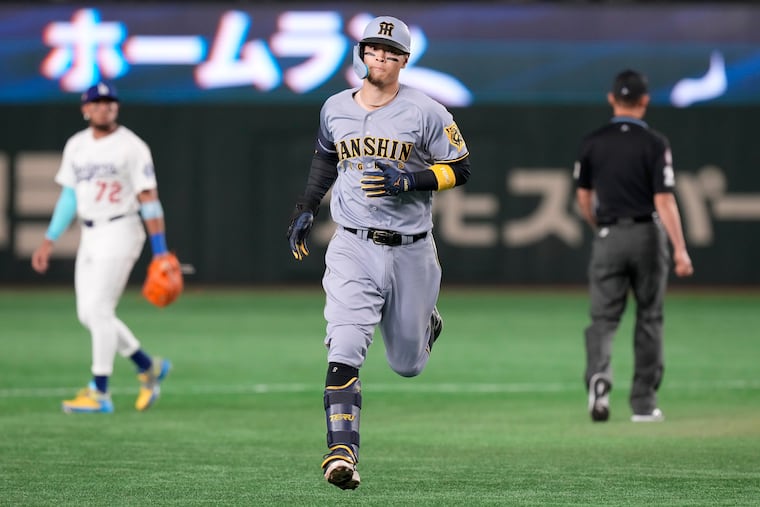
The comparison is easy.
Munetaka Murakami and Teruaki Sato bat from the left side of the plate. They have light-tower power — and the swing-and-miss tendency that often goes with it. And they are the last two winners of the triple crown in Japan’s Nippon Professional Baseball, where they were poor defenders at third base.
So, after Murakami banged 35 home runs with an .825 OPS this season and finished fourth in the American League Rookie of the Year voting — after signing a two-year, $34 million contract with the White Sox last December — what’s reasonable to expect from Sato?
“I believe [that] Teru,” Jon Duplantier said by phone, “I think he’s better [than Murakami].”
» READ MORE: The Phillies are counting on Aidan Miller in 2027. Could they also turn to Teruaki Sato for outfield help?
OK, a few disclaimers: Duplantier, an erstwhile prospect who pitched for the Diamondbacks and went to spring training with the Phillies in 2023, respects Murakami. He faced him in Japan two years ago and gave up a double. He wasn’t surprised by the slugger’s success in the majors.
But Duplantier played alongside Sato with the Hanshin Tigers in 2025. They won a Central League pennant together. Flags fly forever in Osaka, just like in Philly, so let’s concede that Duplantier’s scouting report on his one-time teammate is tinged with the forever bonds of a sudsy celebration and championship rings.
Even so, the perspective of a former major league pitcher is valuable, especially as at least a handful of teams, notably the Phillies, explore a deal with Sato before the owners lock out the players and shut down the sport on Dec. 2.
Speaking of which, here’s what we know, based on information from sources familiar with the Sato sweepstakes but not authorized to discuss them:
The Phillies scouted Sato this season, with general manager Preston Mattingly getting an in-person look in May, and are discussing him as a corner outfielder. Sato started 45 games in the outfield over the last two seasons and played right field for Japan in the World Baseball Classic. A non-Phillies evaluator described him as a “below average” third baseman and said “left field is probably his best position.”
Even though the Phillies’ lineup leans left-handed, Sato’s youth appeals to them. He will turn 28 in March. The best righty-hitting outfielders in free agency — Randy Arozarena and Seiya Suzuki — will play at 32 next season. The Phillies have four everyday players who will be 34 or older next year (J.T. Realmuto, Kyle Schwarber, Bryce Harper, Trea Turner).
After the success this season of Murakami and the Blue Jays’ Kazuo Okamoto (33 homers, .762 OPS after signing a four-year, $60 million deal), Sato is expected to get bigger offers, likely for more than four years and $20 million annually.
Under the posting rules, Sato’s 45-day window to sign with a major league team closes on Dec. 16. But MLB said it won’t pause the window during a lockout, effectively moving up Sato’s deadline to Dec. 1 at 11:59 p.m. His market is difficult to ascertain. Various reports have linked him to the Yankees, Padres, Blue Jays, Cubs, and Angels. Only a fool would count out the Dodgers, a pipeline for Japan’s best players long before Shohei Ohtani went there.
» READ MORE: Phillies offseason questions: How Teruaki Sato would fit, big bat or reliever, and more
There are other unknowns. For instance: Would Sato go where no player from NPB has gone before? The Phillies have never signed a player directly from Japan to a major league contract. Their interest in Yoshinobu Yamamoto was unrequited in 2023; a year later, Roki Sasaki didn’t meet with them.
Sato also brings a super-aggressive plate approach. He swings at more pitches than most hitters. And although he had an 82.2% contact rate on in-zone pitches over the last four seasons, based on data compiled by Japanese baseball analyst Yuri Karasawa, he also chased 31.9% of pitches out of the zone.
How will Sato’s aggressiveness translate in the majors?
“Dude is the real deal,” Duplantier said. “He’s a good baseball player, and he knows it. It’s not an arrogance. It’s not hubris. He’s confident in himself, and he should be. He puts in a lot of work. He’s a very talented baseball player.
“I’m really excited for him because I know he’s excited for this opportunity, and he’s going to make the most out of it.”
‘The dude’s got pop’
Pop quiz: Name the last left-handed hitter to homer off two-time Cy Young-winning lefty Blake Snell.
No, it wasn’t Schwarber. Or Harper.
Juan Soto? Officially, yes. Soto took Snell deep on June 2, 2024. Technically, though, it last happened on March 16, 2025. Sato rocked the Tokyo Dome by hitting a 95-mph Snell fastball for a three-run homer in the Tigers’ 3-0 exhibition victory over the Dodgers.
Not a bad way to get everyone’s attention.
“It was a moment that made people [in the U.S.] aware of who was on the horizon,” Duplantier said. “For sure.”
» READ MORE: The Phillies’ pursuit of Yoshinobu Yamamoto revealed their challenges in breaking through in Japan
But Sato wasn’t always a star, even in Japan. He went undrafted out of high school in Osaka before getting noticed for his prodigious power at Kindai University and eventually drafted in the first round by the Tigers, his hometown team.
As a rookie in 2021, Sato struck out 38% of the time and went 59 plate appearances without a hit, but also smashed 24 homers. Two years later, he helped the Tigers win their first Japan Series title since 1985. A year after that, he got demoted to the minors for 17 games to work on his defense at third base.
Sato emerged as a force over the last two years, the homer off Snell serving as a preview of a 40-homer, 102-RBI season in 2025. His 79 homers over the last two years were 15 more than any NPB player; he ranked second with a .958 OPS.
And he played in Koshien Stadium, a pitcher-friendly park that Duplantier likened to Kauffman Stadium in Kansas City.
“The ball does not fly there … but I watched this guy, and he used to leave left-center like it was nothing, man,” Duplantier said. “It’s fun. It’s fun when he connects with the ball. It’s loud. You know how some guys are described like that? It’s like the ball off the bat is a little bit heavier for them. Teru has that. The dude’s got pop. He’s strong.”
Indeed, Sato makes high-quality contact. His hard-hit rate, defined as balls put in play at 95 mph or more, was 55.3% this season, based on NPB tracking data. For context, Schwarber’s hard-hit rate over the last three years was 55%, according to Statcast.
Sato’s average bat speed (74.6 mph) this season was similar to the Braves’ Matt Olson (74.8), his exit velocity (93.3 mph) identical to the Royals’ Jac Caglianone (93.3). Those metrics also compared favorably to Murakami (74.7 mph bat speed, 93.9 exit velocity).
But about those swings and misses …
Murakami came with similar red flags, notably a 26.4% strikeout rate in his last four seasons in Japan. (Sato had a 26.2% mark.) Murakami also made less contact on in-zone pitches (74.5%) than Sato (82.2%).
The biggest divergence, though, is in their approaches. Murakami had a 16.9% walk rate and swung at 22% of pitches out of the zone during his last four seasons in Japan. Sato is far more aggressive. He swings a lot, walking at only a 9.5% rate and chasing at a 31.9% rate.
“Over there, a big part of the game is bunting, running, and taking bags; Teru’s game is a little bit more American,” Duplantier said. “He’s going up there to do damage. He ain’t bunting. If it’s time to move a guy over, or we need to elevate to get a run in, cool. But he’s not trying to put it on the ground and beat it out.”
But just because Sato is stylistically American doesn’t guarantee he will have success against better pitching. The average major league fastball this season was 94.7 mph; in NPB, the average fastball was approximately 92 mph, according to data from Yakyu Cosmopolitan.
Murakami’s strikeout rate rose to 35.4% in the majors, while his walk rate stayed roughly the same (16.6%). With superior contact skills, Sato might be able to keep his strikeouts under control. Then again, given how often he swings, he may be vulnerable to striking out more.
» READ MORE: Justin Crawford hopes to make a big leap in Year 2, just like his friend Chandler Simpson
Regardless, Duplantier said it won’t change Sato’s style of hitting.
“With Teru, I’ve seen guys throw certain pitches, he takes the big swing and miss, it looks like you have him fooled, and you throw it again and he makes the adjustment,” Duplantier said. “Or he took a big swing, he looked silly, so you try to go into his kitchen and he spins on it. I just think he’s a really good hitter.
“I won’t say there’s not swing-and-miss there. But I don’t think he’s concerned with his swing-and-miss. It’s gonna be power vs. power. And he’s been good at it.”
Blazing a trail
Upon taking over the Phillies’ baseball operations six years ago, Dave Dombrowski felt he lacked adequate information about available Japanese players. He tasked assistant general manager Jorge Velandia to “build a better infrastructure in how we approach the Far East.”
The Phillies believe they’ve made inroads.
Yet they still haven’t broken through.
In 2023, they flew a seven-person delegation to Southern California to make a presentation — and an offer of more than $300 million — to Yamamoto, who wasn’t interested. The next year, they signed veteran reliever Koyo Aoyagi to a minor-league contract but released him after a few months when he struggled in triple A.
» READ MORE: The Phillies have made progress, but still haven’t signed a player out of Japan. Will that change soon?
Relationship-building, at the amateur and pro levels, is central to recruiting Japanese players. The Phillies have two full-time scouts in Japan. Tora Otsuka recently left the organization for opportunities outside of scouting, and the Phillies replaced him with 27-year-old Ataru Yamaguchi, a former minor-league outfielder in Japan.
But there isn’t a direct flight from Philadelphia to Tokyo. And if Sato wants to know what it’s like to play in Los Angeles, New York, Chicago, Boston, or Seattle, he can ask several players who came before him.
“With the Phillies, you’re starting more from scratch,” former Mets general manager Jim Duquette said on The Inquirer’s Phillies Extra podcast. “And it does require a lot of recruitment. It requires an infrastructure. In essence here, you might have to pay a little bit more to that first guy to get them.”
It also takes a player who is open to blazing a trail in an unfamiliar market.
Duplantier said Sato speaks “a little bit of English,” but said they really started to hit it off because he tried to learn Japanese. He believes the Phillies’ veterans would make a similar attempt to help ease Sato’s transition.
“I think Teru has personality enough to where he could handle being in a place that he hasn’t learned about from fellow countrymen,” Duplantier said. “He could trail blaze that. He could definitely handle that. And I believe he’s confident enough and he’s personable enough that he would make friends. I think that he would get along with guys.
“And one thing that I remember about my brief stint in camp with the Phils is that clubhouse was really, really tight. Those guys enjoy each other. I felt welcomed in there, and I was injured and was only there for a couple of weeks. I’m sure that they would do the exact same thing for Teru. And he would kind of lean into that as well, if that were the situation.”
The Phillies have 10 more days to figure out if Sato is the right fit — and vice versa.
“There’s always got to be a first,” Duplantier said. “And if it works out, he’s the kind of player that would be a good first.”

There’s only one Big Papi. And before his annual celebrity golf event last weekend, the Hall of Fame slugger sat down with Phillies Extra to discuss Kyle Schwarber’s pursuit of 500 homers, watching Bryce Harper take batting practice as a teenager, and how Dave Dombrowski can improve the Phillies’ roster. Watch here.
You can also subscribe to the podcast version of Phillies Extra on Spotify or Apple Podcasts.
Previous episodes: Justin Crawford | Jim Duquette | Garrett Stubbs | Tim Mayza | Aidan Miller | Scott Franzke | Larry Andersen | Matt Klentak | Jeff Francoeur | Luke Murton | Mike Hazen | Tony Gwynn Jr.