This Norristown company trains robot dogs and drones as guards and inspectors
CEO Damon Henry and his engineering partners say Asylon is getting ready to mass produce.
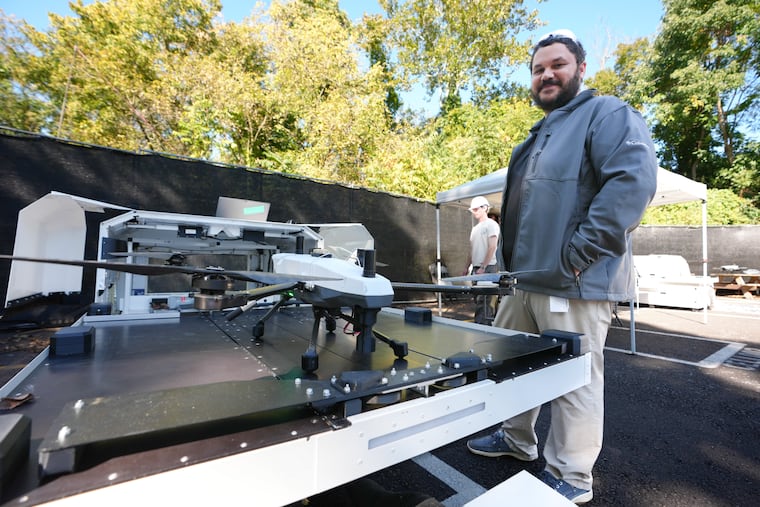
Norristown-based Asylon, whose software and hardware turn off-the-shelf doglike robots and flying quadcopters into inspectors and guards, is planning to expand from its local headquarters and development lab into a mass-production factory.
The company is gearing up for rising sales, as it sells its products to clients such as the U.S. Air Force, Citizens Bank, and pro sports arenas.
Robots are hot, with AI-informed units such as Tesla’s Optimus lines, and military contracts under President Donald Trump’s expanded defense budget, helping fuel expectations for more than 40 publicly traded robotics companies. Few are profitable, industry watchers note.
Locally, South Philly robot developer Exyn Technologies went public earlier this year. And Fort Robotics of Philadelphia, which makes software to keep robots from killing people, plans to list this fall on the Nasdaq stock exchange after merging with an investment company.
Unlike Exyn or Fort, Asylon hasn’t gone public. But the company has raised more than $45 million since its 2015 founding, from investors starting with state-backed Ben Franklin Technology Partners and including New York-based Insight Partners.
Asylon now employs more than 100 “and is hiring quickly,” chief executive Damon Henry said recently at the company’s offices, next to its control shack and testing ground above the Schuylkill.
“We’ve got a phase-three contract with the Air Force, and a follow-on to that contract, and there’s more coming,” added Henry, a former GE Aerospace and Boeing engineer who founded Asylon in 2015 with cofounders Adam Mohamed and Brent McLaughlin.
Asylon’s products include the Guardian drone pack and the “PupPack,” which mounts on Boston Dynamics quadruped robots, and the weatherproofed, robot-armed battery-swap stations that keep them powered.
“The military calls this the ‘Pez dispenser,’” Henry says, demonstrating the battery swap on a hilltop testing ground near the office. He agreed to answer questions from The Inquirer on a recent tour.
Questions and answers have been edited for clarity and brevity.
Why robots?
In the first years of the internet, Internet-of-Thing sensors, and closed-circuit TV, everything “smart” was fixed in place, and the only thing mobile were people.
Robotics enabled us to make those sensors mobile. And artificial intelligence made it so they could move around facilities.
So now we need robots that can go collect, measure, analyze, and use that data. That’s why we have built a fully-automated hardware and software stack to make that happen.
We saw the advantage for security. Now we see we can make inspections go a lot faster, and order them with more flexibility. With robots the data collection is much faster. If you’re thinking about inspecting a C-5 or a C-130 aircraft, to put airmen up there you have to bring a lot of scaffolding, and a lot of trucks. Robots are a lot more efficient.
Why dogs?
We tried a lot of formats. A quadruped has the ability to navigate any terrain. Not just paved surfaces — also grass, stairs, holes in the ground, up to a 30-degree incline.
We are exploring others: A humanoid in a parking garage structure, which doesn’t need something as complicated as a dog. A wheeled robot, for places where you can roll, not step.
And we team them up. In the case of aircraft inspections, the drones and the dogs work in tandem. The drones flying over, the dogs under the wings.
What do you add that the robots’ makers, such as Boston Dynamics, don’t provide?
Getting a robot to work reliably is a billion-dollar problem. But robots aren’t good at analyzing. There’s no replacement for domain expertise.
We are comfortable with robotics but we come from physical security and defense backgrounds. So we are the security partner of Boston Dynamics.
We’re agnostic to robot forms. We want to be the best at operating any platform, to a customer’s desired outcome. Air and ground give you a good mix.
Are Chinese makers building better robots cheaper?
The Chinese are ahead at producing cheap, $10,000 robots that do the base functions, but their reliability and mean-time-between-failures isn’t at the same place as the $200,000 robots [from U.S. makers]. Another reason [we don’t use theirs is] privacy.
We are seeing the start of [mass production] particularly in the drone space. Anduril, Skydio, [Asylon], and PDW are building National Defense Authorization Act-compliant U.S. drone products. Under the act, we use no foreign components. Motors are by far the hardest to source, [domestically-built motors] is a big need in the U.S. And magnets.
In the last two or three years some U.S. manufacturers are refocusing on drone batteries and lithium technology.
How have you branched out beyond basic security?
We started with physical operations. Security inspections and compliance. How can you more effectively see what’s going on? How do you help de-escalate potential situations? We add a machine in the loop. It’s passive.
We’ve done the Indy 500, putting out chemical and biological sensors. We’ve helped the Department of Homeland Security and the Transportation Security Administration in potentially dangerous areas.
At Mercedes-Benz Stadium in Atlanta, their guards were getting hit, spit on, yelled at; it became an employee-safety issue. Now the robot is their first interaction. It’s a deterrent and usually people [back down].
Can that work in Philly, with our history of beating up robots?
People like to beat up robots. That’s why they can flip themselves back over.
Do you name your robots?
We do a lot with employee endearment — we sometimes run a naming competition. There is Thor, from Power Design Inc. At Moderna we have Spike, and Vax.
At Citizens Bank, we have a robot at their headquarters [in Providence, R.I.]. People come up and pet it like a pet dog.
Any advantages to a Pennsylvania location?
Pennsylvania is full of contract machine shops. We have one of the densest manufacturing bases in the country. For example, we used to make the lids for the charging equipment in-house, but we found a company in the next county that assembles dog houses, and they do it now. A lot of our suppliers are within 100 miles.
And I love being a really high-tech company that’s tucked away on the end of this road, in hundred-year-old buildings, with the hardwood, and with our drones hanging from the ceiling.