Politics and misinformation shadowed the measles response in Pa. The fix won’t be easy.
The state’s messaging — and the incomplete and sometimes contradictory information emerging from local government boards and coroners — has fueled controversy since the onset of the outbreak.
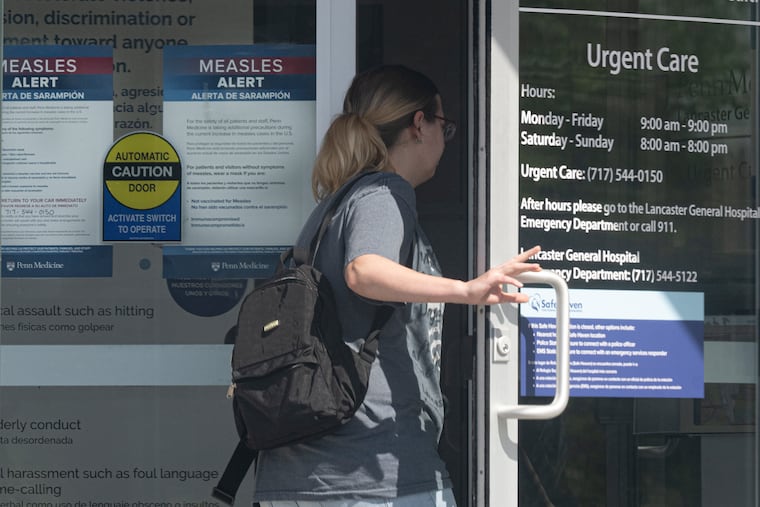
Pennsylvania health officials convened leaders from Lancaster County’s hospitals, emergency response services, and schools earlier this month in an effort to “enhance response efforts” in the community hit hardest by the spiraling measles outbreak.
But County Commissioner Ray D’Agostino, like other elected officials, was not invited. The two-term Republican commissioner has grown increasingly frustrated that most of his information about the monthslong public health crisis has come through news outlets and a public state website.
The county’s frontline responders have also taken note. “Goes to the press first … then official notices?” the county’s director of public safety wrote in an email to the commissioners’ communications director in February, forwarding a news release from the state when five measles cases were reported in the county.
The state’s messaging — and the incomplete and sometimes contradictory information emerging from local government boards and coroners — has fueled controversy since the onset of the outbreak, interviews and internal communications obtained through public records requests show.
The resulting confusion, especially over details about high-profile deaths, has contributed to the spread of politically divisive misinformation over the resurgence of a vaccine-preventable disease.
Two measles deaths in Lancaster County, announced in August by Gov. Josh Shapiro, showed how a lack of information can get exploited. Citing state privacy laws, state health officials provided few details on the deaths. When a local coroner disputed that one of the deaths was caused by measles, Health and Human Services Secretary Robert F. Kennedy Jr. claimed that Shapiro’s staff had “fabricated” the deaths.
The resulting information void allowed anti-vaccine rhetoric to spread, public health experts have said, even after prominent physicians challenged the coroner’s claim and state officials reiterated that the death fit the official definition for a “measles-associated death.”
Lancaster County relies on the state to lead the public health response to the highly contagious virus. Like all but six of the state’s 67 counties, it has no local health department to organize vaccination clinics, trace contacts of those exposed, and disseminate sensitive information about deaths.
Though local elected officials across party lines say they would welcome more information from the state on the outbreak, they differ on how that information should be shared.
Legislation proposed last year, before the outbreak began, would require the state to share more data on communicable disease outbreaks with local officials in counties that lack public health departments.
But as Alice Yoder, the lone Democrat on the Lancaster County Board of Commissioners, notes, counties like hers still would not have the public health infrastructure to handle complex data on infectious diseases.
State and local governments have a responsibility to coordinate during a health emergency, said Kathleen Hall Jamieson, the director emerita of the University of Pennsylvania’s Annenberg Public Policy Center and an expert on health communications.
“We don’t realize the need for a structure of communication until you get a communication breakdown,” she said.
State officials said that they do work closely with local leaders, and that the roundtables organized this fall in Lancaster County and Mifflin County, another central Pennsylvania community with exceptionally high infection rates, were not intended for local officials, but rather for healthcare, EMS, and school leadership.
The state notifies county commissioners and local state lawmakers when cases are first identified in their areas, and maintains a public measles dashboard to help officials track cases in “near real-time,” department spokesperson Neil Ruhland said in an email.
“PA DOH engages with them in other ways,” Ruhland wrote, noting that frustrated officials such as D’Agostino can reach out to the department to share direct feedback.
Pennsylvania Health Secretary Debra Bogen connected with county leaders at a virtual statewide commissioners meeting earlier this year. On that call, D’Agostino recalls asking for “just a little transparency” and for the state to “[work] with us” around the deaths that had recently been reported. Bogen thanked him for the comment, he said.
Crisis communications
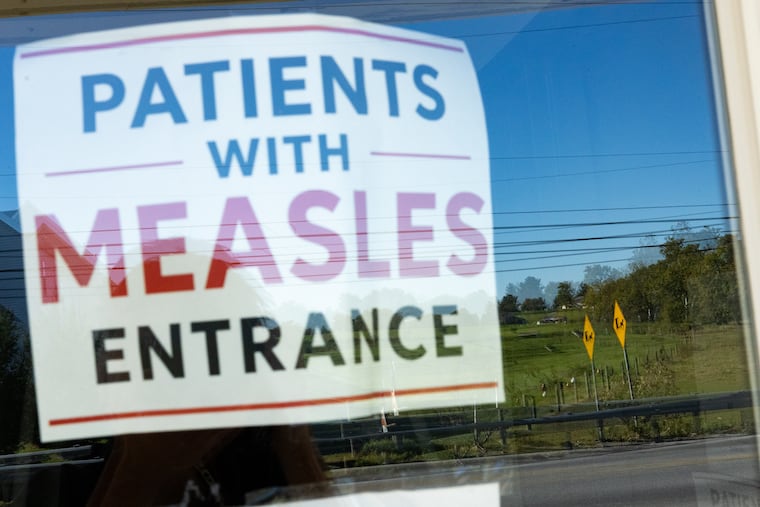
Lancaster County rapidly emerged as the epicenter of the nation’s largest measles outbreak in three decades, home to one in three of the more than 1,500 cases reported since the virus began spreading statewide last spring.
By June, Lancaster County leaders were worried about the flow of information from the state. The 31 reported measles infections were already nearly double the total cases reported across all of Pennsylvania in 2025.
Yoder, a former nurse, implored her fellow commissioners to raise awareness of the disease. She told The Inquirer at the time that she was learning about the extent of the outbreak mostly through the local news.
So was Jeffrey Martin, a physician who heads the family medicine department at Penn Medicine’s Lancaster General Hospital. He could track cases in his health system, but not elsewhere.
As the outbreak spread rapidly all summer, especially in the county’s large Amish community where many have eschewed vaccinations, Yoder could not persuade her fellow commissioners to add measles warnings to the county’s homepage.
The county does have a dedicated page on its site with information on the virus, and a map of clinics offering vaccinations.
The stakes grew higher when Shapiro held a news conference inside a Lancaster hospital in late August to announce the state’s first measles-related deaths in 30 years.
Flanked by Bogen and other state health officials, the Democratic governor linked the deaths to Kennedy’s longtime anti-vaccine activism, saying that President Donald Trump’s appointee had spread misinformation that led to plummeting vaccination rates and spiraling case counts statewide.
Lancaster County’s coroner, Stephen Diamantoni, said he was surprised by the announcement. He told reporters after the news conference that his office had handled only one of the two deaths reported in the county, in an infant who died shortly after birth, and that he did not believe it was caused by measles. Instead, he said, the death was caused by a lacerated spleen.
Prominent physicians have questioned that interpretation, saying that measles can weaken a spleen and put it at risk for rupture.
Yet the conclusion of the coroner, an elected Republican, got publicized in a series of viral tweets by Josh Parsons, a Republican county commissioner, who called for more transparency from the state. “The evidence now leads to the conclusion that there is deception happening here,” he wrote. Parsons did not return calls for comment on the state’s communications around measles.
Diamantoni also told reporters at the time that the state had not communicated directly with him about the measles death, speaking only to his deputy a few hours before the news conference.
Emails The Inquirer obtained through a public records request showed state health officials had in fact tried to contact his office for days beforehand.
At one point, an infectious-disease doctor with the state health department said that he was available “24/7” to discuss the case.
Experts see failures on both sides in the communications breakdown. The coroner’s office apparently lacked clear communication procedures to ensure prompt contact with state officials, they say. And the state could have been clearer in the initial announcement about how it defined a “measles-associated death.”
In the aftermath of the dispute, the state provided that clarity: a person who dies within 30 days of developing clinical signs of measles, with a positive lab test for the disease, whose death is not due to another cause, like a car crash.
The political fallout continues. The Centers for Disease Control and Prevention refused for weeks to add any deaths from Pennsylvania in its online tracking of measles outbreaks and still does not acknowledge the full death toll reported by the state.
At Lancaster General Hospital, Martin watched in dismay as news organizations devoted days of coverage to the sniping over the deaths. His colleagues were treating patients with severe complications from measles — pneumonia, brain swelling, cases of the virus in pregnant women — but receiving far less attention.
“The political games that are being played around deaths or not deaths really miss the point,” Martin said, noting that more than one-third of children under the age of 4 with measles are requiring hospital care. “That story needs to be told.”
The state health department has worked with Martin when he asks for more information on cases, he said, and he appreciates the agency’s local engagement in setting up community vaccination clinics.
“I feel like the state has worked really well with local county partners,” he said.
Solutions proposed
State Rep. Dave Zimmerman, a Republican who represents parts of Lancaster, has heard from constituents incensed over the state’s initial handling of the local deaths.
“There’s a lot of people in Lancaster County that felt that they were troubled by someone coming in and lying in a position like that — that essentially lied to them, that’s how they felt,” he said.
He would address their concerns through legislation requiring the state to share data on communicable disease outbreaks with county officials in counties without a local health department. He first filed the bill last January and plans to reintroduce it in the legislative session that begins next year.
He says that counties like his deserve the same kind of detailed outbreak information that counties with health departments regularly access.
Philadelphia and all four of its surrounding suburban counties in Pennsylvania operate their own health departments. But most counties have not wanted the additional expense and bureaucracy. After Delaware County created the state’s newest health department in the aftermath of the COVID-19 pandemic, it faced a protracted controversy over its responsibilities around mosquito control and restaurant inspections.
In Chester County, the local health department responded directly as the measles outbreak spread from neighboring Lancaster County. It conducted contact tracing, reached out to schools at risk of outbreaks, and monitored local cases.
Even if they cannot do similar outreach, just knowing exactly where in the county cases were reported could have helped Lancaster officials direct resources to hard-hit areas, said D’Agostino, the county commissioner, who supports Zimmerman’s bill.
During COVID, counties without health departments also had to push the state to provide more information on cases in their area, D’Agostino recalled, adding that local governments eventually worked closely with state health officials.
Yoder, a former hospital executive, said she also wants more data from the state but does not know what the county would do with it.
As a local physician, Martin noted that a public health department’s trained epidemiologists could protect such data and safeguard it from political whims.
Zimmerman said sharing knowledge is essential in a serious outbreak.
“Here in Harrisburg, we talk so much about transparency,” he said. “I believe that our department of health should be a little more transparent for some of those things without us needing to beg for it.”

-
Your questions about Pennsylvania’s measles outbreak, answered
-
Measles is thought of as a childhood illness, but more Pa. adults are getting sick
-
New vaccination data show hundreds of Philly-area schools vulnerable to a measles outbreak
-
Chester County has more measles cases than most entire states in the country
-
Pa. measles outbreak is nation’s worst, echoing deadly 1991 Philadelphia epidemic
-
Pa. measles vaccine messaging depends on word-of-mouth to reach the Amish community