President Trump’s grotesque rescue of Jensen Huang shows America’s security is for sale | Editorial
The Nvidia CEO’s government-assisted return, despite his relationship with an alleged Chinese spy, gives the next Congress a lot to look into.
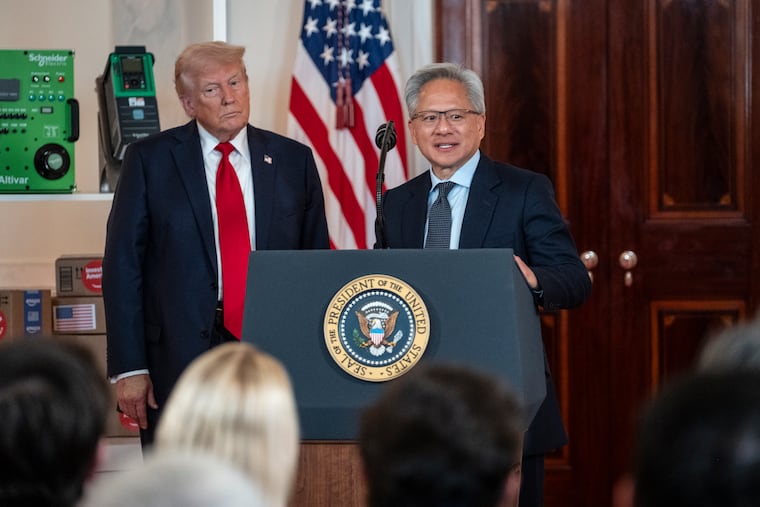

Jensen Huang, the chief executive of the AI-enabling chipmaker Nvidia, violated his duty to his family, his company, and his country. President Donald Trump considered all this and reached a verdict: What’s not to like?
This was no idle opinion on Trump’s part: He personally orchestrated Huang’s rapid, reckless return less than two weeks after he was forced to resign following reports that he had extramarital affairs with a Chinese intelligence asset and two of his subordinates. The president pressured the company’s board to reverse a justified decision, ignored the appropriate concerns of top officials in his own administration, and chose short-term profits over national security.
The sordid episode epitomized Trump’s frivolous approach to the serious issues raised by advancing artificial intelligence capabilities. Frontier AI developers such as Anthropic and OpenAI have issued a series of dramatic warnings about the dangers of the technology, and the public has bristled at its threat to employment and drain on resources. And yet, Trump has opposed every serious effort to regulate the industry for fear of slowing the flow of money into markets, his cronies’ vast accumulations of wealth, and his own portfolio.
» READ MORE: Trump’s history of sexual assault allegations cannot be forgotten | Editorial
Anthropic’s $81 billion initial public offering last week, which valued the company at $1.5 trillion, accelerated this unprecedented concentration of riches, making a few thousand company employees and investors richer than the 45 million households that make up the country’s least wealthy third. Given Anthropic’s former position at the forefront of those sounding the alarm about the dangers of AI, up to and including its “catastrophic or existential risks to humanity,” the IPO amounted to a disturbing triumph of greed and irresponsibility.
So does Huang’s breakneck comeback. The reportedly tyrannical and abusive CEO’s alleged affairs with not one but two of his employees render him unfit to manage a McDonald’s by any modern standard, much less run one of the world’s wealthiest and most powerful companies. But his relationship with an alleged Chinese spy, known variously as Alice Huang or Huang Le, has still further-reaching implications. The former state media employee led a Singaporean-based Chinese company called Megaspeed that was an outsize purchaser of Nvidia chips, raising suspicions of a plot to systematically circumvent U.S. restrictions designed to limit China’s AI development to protect American security.
One doesn’t have to look beyond Trump’s own top lieutenants to find deep concern about this.
» READ MORE: Philadelphia has the will to reopen the Academy of Natural Sciences. Let’s find a way. | Editorial
Secretary of State Marco Rubio reportedly warned the president of the executive’s compromising relationship while they were en route to Beijing in May, to which Trump responded by bringing Huang along anyway. Treasury Secretary Scott Bessent called for a “dramatic shake-up” at Nvidia, including a new leader from outside the company, only to embarrassingly backtrack days later to get in line with the boss. And Commerce Department officials were reportedly investigating Megaspeed’s alleged chip smuggling before high-level contacts between Nvidia and the administration quashed the probe.
Now, the investigation is up to the coming Democratic Congress: The presumptive next House speaker, Hakeem Jeffries, has rightly promised a “swift, thorough, and wide-ranging investigation into business malfeasance by Nvidia.”
Trump’s unscrupulous collaboration with Huang reaffirms the voters’ decisive rejection of a politics bent on enriching and enabling the few at the expense of the many.
About our editorials
Editorials express an opinion about a matter of policy or public interest that has been researched and written by our Editorial Board, a group of journalists separate from the newsroom. Unlike news stories, which are fact-driven and written by reporters, editorials advocate, champion, argue, critique, and offer solutions. Editorials are not intended to dictate what readers should think, but to cut through the noise of polarized debate and provide a catalyst for elevated discourse.