Penn started in a broke evangelical preacher’s abandoned meetinghouse. This Saturday, the city celebrates its founding.
It owes its formation to Ben Franklin and was the first American institution of higher learning with "university" in its title.
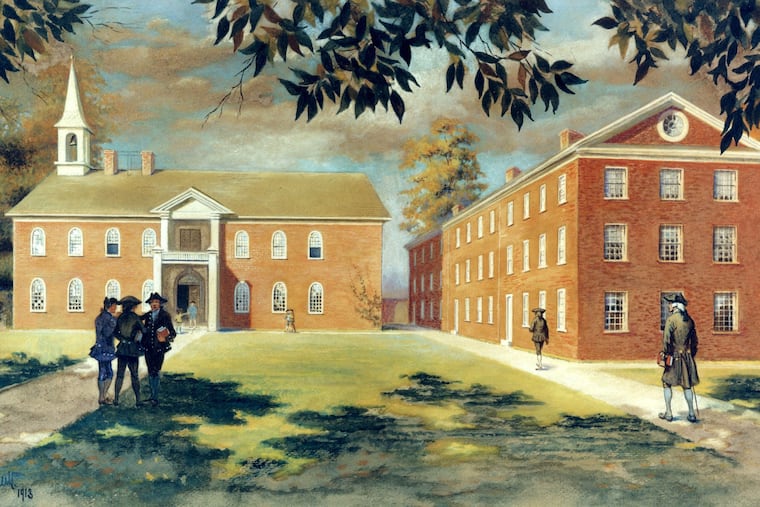
In 1740, Anglican priest George Whitefield welcomed his fellow clergymen to preach at a stately Fourth and Arch Street meetinghouse.
Whitefield, considered the father of the modern evangelical movement, declared Philadelphia his new Christian denomination’s headquarters. He dreamed of preachers from all over the world coming to speak.
That dream didn’t last. By the late 1740s, Whitefield and his movement were broke and in debt, eventually abandoning the building.
Meanwhile, Ben Franklin was in the midst of proposing a revolutionary idea of his own. The country’s first colleges were founded to train men of the cloth. But Franklin envisioned an institution of higher education that would teach the humanities, arts, sciences, and, of course, the antiquities, to the next generation of businessmen and community leaders.
He presented his proposal in 1749 and won support of prominent Philadelphians. He formed a board of trustees and purchased the former clergyman’s building. In 1751, Franklin’s College, Academy, and Charity School of Philadelphia opened to students.
The founding of Pennsylvania’s first school of higher learning, which would ultimately become the University of Pennsylvania and America’s first university, will be celebrated Saturday as part of the Philadelphia Historic District’s firstival. Firstivals are weekly day parties marking American institutions with Philadelphia roots.
This week’s firstival will be held in Penn’s Houston Hall from 11 a.m. to 1 p.m.
In 1755, Penn trustees secured a new charter for the school, named it the College of Philadelphia, and appointed William Smith as the first provost. The first class of seven boys graduated in 1757, said John H. Pollack, curator of research services at the University of Pennsylvania’s Kislak Center for Special Collections.
However, explained J.M. Duffin, Penn’s assistant archivist, the College of Philadelphia didn’t become a university until 1765 when physicians John Morgan and William Shippen opened the country’s first medical college there.
“Now there were two distinct colleges operating under the same umbrella,” Duffin said. “This now qualified the College of Philadelphia as a university, the first on North American soil.”
During the Revolutionary War, the Pennsylvania legislature removed Smith because of his loyalty to Britain, Pollack said. The legislature formed a new board of trustees and a new charter changing the institution’s name to the University of the State of Pennsylvania. (The University of Pennsylvania was a state school before Penn State.)
“With that, we became the first school to have the term ‘university’ in our name,” Pollack said.
Smith returned to the university after the war seeking his old position. In 1789 the legislature created two separate institutions and Smith was put in charge of one. His university was situated in the original building at Fourth and Arch. The second school moved to the American Philosophical Society at Fifth and Chestnut.
“Those were a weird couple of years,” Pollack said. “There were two colleges and two medical schools. … But there weren’t enough students to sustain two universities.”
Pennsylvania adopted a new state constitution in 1791. Language in the document joined the two schools and established the University of Pennsylvania as a private school.
The university moved to Ninth and Market in the 1800s.
“The state built that building to be the president’s house when it believed Philadelphia would be the capital city,” Duffin said. In this location, the University of Pennsylvania was the center of Philadelphia’s political and social scene.
“Penn wasn’t isolated from the world in its ivory tower,” Pollack said. “It wasn’t part of that elite club that the Ivy League evokes today.”
It moved to its West Philadelphia campus in 1872, occupying four buildings designed by architect and Penn alum Thomas Webb Richards.
In 1882, Penn — following in the footsteps of graduate and doctoral programs at Johns Hopkins University — introduced its graduate program. The program meant more faculty, staff, and degrees, becoming the bellwether for the university system that we know today.
“During the late 1880s, through until about 1930, we see Penn’s biggest period of growth,” Duffin said. With the 20th century came a focus on college sports, especially football. Sports journalists began referring to many of the private colleges with strong sports teams as the Ivy League, a reference to their ivy-covered stone buildings.
In 1954, Penn was one of eight schools — seven of which started in colonial America — that signed the agreement forming the the Ivy League athletic conference.
With time, the Ivy League schools became synonymous with America’s most elite institutions.
Today the University of Pennsylvania boasts more than 30,000 students and 6,049 faculty members, with four undergraduate schools and 12 graduate and professional schools.
This week’s Firstival is Saturday, Nov. 14, 11 a.m. to 1 p.m. at Houston Hall at the University of Pennsylvania, 3417 Spruce St.
The Inquirer will highlight a “first” from the Philadelphia Historic District’s 52 Weeks of Firsts program every week. A “52 Weeks of Firsts” podcast, produced by All That’s Good Productions, drops every Tuesday.