A climate disaster rises in Western Pa. Jared Kushner is here for it.
As the world burns from climate change, a monster gas plant/data center in Pennsylvania is backed by Kushner’s petrodollars.

Homer City, Pa. — a tiny borough of just 1,746 people about 50 miles east of Pittsburgh in Western Pennsylvania, named for the Greek bard and home to a museum that fits inside an old railroad caboose — is not a place you’d expect would get much attention from the president of the United States … or his avaricious family.
But this remote outpost in Indiana County has been on Donald Trump’s radar since his 2024 campaign, when he bemoaned the looming implosion of the towering 100-foot smokestacks that has once made a massive coal-fired power plant the region’s most prominent landmark. In July 2025, the now-47th president returned to Pennsylvania with news.
Trump said a global fund called Knighthead Capital would spend some $15 billion in Homer City to build a massive new power plant — now to be fueled by natural gas from fracking — and a data center at the abandoned coal plant. “They’re going to spend billions of dollars on rebuilding it,” he said. “It’s going to be the largest plant of its kind in the world, I believe. It’s going to be great.”
Just over three months later, a Bombardier Challenger private jet touched down at Indiana County’s Jimmy Stewart Airport, and out popped a modern-day Mr. Potter: Jared Kushner. Trump’s son-in-law, in a North Face vest and baseball cap, posed for a photo with the airport manager amid unconfirmed rumors he was checking out the Homer City project.
This July, a veteran financial journalist named Miles Weiss unearthed a regulatory document showing that a Cayman Islands-based subsidiary of Kushner’s Affinity Partners, his $6 billion investment vehicle funded almost solely by oil dictatorships like Saudi Arabia and the United Arab Emirates, has made a major investment in the Pennsylvania power plant.
The confluence of 21st century power and wealth on little Homer City — not just the involvement of the Trump family and Middle East oil money, but the news that a whopping 36 data centers on the site will power artificial intelligence, or AI, for Amazon Web Services — would overwhelm even the Everyman heroes portrayed by local native Stewart. But that’s not even the biggest question here.
No, that would be this: How — after a summer when global warming fueled record heat waves, wildfires and killer floods, and as the United Nations said just this week that civilization is blowing its last chance to avert climate disaster — did this rising greenhouse-gas monstrosity in Western Pennsylvania get this far along?
If the U.N. wants to dig deeper into why the Earth is missing the life-or-death goal of avoiding a 1.5-degree Celsius rise in average temperatures, let them come to Homer City.
The massive bank of gas turbines at Homer City aims to produce up to 4.7 gigawatts of power, or considerably more than double the capacity of the coal plant, which in its heyday was the largest source of electricity in Pennsylvania. The size of the project overrides the fact that natural gas is a cleaner source of energy than coal. The gas turbines are projected to spew more particulate matter, volatile organic compounds (VOCs), and carbon dioxide into the air than the coal plant did.
An alarming new report on data centers and their natural gas power plants by the environmental group Earthjustice notes that the opening of the Homer City facility would increase carbon emissions from all Pennsylvania power plants by a whopping 15%, right at the moment that climate change is becoming a five-alarm fire.
The potential damage is stunning: The formula developed by the U.S. Environmental Protection Agency for the global social costs of carbon pollution would peg the annual damage from Homer City at $2.5 billion. A separate EPA formula projects that ozone and particulate pollution would kill at least 13 to 22 people prematurely every year.
“The AI data center boom is truly the greatest threat to a stable climate that we face today,” Alex Bomstein, executive director of the Clean Air Council in Pennsylvania, told me.
The pollution projections are alarming both to the national community of climate groups — who see Homer City as the vanguard of a trend that would see nine of the 10 largest power plants in the United States as new gas-fired facilities driving AI data centers — and to locals who lived through the environmental degradation of the coal plant for decades.
“Homer City is an environmental justice area, which means these communities are more vulnerable to climate and health risks, and are supposed to get special attention from the state,” Leigh Hendrix, a local activist with Concerned Residents of Western PA (CROW) told me this week.
Instead, the special attention for the Homer City project from government officials has been often silent acquiescence from their local representatives, a speeded-up “concierge” permitting process from Gov. Josh Shapiro’s administration, and an endorsement from the president as a close relative saw dollar signs.
Some local support for this project in an economically struggling corner of Western Pennsylvania is understandable. The massive private development would mean a surge in tax dollars for a Homer-Center School District which, like many rural districts, struggles with resources and enrollment. The coal plant was a major employer, and while job creation by data centers is often underwhelming, the sheer size of this project would eventually means hundreds of new hires, on top of the construction work.
Still, Jack Hanna — a retired, politically active, attorney who’s lived most of his life in Indiana County — said he’s deeply troubled by the secrecy from county and other local officials who professed to know little about the massive project even as it gained momentum behind gilded locked doors.
“Very, very little information is released by the company and by public officials,” Hanna said. “The company — they have their motivations and I understand that. But public officials, in my opinion, have a duty to have transparency and public disclosure …”
For the developers, there have been many advantages to building at the coal-plant site — existing connections to the power grid and local water supplies, as well as emissions credits for ending coal burning, and some established permits for the site, which was bought by Knighthead in 2017 as a bankrupt “distressed property,” that have greatly eased permitting.
The Earthjustice report noted the Homer City gas plant received an air permit from the Pennsylvania Department of Environmental Protection (DEP) in just seven months, far less than typical. A Right-to-Know request by environmental opponents found a communication from a DEP staffer that the goal was “to provide a concierge level of service” for a project that Shapiro had endorsed as a source of economic development for Indiana County.
In August, Shapiro publicly reversed course on data centers and said the state would now be imposing strict guardrails, but Homer City plant opponents say they’ve seen no change in state policy. Local residents continue to fight a wastewater permit for the plant — arguing it would dump 110-degree water into creeks that were coming back to life after a coal era when they often turned orange with waste — while a coalition of groups including the Clean Air Council is aggressively appealing the air permit.
Little opposition is expected from Trump’s totally neutered EPA, with the president continuing to serve as a cheerleader for both fossil fuels — including the fracking of natural gas in Pennsylvania that would need to increase in order to power Homer City — and data centers, even as their popularity with voters plummets. Earlier this month, Trump praised data centers in Ohio as “so much money to be made …”
Now it appears his own son-in-law will be making some of that cash. Weiss, the financial journalist with a site called Deadline Disclosures, uncovered a June regulatory filing by an affiliate of Kushner’s fund called Affinity HC Cayman Blocker L.L.C. The Cayman vehicle disclosed that it held an equity stake in Homer City Holdings L.L.C., parent company to the power plant. Weiss wrote that the filing did not disclose the size of the Affinity/Kushner investment but he speculated it was sizable, noting that the firm had disclosed borrowing money against its stake.
The source of Affinity Partners’ assets is almost entirely from the sovereign wealth funds of Middle Eastern oil producers such as the Saudis, UAE, and Qatar — all nations that Kushner routinely deals with in his wildly conflicting role as a “peace” negotiator in the region for his father-in-law. The world’s most powerful people taking such interest in a small Pennsylvania borough only makes sense as part of their drive to maintain the dominance of fossil fuels, climate crisis be damned.
I know you’ll be shocked to learn that Affinity Partners has not yet responded to my request for comment.
» READ MORE: The annoying buzz of our AI future is keeping Vineland awake | Will Bunch
The locals who are fighting against an environmental nightmare understand what they are up against, because Pennsylvania has been here before, again and again. From the first oil rigs in the mid-19th century backed by John D. Rockefeller that scarred the landscape, to the bloody workers’ battles with coal mine owners, the story of the Keystone State has been the brutality of an extraction economy.
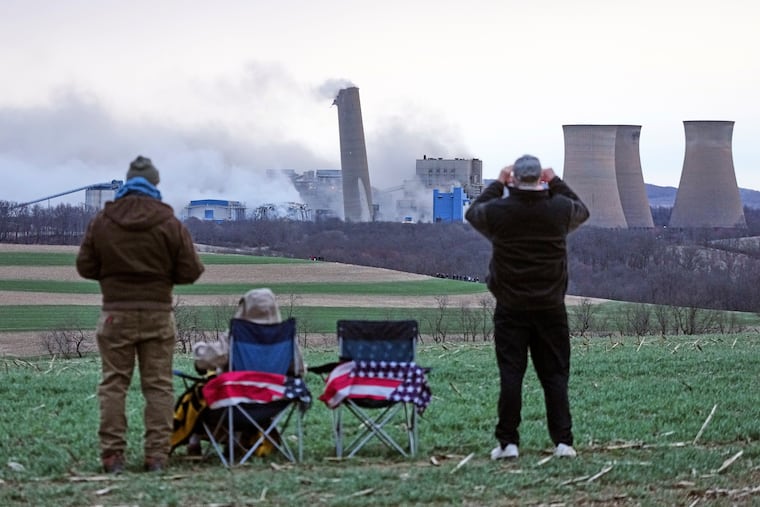
And every time we try to get out — like the implosion of those coal plant smokestacks in March 2025 — they pull us back in with their newest discovery of black gold under our lush hillsides.
“That’s a really critical thing about this place — this history of boom and bust and extraction,” Hendrix told me. But while the prospect that AI data centers will create billion-dollar fortunes for a handful of politically wired folks — money that even Rockefeller could not have dreamed of — is now sparking significant backlash, the vampire squids of a fossil-fuel kleptocracy will keep drilling for new gushers.
This August, locals at the popular Viewmont Diner on Business Route 6 near Scranton were shocked to see Kushner and his wife, the president’s daughter Ivanka, eating there. The diner is not far from a Scranton suburb where as many as five large data center projects have been proposed.
The fight over modern Pottervilles in Pennsylvania has just begun. Where’s Jimmy Stewart when you need him?
About our columnists
In contrast to news reporters, who operate within an independent, nonpartisan framework, columnists are charged with including their perspectives, opinions, and viewpoints when presenting their reporting. Inquirer columnists include Jenice Armstrong, Will Bunch, Luis F. Carrasco, Paul Davies, Daniel Pearson, Trudy Rubin, and Sabrina Vourvoulias.

Sign up for the Will Bunch Newsletter