Philly Marathon discriminates by not allowing nonbinary runners in pro division, lawsuit says
The Philadelphia Marathon has allowed for nonbinary registration since 2022, but to compete with professional athletes for top prizes participants need to select to run as male or female.

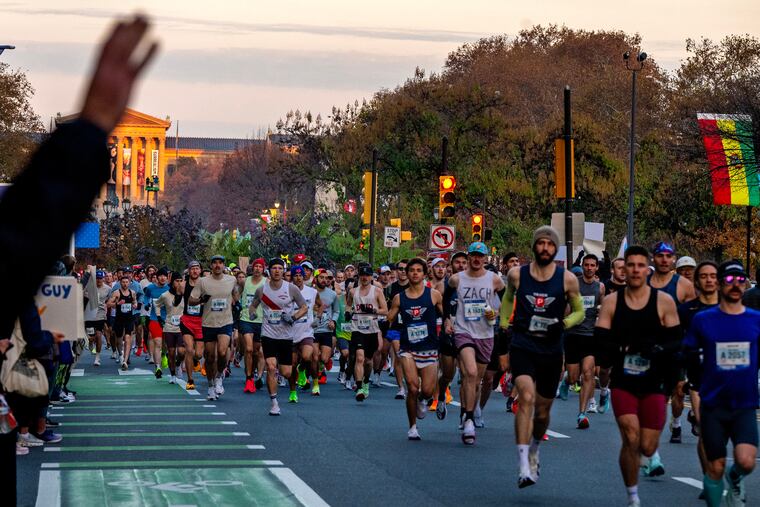
Roughly 40,000 people are expected to run in the Philadelphia Marathon Weekend races Saturday and Sunday, but a new lawsuit says not all runners are treated equally.
Three nonbinary athletes say the race violates city antidiscrimination law because the marathon and half marathon do not offer a nonbinary registration option in the professional divisions.
Athletes can register as nonbinary in the open division, which is meant for the wider public, but runners must register as male or female to compete for a larger cash prize, extra accommodations offered to elite runners, and prestige.
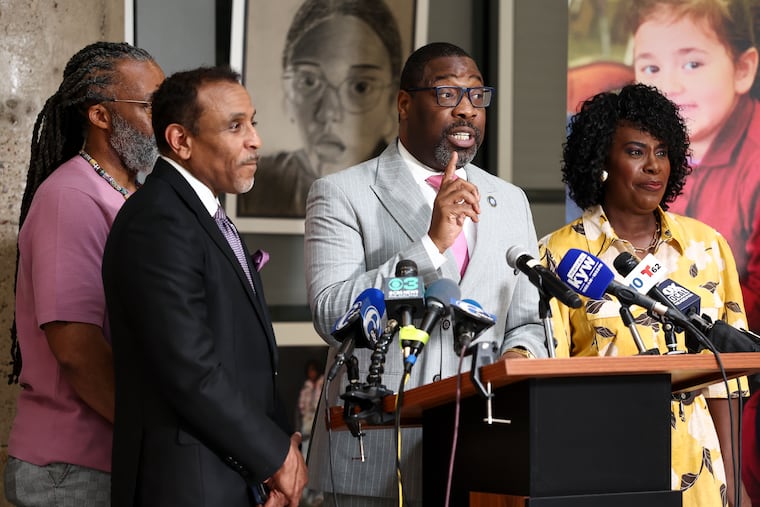
Winter Parts, Reed Williams, and Miche Palmer — nonbinary runners who have run in Philadelphia Marathon races in previous years — filed the lawsuit against the city and race director Kathleen Titus on Tuesday in Common Pleas Court.
“The Philadelphia Fair Practices Ordinances has a very specific protection prohibiting discrimination on the basis of gender identity,” said Maia Goodell, the attorney representing the runners.
The suit asks a judge to find the city violated the Philadelphia Fair Practices Ordinance, order the race to end its discrimination against nonbinary athletes, and award the three runners damages.
A spokesperson for the Philadelphia Law Department declined to comment, as did Titus through a spokesperson.
» READ MORE: Swarthmore College says U.S. Supreme Court ruling on trans athletes dealt blow to alum’s lawsuit
Local LGBTQ+ run clubs, such as Queer Run and Lez Run, asked the Philadelphia Marathon to allow participants to register as nonbinary for years before the race ultimately opened nonbinary registration for nonprofessional runners in 2022, the suit says.
The run clubs met with Titus ahead of the 2023 race to advocate for a nonbinary professional registration option that would offer “equal benefits, status, and prize money,” the suit says.
Professional runners who qualify receive free registration and special starting positions, and may be eligible for complimentary travel and accommodations. The elite runners also receive additional support on race day, such as special hydration stations.
“We brought up examples from other races. We discussed things like qualifying standards. We tried to address any practical questions that were being raised,” said Josh Fernandez, president and executive director of Queer Run.
But the marathon would not open professional registration for nonbinary athletes.
In 2024, the marathon created a path for nonbinary runners to win cash awards in the open division. But registration for the professional division remains male or female.
Nearly 120 nonbinary runners participated in races throughout the marathon weekend that year.
The marathon’s professional division policy follows the guidance of USA Track & Field, the city and race organizers previously told The Inquirer.
The nonbinary runners’ placements would have garnered them additional prize money had there been a professional division, the suit says.
Williams placed first in the nonbinary open division in 2024 and won $4,000, the suit says, instead of the $10,000 the professional division winners won.
Parts first ran the Philadelphia half marathon in 2021, and had to register as male despite identifying as nonbinary.
In 2022, Parts finished as the first nonbinary runner in the marathon’s open division, the suit says. The top prize for the fastest male or female runner was $10,000, but Parts received nothing.
“We’re not in this for the money,” Parts said. “We’re in it for the equality.”
Even after allowing nonbinary registration, much of the event’s infrastructure did not adapt to serve the new category, the suit says.
After top runners crossed the finish line in 2022, marathon staff directed male athletes to one direction and female athletes to another direction, the 28-year-old Pennsylvania State University graduate student said. Fatigued from running 26.2 miles, Parts had to pick a side because there was no nonbinary option despite the registration option.
Even though they are nonbinary, Parts likes having a feminine presentation. But fearing some people would assume they registered as a woman to rank highly, the runner chose to join the men.
The runner was forced to choose how to be misgendered, they said, because the system did not accommodate nonbinary runners.
“I think a lot of those people don’t understand how much mental difficulty we got through in trying to avoid these kind of difficult situation,” Parts said.
When the results of the 2022 race were published online, all nonbinary runners were assigned either male or female, the suit says.
The following year, Williams witnessed nonbinary runners misgendered at the finish line, the complaint says.
Williams and Parts are not running this year, the suit says. Parts will be on the sideline to cheer on friends and other nonbinary runners. Among them will be Palmer, who decided to run with training partners despite the discrimination, according to the suit.
“It’s a complicated set of emotions,” Parts said ahead of the weekend. “It sucks that this race is not fully including us.”