Josh Shapiro for governor of Pennsylvania | Endorsement
Shapiro prides himself on getting stuff done. But what truly sets him apart are his commonsense policies, willingness to stand up for what is right, and ability to work across the aisle.
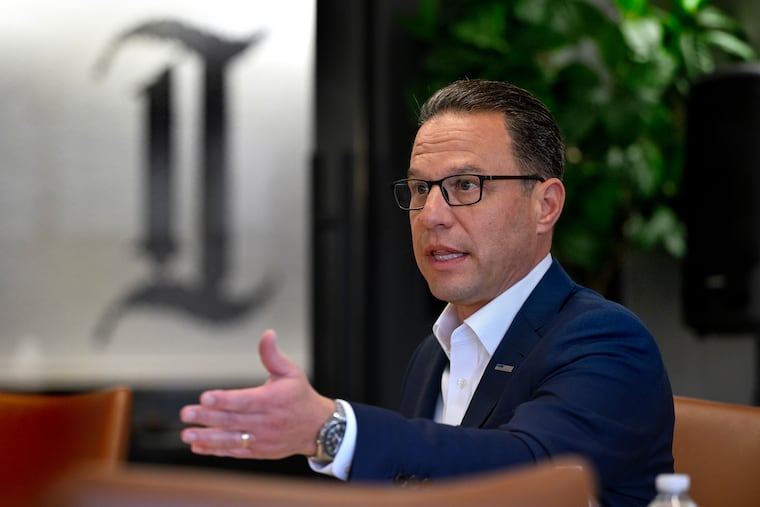

If the polls are accurate, Gov. Josh Shapiro, who was twice elected Pennsylvania’s attorney general, should cruise to his fourth statewide election on Nov. 3.
In these divided political times, in one of the most evenly split states in the country, that says a lot about Shapiro’s ability to appeal to a broad swath of voters across the commonwealth.
While the two political extremes on the right and left generate the most noise, Shapiro sits in the moderate middle. That rankles many on the far left and the right, but it is smart politics in Pennsylvania.
While Shapiro is pragmatic, he is also tough and empathetic. He takes public service seriously but is also a regular guy from Abington who is passionate about Philly sports. He is welcome in boardrooms, Black churches, and even red counties.
Shapiro surrounds himself with competent people and prides himself on getting stuff done. His administration has been largely free of drama and major scandals — a stark difference from the chaos, corruption, and incompetence coming from the Trump administration.
As state attorney general and governor, Shapiro repeatedly stood up to Donald Trump. He went 43-0 defending flimsy lawsuits Trump filed to overturn the results of the 2020 presidential election. Shapiro also brought some accountability to opioid companies, racist mortgage lenders, and decades of sexual abuse within the Roman Catholic Church.
As governor, Shapiro has sued the Trump administration two dozen times, opposing efforts to slash federal funding for Pennsylvania and roll back environmental regulations. Shapiro — and Al Schmidt, the Republican he appointed to run state elections — are ready to defend against Trump’s efforts to subvert the 2026 election.
As democracy teeters, Shapiro’s legal bulwark against Trump is reason enough to keep him in the governor’s mansion. But his commonsense policies, willingness to stand up for what is right, and ability to work across the aisle cements the case for why The Inquirer Editorial Board endorses Josh Shapiro for a second term as governor.
This was not a difficult decision, because his opponent, Stacy Garrity, the Republican state treasurer from Bradford County, has a slim record. Even worse, she supports Trump’s disastrous MAGA agenda as well as data centers and sleazy skill games — three big strikes.
Garrity’s main accomplishment as treasurer has been returning unclaimed property to Pennsylvanians and hundreds of unclaimed military decorations to veterans. That constitutes a practical, down-to-earth baseline for her role to be sure, but Garrity’s resumé lacks the kind of expansive, broad-based signature achievement to suggest that she would bring a truly transformational approach to governing. Her biggest donor is Robert Asher, a longtime GOP power broker from Montgomery County who was convicted of bribery in 1986.
Garrity’s best argument may be that she is not Doug Mastriano, the GOP’s 2022 gubernatorial nominee, who dressed up in Confederate garb and helped plan Trump’s Jan. 6, 2021, coup attempt.
The Editorial Board invited Garrity to advocate for her candidacy, but she did not respond to multiple requests to meet. Shapiro, on the other hand, has a compelling case to make, which explains his commanding lead in the polls.
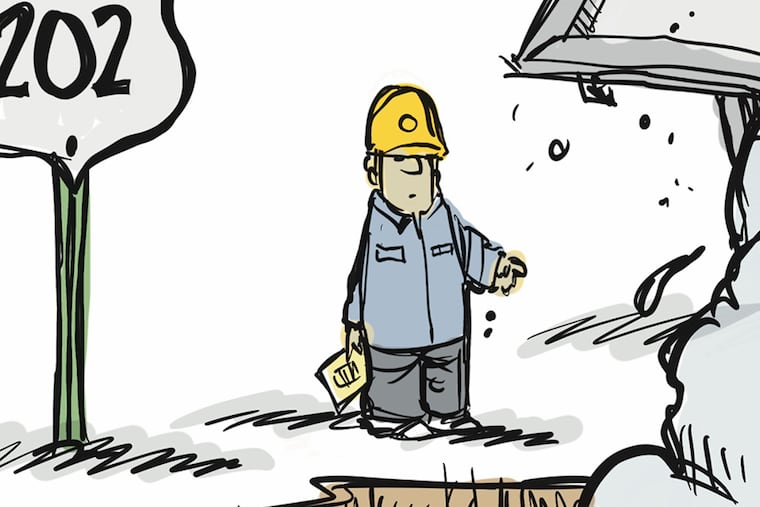
Shapiro’s most high-profile accomplishment was rebuilding the stretch of I-95 that collapsed in Northeast Philadelphia after a tanker truck fire in 2023. The highway closure along the main artery connecting the Northeast trucking corridor was expected to take many months to fix.
But Shapiro mobilized federal, state, and local officials, used accelerated emergency contracting rules, and hired a Philadelphia-based construction firm that worked round the clock to reopen the highway in 12 days.
It was a case study in how government can do good under the right leadership. It’s also a stark contrast to Trump’s multiple, ongoing fiascos, including the botched reflecting pool repairs, the costly White House ballroom, and the sabotaging of the John F. Kennedy Center for the Performing Arts.
Under Shapiro, the commonwealth has lowered taxes for some, increased public safety, and pushed policies to make housing more affordable. Unlike Trump’s relentless efforts to restrict voting, the governor expanded voter registration by making it automatic for eligible voters when they renew or receive a driver’s license or ID at driver and photo license centers.
Shapiro has also increased funding for public education by hundreds of millions of dollars. Pennsylvania remains far below adequate funding levels, even after a state court found in 2023 that the state’s funding system was unconstitutional.
Shapiro’s efforts to close the education funding gap faced opposition from the Republican-controlled state Senate. The recalcitrant GOP has stymied other efforts to adequately fund mass transit, increase the minimum wage, and tax skill games at the same rate as slots.
But it is not due to a lack of effort by Shapiro. The divided legislature makes Harrisburg largely ungovernable. That is why Shapiro is working to help Democrats flip at least two seats to win control of the state Senate and maintain their thin majority in the state House.
The last time Democrats controlled all three chambers of government was in 1993. As a result of the chronic stalemate, a lot hasn’t happened in Harrisburg beyond keeping lobbyists employed and lawmakers in power. Just getting the budget passed is an annual ordeal.
If Shapiro’s coattails can power Democrats to control of the House and Senate, the first bill he plans to sign will be to increase the minimum wage to $15 an hour. Other major initiatives on Shapiro’s to-do list include increasing mass transit funding and codifying abortion and LGBTQ rights.
“I’ve got a lot more to do, which is why I’m running again,” Shapiro told the Editorial Board.
Of course, the governor is far from perfect. He was for data centers before he was against them. (But he listened to voters and adjusted.) He supports legalizing and taxing skill games — which are more predatory than slot machines — rather than banning them as Kentucky did.
Shapiro has been largely mum on efforts to reform or better yet repeal Act 12, which has allowed for-profit companies to buy public water and sewer utilities, and jack up rates for residents. (He did force Peco to withdraw a double-digit rate-hike request.)
Shapiro helped attract thousands of new jobs to Pennsylvania, often dangling financial incentives like the ones used to lure the Burlington Stores headquarters and a Chobani facility to Philadelphia. Another pricey deal that included more than $600 million in state and federal money combined is expected to add 6,000 jobs at the Philadelphia Port. (Attracting jobs is nice, though there is an argument to be made as to whether the state should use tax dollars to pick winners.)
It is widely assumed Shapiro will run for president in 2028. That campaign will begin early next year, raising concern if Shapiro enters the race that he may be distracted from his day job while campaigning in South Carolina, Iowa, New Hampshire, and beyond.
Since the road to the White House leads through Pennsylvania, Shapiro may be uniquely positioned to clean up Trump’s mess. But a White House win means Shapiro would not complete his gubernatorial term. Though two years of Shapiro is certainly better than four of Garrity.
When asked about running for president, Shapiro told the Editorial Board, “The only thing I’m running for is governor.” (Check back in a few months and see how well that quote ages.)
During recent campaign events with students at the University of Pennsylvania and at an event at a Black church in Abington, Shapiro looked beyond his own reelection and painted a picture of what could happen if Democrats take control of the state Senate and the House in Washington.
“You have the power to make a difference,” Shapiro told the Penn students.
At Salem Baptist Church, Shapiro told the crowd of mostly Black women their votes could give hourly workers a raise, increase funding for mass transit, and protect reproductive rights.
Shapiro’s reelection could bring positive change across Pennsylvania — and maybe propel the governor to new heights.
About our editorials
Editorials express an opinion about a matter of policy or public interest that has been researched and written by our Editorial Board, a group of journalists separate from the newsroom. Unlike news stories, which are fact-driven and written by reporters, editorials advocate, champion, argue, critique, and offer solutions. Editorials are not intended to dictate what readers should think, but to cut through the noise of polarized debate and provide a catalyst for elevated discourse.