Philadelphia’s 7% advertising tax would hit small media outlets hardest
The city’s proposed levy threatens local publishers, independent journalism, and the communities whose stories too often go untold.
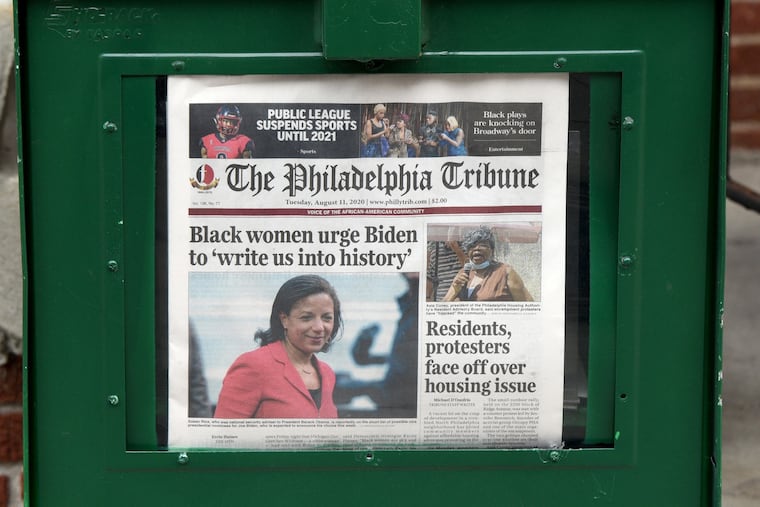
Elizabeth H. Hughes is the publisher and CEO of The Inquirer, Sara M. Lomax is president and CEO of WURD Radio, Larry Platt is president and CEO of Citizen Media Group, Robert W. Bogle is president and CEO of the Philadelphia Tribune, and Mark Segal is the founder and publisher of Philadelphia Gay News.
Public education and a free press are pillars of a healthy democracy. In Philadelphia, democracy’s birthplace, we ought to be investing in both. Which is why we are so troubled by the proposal from City Council President Kenyatta Johnson and Mayor Cherelle L. Parker to expand a 7% tax on advertising to fund our public schools. Surely we can educate the next generation without jeopardizing the institutions that keep our citizens informed. If we can’t, all of us face dire consequences, both as an economy and as a beacon of democracy.
The Johnson-Parker proposal would expand the city’s existing outdoor advertising tax to newspapers, magazines, television, radio, and digital media. Its goal of generating $50 million for the school district is laudable. But its unintended consequences could do lasting damage to our city’s economic, civic, and cultural fabric.
Advertising is an engine of local economic activity. According to the Advertising Coalition, every $1 spent on advertising generates $21 in economic activity, and every $1 million in advertising leads to 59 American jobs.
The tax would make it more expensive for neighborhood restaurants, independent retailers, our museums, and businesses owned by women and people of color to reach new customers.
All those sponsorships that support the salaries of our beloved professional athletes? They’d be in serious jeopardy, too. Econ 101 tells us advertisers will buy less advertising, leaving local media with less revenue to employ Philadelphians and tell Philadelphia’s stories. National advertisers, meanwhile, will conclude their dollars go further in other markets.
At a time when we should be encouraging businesses to invest in Philadelphia, this proposal would do the opposite. It also runs counter to how other cities, recognizing the importance of a free local press to civic health, are bolstering their news ecosystems.
At a time when we should be encouraging businesses to invest in Philadelphia, this proposal would do the opposite.
New York City, Chicago, and San Francisco all direct municipal ad dollars toward local, multicultural, and community-based outlets. New York has enacted a $90 million three-year payroll tax credit for local newsrooms, and New Mexico offers a 30% wage tax credit for local newsrooms to hire and retain talent.
Here, local media organizations have long fought to keep advertising dollars in Philadelphia as spending migrates to global technology companies like Meta. But when you advertise with a local news organization, you help pay someone to cover your community meetings, investigate how your tax dollars are spent, and review your arts institutions.
We’ve been here before. In 1765, the British Parliament imposed a tax on newspaper advertisements as part of the Stamp Act. Benjamin Franklin, himself a publisher who understood the relationship between advertising and editorial independence, was among its most prominent opponents. His principle remains true today: Freedom of the press cannot be meaningfully separated from the economic conditions that make a free press possible.
Since then, the courts — including the U.S. Supreme Court — have repeatedly recognized the constitutional dangers of imposing special financial burdens on the press. Whatever the legal merits of Philadelphia’s proposal, the prospect of protracted and costly litigation ought to give policymakers pause.
Like the mayor and the Council president, we, too, have a stake in the success of Philadelphia’s schools. But the $50 million sought represents less than one-half of 1% of what the city spends on education.
Have we exhausted every opportunity to redeploy existing resources? Have we fully assessed the tax’s economic consequences? And have we heard from the people whose businesses and communities would be most affected?
We ask that Council reject this proposal and work with the business, education, and media communities to identify a more sustainable solution. And we ask you — Philadelphia’s media consumers — to urge your Council representative to slow down and act more deliberatively.
Remind your elected representative that Philadelphia has a diverse ecosystem of independent media, much of it established because certain voices have been denied equal access to the public square.
Our African American press, Latino publications, LGBTQ media, immigrant-serving news organizations, and neighborhood newspapers are not merely small businesses. They are institutions of belonging, places where generations of Philadelphians have seen themselves reflected in the larger story of their city.
These are among the media outlets least equipped to withstand another economic shock. In the last decade, many corporate advertisers have walked away from investments in multicultural media. Now comes another financial disincentive to support those publications — this time from our own city government.
There is a cruel irony here. A city administration purportedly committed to economic inclusion and lifting up historically marginalized communities risks enacting a policy that diminishes those communities’ ability to be heard. A tax can be uniform in its application and profoundly inequitable in its impact.
Philadelphia cannot credibly champion diversity while jeopardizing the institutions that embody it. We cannot lament the national assault on independent journalism while making its practice more economically precarious here at home. We cannot celebrate ourselves as the birthplace of democracy while inhibiting free and open debate in the 250th year of this grand experiment. And we ought not ask the communities that have historically had the least access to the marketplace of ideas to bear a disproportionate share of the cost of educating the next generation.
After all, what are we educating our children for, if not to participate in a democracy in which their voices matter?
The authors submitted this essay with the support and contributions of more than a half dozen other Philadelphia news media leaders, including: Monique Curry-Mims, publisher and editor-in-chief, Generocity; Melissa Mitman, editor, Metro Philadelphia; Alex Mulcahy, publisher, Grid Magazine; Donna Shaw and Jeff Meade, coeditors, Chestnut Hill Local; Gene Sonn, program manager, Philadelphia Journalism Collaborative; and Christopher Wink, publisher, Technical.ly.
About guest essays
Guest essays, or op-eds, are commentary pieces that present the opinion or perspective of the author. Many are submitted to us by Inquirer readers and writers with insight on the news, but we also solicit op-eds from authors on specific topics. For more information visit our guidelines.