As costs rise faster than people can keep up, Share Food Program offers sustenance for body and soul | Philly Gives
The most vulnerable Philadelphians don’t need a research company to analyze what’s going on in the economy. They just open their refrigerators and see what’s not there. Share tries to help.


About Philly Gives

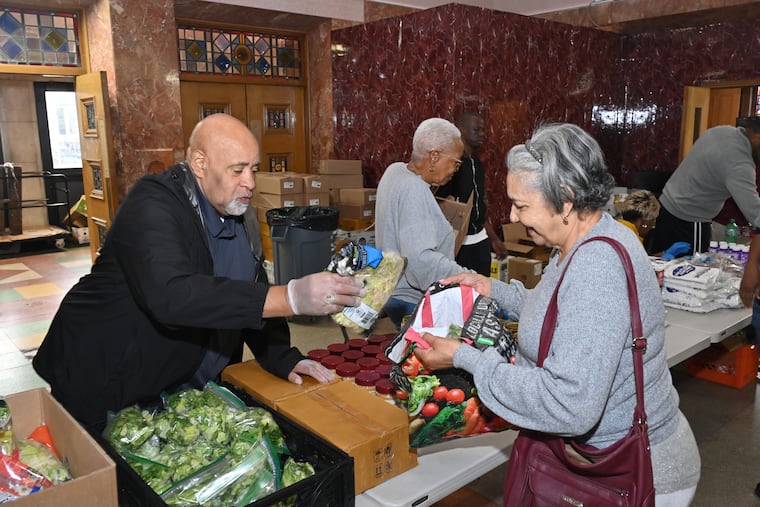
Let’s take inventory of Ken Berry’s refrigerator before he arrived at the Friday food pantry at St. Benedict’s church in West Oak Lane.
“A bottle of water, half a can of tomatoes, a can of peaches, a can of diced pears. Freezer, empty. Vegetable drawers? What’s that?” Berry listed.
The night before, he finished the last of a slow-cooker meal of ground turkey, rice, and beans that he had managed to stretch out over a couple of days.
“My mind is spinning,” he said, excited about what he might cook with ingredients from a heavy bag of groceries provided by Share Food Program and other partners. Ground turkey, frozen pollock, a nice-looking head of lettuce, rice, beans, yogurt, cheese, and butter, plus some canned goods added up to some decent meals at the right price.
Food, like everything else, costs more — and not just for Berry and the 120-plus other West Oak Lane neighbors who stopped in for groceries that day.
Costs are also up for Share. The nonprofit, with its main warehouses and offices near Henry, Hunting Park, and Allegheny Avenues, pays $12,000 to $14,000 a month for electricity to keep those warehouses running, along with two others, one in Ridley Park and the other near Lansdale.

Help Support This Work

Last year, each tractor-trailer-sized truckload of food cost $40,000. Now it costs 15% more — $46,000 — to fill that truck.
Share needs money for forklifts, for payroll, for trucks. Funding pays for groceries, of course, but it’s also necessary to bankroll the infrastructure required to move not just boxes of food but tons of it to the people who need it. Share pays drivers to deliver food to homebound seniors.
As for the trucks? In mid-October, diesel fuel was running $6.18 a gallon, up 66.5% from $3.71 a gallon a year ago, according to Macrotrends LLC, a research company that tracks prices on everything from diesel to chuck roasts.
Indeed, those are the macro trends, but at St. Benedict’s, no one needs a research company to analyze what’s going on in the economy. All they have to do is open their cupboards and refrigerators and see what’s not there.
“The jobs aren’t paying enough, and everything’s going up,” said Tanya Lewis, who is raising five grandchildren, ranging in age from 18 to 12, in her home in West Oak Lane.
“Two weeks ago, I didn’t have food to feed them all,” Lewis said. “I had some rice, so I was going to make some kind of Hamburger Helper dish. But I didn’t have any hamburger.”
But when she got to St. Benedict’s, “they had hamburger, and I said, ‘Thanks be to God. I’m so grateful for this pantry being around me.’”
Berry, who served as an altar boy at St. Benedict’s as a youngster, used to be able to count on food stamps, but he doesn’t have them now.
Before the COVID-19 pandemic, Berry didn’t need them. He would earn enough money as a handyman to pay his bills and put food on his table. But when COVID came, people didn’t want outsiders in their homes, he said. And they weren’t coming to church, either, where his mother would help connect him with her friends who needed home repairs or painting.
Business fell down, way down.
When Berry lost his food stamps, what shocked him the most was how much food, and everything else, cost — even soap, “laundry soap, house soap, I never realized. Do you want to eat or do you want to stink?”
On a fixed income, Louis Millhouse manages to pay all his bills, but there’s not much left over for food. “Food is high. The gas is high, the electric bill, gas bill, home bills. I come here whenever I need food.”
Or just ask the Rev. Joseph Okonski, who serves St. Benedict’s and its sister parish, St. Athanasius.

Make Your Year-End Gift

“We have a lot of older people on fixed incomes. While that remains the same, rent goes up, food goes up exorbitantly, gas goes up for cars, or bus tickets. All the prices are going up, but the money isn’t rising,” he said. Some people don’t want to accept food, but he urges them to, so they can put that money toward their heating bills or medicine.
At St. Benedict’s, food is the main attraction on Monday and Friday mornings, but there was other help — free books for kids and a sign-up sheet for holiday toys from a suburban church. When they arrive, the toys pack the pews, sorted by child and family.
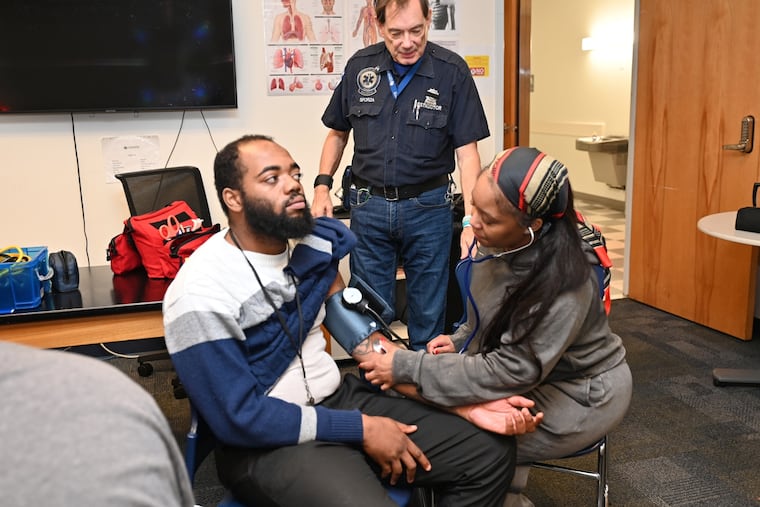
Gail Prater, a retired nurse who grew up in the neighborhood, now comes back to measure people’s blood pressure. Many people she checks have high blood pressure, she said, leading to other health challenges.
“Part of it’s cultural. We see it a lot in Black populations, and there’s a whole lot of reasons,” she said. “Poverty is always a factor. If people don’t have enough money to buy fresh produce and fish, or can’t shop at a fully-stocked supermarket, they’ll eat what’s available at corner groceries.”
“Preventive care health benefits are being reduced. SNAP [food stamps] benefits are being reduced,” she said. “We’re making the situation worse. We’re not helping people.”
She reminds people to take their medicine and offers practical tips. If there’s a can of beans that’s high in sodium, she urges people to rinse them before cooking them. “It’s small, but small changes can make a big difference.”
Up until 2013, when it was incorporated into a parish with nearby St. Athanasius, St. Benedict, with its angels painted above the altar, served as a place of worship for the neighborhood. Masses are still held there, but where there were once confessionals, there is now rice, beans, and canned beans on pallets behind the confessional doors.
The sacristy, which once stored extra candles and worship supplies, now holds industrial-sized refrigerators and freezers. A grant from Share bought one refrigerator, priced at $2,000.
In fact, other Philly Gives partners — Catholic Charities of Philadelphia and Philabundance — also help support the food pantry at St. Benedict’s.
Catholic Charities provides funding for refrigerators and freezers, along with money allowing parish priest Okonski to hire three strong people to unload food trucks as they come from Share and Philabundance.
Okonski opens each food pantry session with prayer, although people don’t have to participate.
“People are fed spiritually and physically in our Father’s house,” he said, adding in prayer, “And may the Almighty God bless us all.”
About the Share Food Program
Mission: Share Food Program leads the fight against food insecurity in the Philadelphia region by serving an expansive, quality partner network of community-based organizations and schools engaged in food distribution, education, and advocacy.
People served: 2,595,634 in FY 2025-2026
Annual spend: $33 million, including $15 million of in-kind food commodities and $8 million of purchased food.
Point of pride: In fiscal year 2025-2026, Share Food Program supported nearly 300 food pantry partners across the region. Through all its programming, Share serves 60,000 children and 40,000 seniors monthly, including 6,400 seniors who each receive a 30-pound food box delivered to their homes. Share rescued and redistributed nearly four million pounds of surplus food. Altogether, Share distributed 20,585,634 pounds of food.
You can help: You can volunteer your time by packing boxes, helping rescue food, conducting a food drive, or making calls to help coordinate home deliveries for elderly and disabled people.
How to donate: phillygives.org
How your donations can help:
$40 feeds four school-aged children for a week.
$80 gives an elderly adult 40 days of food.
$160 nourishes a family of five for a week.
$280 helps fuel Share trucks for food pantry deliveries.
$400 sponsors a school field trip and hands-on educational program at our Nice Roots Farm.
About guest essays
Guest essays, or op-eds, are commentary pieces that present the opinion or perspective of the author. Many are submitted to us by Inquirer readers and writers with insight on the news, but we also solicit op-eds from authors on specific topics. For more information visit our guidelines.